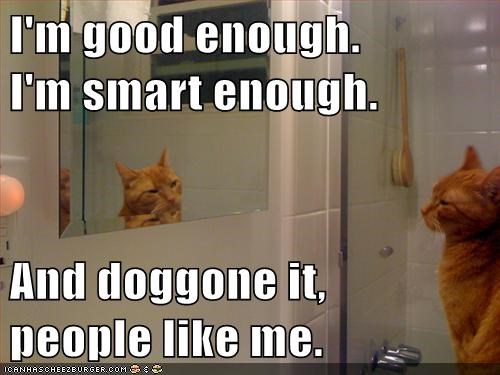
It’s been a traumatic and bruising week for the science blogosphere, particularly for the ScienceOnline community (if you don’t know why, please come back next week for a normal, funny Science Caturday). This one is for the women of ScienceOnline, you wonderful, smart, hardworking, funny, talented, kind, empathetic and supportive group. You deserve to be treated like the dedicated professionals you are. I stand with you. Whenever possible, I drink with you and eat cake with you. I know it’s not much, but this cat’s for you.
This week’s Economist is out with a provocative article about how science goes wrong. It’s a good piece, raises some good points, and it reaches a conclusion that is completely the opposite of mine.
Science goes wrong, the piece argues, because “Modern scientists are doing too much trusting and not enough verifying—to the detriment of the whole of science, and of humanity.” I don’t think this is true, and the old adage that scientists need to “trust but verify” actually doesn’t reflect how scientists throughout history have worked. Scientists have never been particularly interested in spending much time and effort verifying anyone else’s results – unless it advances their own research. Science is not founded on the idea that results need to be replicated – it’s founded on the idea that results need to be fruitful. A scientist’s new ideas and experimental results become accepted because they lead to success in other people’s labs. They lead to progress in other people’s research programs. Continue reading “The Economist weighs in on what’s wrong with science”
Editor’s Note: Regarding the title – Could. Not. Resist. Sorry.
The family Dicamptodon is a sweet little packet of goodness. Commonly, they are known as “giant salamanders” even though they are not, in fact, the biggest salamanders around. I was not consulted in this naming process, so don’t blame me. While containing just a single genus and four species, they are few, but mighty in size, bark and bite. Members of this mainly terrestrial (although they can be paedomorphic) family may grow to be just over a foot long. They are known to be voracious eaters and a bit aggressive. “Aggressive salamander” sounds as oxymoron-ish as jumbo shrimp, christian scientist, or Chief Justice William Rehnquist, but check out this video below and judge for yourself.
These guys even eat small mammals (hey, don’t we all) and make a barking noise that sounds kind of like my stomach growling.
Finally, if you spend too much time on the internet looking up “salamander vocalization” (and oh yes, I do) you will eventually stumble upon some disturbing mormon business about a “talking white salamander”. This has me wondering if maybe Joseph Smith encountered a species of Dicamptodon , but it was “barking” and definitely not talking. Also, the correct translation was most likely “you are crazy and I’m not a spirit”. While salamanders are awesome, they are not supernatural.
To learn more, follow-up with this video from some California Conservation Corps members:
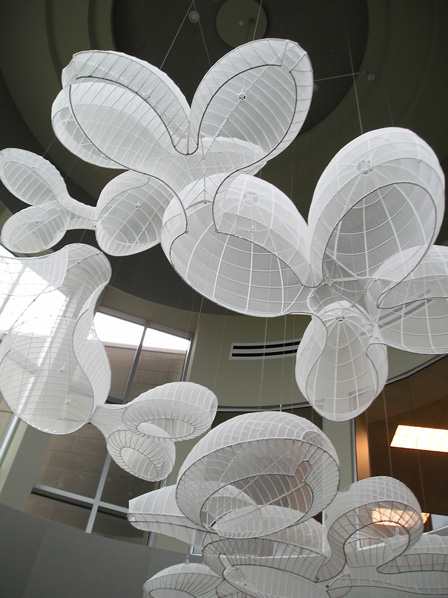
Kendall Buster was educated as a microbiologist and then became a sculptor. Her scientific training is manifest in her work: huge sculptures, often made of fabric over metal armatures, that refer directly or obliquely to the cells, vessels and biological processes of living creatures. I was drawn to this 2004 piece, Parabiosis IV, simply because of its intriguing beauty, but I had no idea what it meant. I discovered that parabiosis is a technique dating from the 19th century in which two living animals are joined together surgically and develop a single, shared circulatory system” (source). In recent years, researchers have used the technique in mice and found that giving old mice “young blood” through parabiosis may enhance neurogenesis (brain cell growth) and reverse age-related degeneration of the heart muscles. So obviously, this is an exciting field of research – but it’s also deeply creepy, involving stitched-together “frankenmice”, which are quite unsettling to look at. So let’s thank Kendall Buster for presenting this thought-provoking concept, rich in history as well as promise for the future, in such an attractive (non-bloody, non-furry) way.
Image courtesy of South Carolina Governor’s School for Science & Mathematics
As she is every Ada Lovelace Day, my “Ada” is Jenn Taylor. She doesn’t just talk about inspiring students to become scientists (in their approach to life or professionally), she does it. Every. Single. Day.
Here she is with her Advanced Genetics class. At the request of students (inspired by her college-credit introductory biology classes), Jenn created a college-level Advanced Genetics course at the South Carolina Governor’s School for Science & Mathematics. The material is challenging (I’ve seen the problem sets); but the students rise to the challenge, especially when they are given the confidence that they can handle it and the support when they need a little boost.
I also get to see her the time and effort she puts into recommendation letters, using her reputation and track record to makes sure students have all the opportunity they can handle when they leave her classroom.



 The Finch and Pea
