Science Denial Then and Now

George Herbert’s “Vanity (I)” (1633)

Science has always made people uncomfortable. Witness the recent comments from the U.S. House Science (Denial) and Technology Committee:

We’ve had climate change since the day the earth was formed, whenever that was, depending on whatever you believe. — Rep. Bill Posey (R – FL)

I just don’t know how y’all prove those hypotheses going back fifty, a hundred, you might say thousands or not even millions of years, and how you postulate those forward. — Rep. Randy Weber (R – TX)

These confused politicians are part of a long tradition that stretches back to the beginnings of modern science itself. George Herbert was a friend of Francis Bacon, but the pious Herbert wanted nothing to do with Bacon’s radical ideas about the natural world. Herbert’s recent biographer John Drury explains:

Long before the discoveries of Darwin and modern astrophysics, some explanation of how everything had come into existence and how it worked was required. Divine creation provided that, had no challengers, and held the field. The natural world presented no moral problems. Rather, it provided ample scope for the investigation of the heavens and the earth which was beginning to gather pace among intellectuals, led by Herbert’s older friend Sir Francis Bacon. In his early poem ‘Vanity (I)’ Herbert was chary about such ‘philosophy’ as it was called, dismissing astronomy and chemistry as too speculative to occupy the valuable time of the practical Christian.

Music at Midnight: The Life and Poetry of George Herbert, John Drury p. 12

Continue reading “Science Denial Then and Now”

Science for the People: Troublesome Inheritance

sftpThis week, Science for the People is looking at the intersection of race, history and genetics in science writer Nicholas Wade’s 2014 book A Troublesome Inheritance: Genes, Race and Human History. DNA researcher Jennifer Raff and science journalist David Dobbs share their critiques of the claim that differences between genetically distinct “races” are responsible for global divergence in cultural and political structures. Blogger Scicurious walks us through the (delicious) basics of the scientific method with Cookie Science.

*Josh provides research help to Science for the People and is, therefore, completely biased.

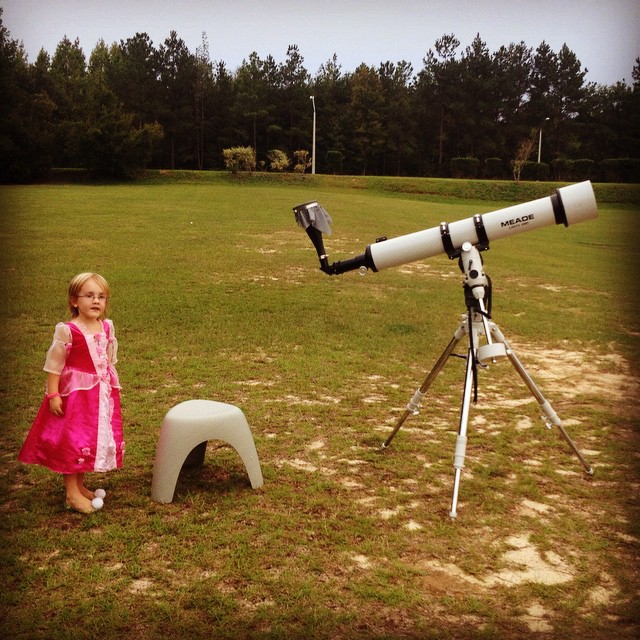
Caroline Herschel Cosplay

My daughter’s Caroline Herschel costume is not late for Ada Lovelace Day. We were simply traveling too close to the speed of light relative to the rest of y’all.

Photo Credit: Josh Witten (All Rights Reserved)

Picture was taken at ScienceSouth’s NASA Saturday public viewing after a “fancy dress” birthday party.

Did NIH budget cuts delay an Ebola vaccine?

Mike Eisen makes an excellent point about NIH Director Francis Collins’ recent claims:

But what really bothers me the most about this is that, rather than trying to exploit the current hysteria about Ebola by offering a quid-pro-quo “Give me more money and I’ll deliver and Ebola vaccine”, Collins should be out there pointing out that the reason we’re even in a position to develop an Ebola vaccine is because of our long-standing investment in basic research, and that the real threat we face is not Ebola, but the fact that, by having slashed the NIH budget and made it increasingly difficult to have a stable career in science, we’re making it less and less likely that we’ll be equipped to handle all of the future challenges to public health that we’re going to be face in the future.

You can make a better case about the direct impact of funding cuts with the shrinking budget CDC Public Health Preparedness Funding, as Judy Stone notes over at Scientific American.

Science Online and Me

If you are going to read one discussion of the collapse of Science Online, you need to read our own Eva Amsen’s analysis on her personal blog:

When I went to Science Online the last time, in 2014, it was very different from that first time in 2007. There were communication specialists and YouTubers and startup founders and publishers. I was there on behalf of a publisher. My trip had been paid for. I couldn’t just have fun – I had to work. It was different now. – Eva Amsen