
The dark side of running a lab

Image courtesy of Ludie Cochrane

A lucky few scientists make it through graduate school and a post-doctoral fellowship AND manage to secure a position running their own lab. Once they begin the day-to-day grind of operating a research enterprise they often realize there’s way less time for science and more administrative tasks to do. This administrative burden can be a drain on creativity and scientific productivity. The National Science Foundation (NSF) issued a request for information (RFI) to learn what aspects of administration are affecting scientists at work, and hear their suggestions for change. The Federation of American Societies for Experimental Biology (FASEB), a coalition of many scientific societies, administered a survey sent out to all 26 member societies to collect the data for NSF. The answers they received painted a picture of what it’s like to be a scientific investigator. Continue reading “The dark side of running a lab”

Sunday Science Poem: Science and doubt on the naked shingles of the world

Matthew Arnold’s ‘Dover Beach’

Dover BeachFor at least a millennium in the West, Christianity was the dominant public perspective on how the world operates. That is no longer true. In our culture, science now explains the world.
Despite widespread private expressions of piety, in our public culture science is what we believe. Intelligent design, fad diets, ESP, or any other ideas that make a go at competing on science’s materialistic home turf all end up measured by science’s standard. This is why pseudo-science exists: you have to dress your ideas in a lab coat and protective eyewear if you want other people to believe your ideas about the physical world. That was not true when Victoria inherited the British throne in 1838, but it was largely true when she died in 1901. This was the result of a tectonic shift in the psychology of an entire society, and Matthew Arnold’s poem ‘Dover Beach’ captures the mental anguish of that shift. Continue reading “Sunday Science Poem: Science and doubt on the naked shingles of the world”

Science Caturday: Properties of Water

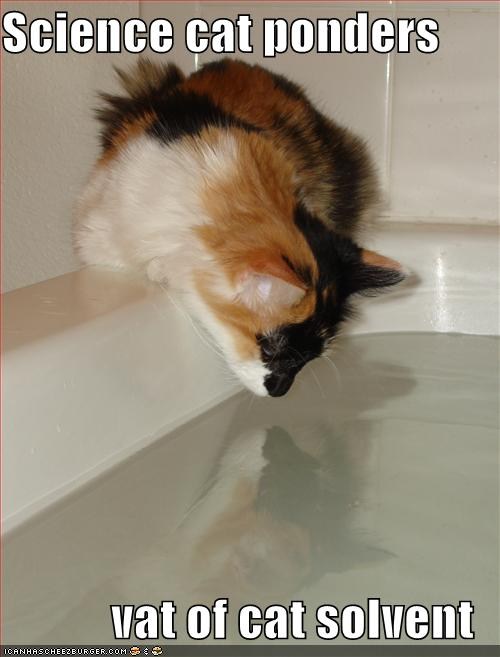
We know that alcohol is a solution, but is warm water really a kitty solvent?

solvent

We might need to consult Chemistry Cat again.

photo via Cheezburger.com

Meet the Pangolin

pangolin-tongueThe pangolin (Order: Pholidota) is a mammal covered in keratin scales. They can be found in Asia as well as Africa and their size ranges from 1 foot to just over 3 feet. These weirdo cuties eat thousands of ants everyday. Their oversized claws help them dig out ant colonies. As the video below explains, the pangolin uses its super-long tongue to reach the ants. Oh yeah and when it wants to protect itself from predators it pulls an 80s style popple move and rolls up into a tight ball.

Photo credit:  Mark Sheridan-Johnson
Photo credit: Mark Sheridan-Johnson

“Meet the…” is a collaboration between The Finch & Pea and Nature Afield to bring Nature’s amazing creatures into your home.

For Better Science Meetings, Invite an Artist

Regina Holliday paints at a conference
Regina Holliday shows artwork that she live-painted at a conference

So you’re putting together a scientific conference. You’ve chosen your topic, location and date. You’ve booked a venue and lined up sources for coffee, lunch and cocktails. You have all your podiums in a row. You’re scouring the planet for the top experts in the field, hoping that you can get enough of them in one room at one time to spark a great conversation, launch a new initiative, maybe even shift a paradigm or two.  Here’s something that might help you accomplish that: invite an artist.

Why should conferences invite artists? What do they bring to the table? I asked Regina Holliday,  who has been live-painting at health care conferences for three years. “I disrupt them,” says Holliday. “I give them a different worldview,” adding that her “very visual” take on the proceedings of large meetings can cut through the massive pileup of verbal information that most conferences provide. Continue reading “For Better Science Meetings, Invite an Artist”