Creative output, social media & the tragedy of the commons

Screenshot 2014-01-24 11.43.27

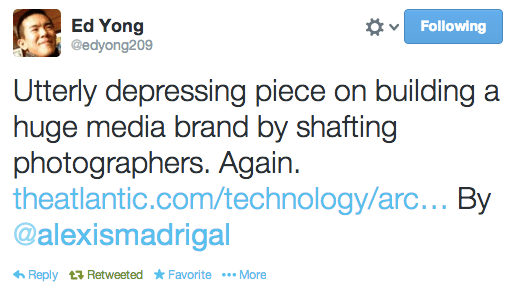
Ed Yong’s comment on Alexis Madrigal’s article at The Atlantic is spot-on.

Can you spot the fundamental flaw in the logic of self-justifying logic of the owners of @HistoryInPics*?

“Photographers are welcome to file a complaint with Twitter, as long as they provide proof. Twitter contacts me and I’d be happy to remove it,” he [Xavier Di Petta] said. “I’m sure the majority of photographers would be glad to have their work seen by the massives.”
-from “The 2 Teenagers Who Run the Wildly Popular Twitter Feed @HistoryInPics” by Alexis Madrigal

If you don’t tell people who took the pictures, how do the photographers benefit from having their work seen by the “massives”? Sure, having one’s work make an impact is a reward unto itself, but it doesn’t pay the bills.

When our artists can’t pay their bills, we get less art. Or as the internet would say,  “This is why we can’t have nice things.”

*In general, I avoid linking to folks that are making their bank on the backs of uncredited artists.
Don’t give your megaphone to just anyone

On the one hand, it has been a rough couple of months for science communication. We’ve been reeling from problem with sexism/racism/harassment to another. The reputations of even science communication juggernauts like Scientific American and Nature Magazine have not survived intact.

On the other hand, we seem to actually be talking about these issues publicly, which may be a sort of progress.

Established institutions, with their established audiences, retain the capacity to dominate such public discussions. In a must-read post (originally published last week and now republished on the excellent LadyBits), our Raleigh Sewer Tour buddy Anne Jefferson explains the problem of institutions, who claim to not be sexist or racist, providing a platform for bad actors to amplify their sexist and racist messages. As she lays out the problem, it is akin to the issue of false balance in journalism surrounding issues like vaccinations.

Anne also lays out three easy steps to avoid handing your institution’s supposedly progressive megaphone to a jerk. My favorite is tip #1:

If you receive racist or sexist material for publication, DON’T PUBLISH IT. Throw it out.

The Art of Science: Hiroshi Sugimoto Gets Right to the (Infinity) Point

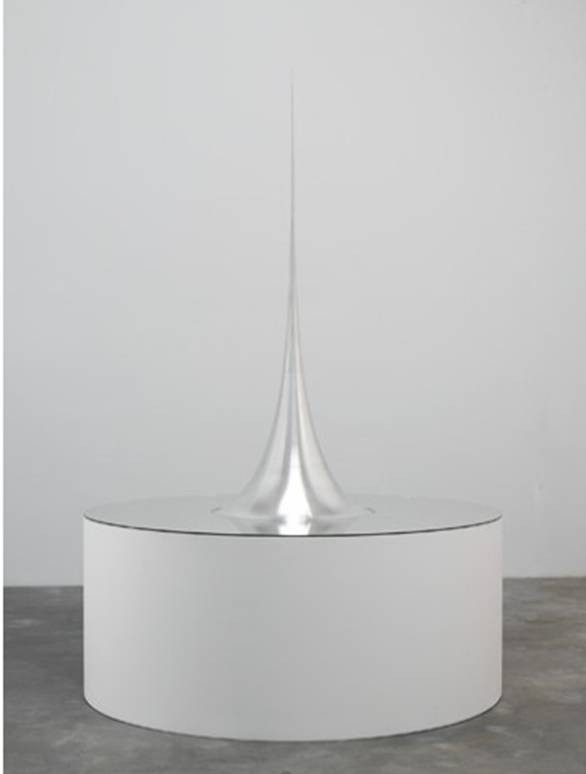
Mathematical Model 009 Surface of revolution with constant negative curvature, 2006
Hiroshi Sugimoto, Mathematical Model 009, Surface of revolution with constant negative curvature, 2006

Japanese artist Hiroshi Sugimoto is best known for his photography, especially his gloriously simple compositions of seascapes and lightning. But my favorites are his sculptures based on mathematical models. According to Art News, “Drawn to the objects’ purity of form and also inspired by Man Ray’s interest in photographing mathematical models, Sugimoto first photographed nineteenth-century plaster examples for his Conceptual Forms series. During the process, he was struck by the softness and fragility of the vintage models – many had lost pieces or no longer possessed the sharpness that they were meant to represent. Sugimoto sought to extend the limits of these mathematical models using cutting-edge technology, searching out the highest-level precision metalworking team in Japan. For Conceptual Form 009, a model of the equation for a surface containing a single point extended to infinity, Sugimoto succeeded in creating an infinity point with a mere one millimeter diameter, the minimum width before the material itself becomes structurally unstable.”

I can’t even begin to understand the math behind it, but as a visual representation of an “infinity point” it’s hard to top that.  If you live in LA, don’t miss the chance to see an exhibition of Sugimoto’s work at the Getty Museum from February 4-June 8 . If you don’t, see lots more of his work at his website.

Nemo – Amsterdam’s science center

800px-NEMO_(Amsterdam)Finding Nemo isn’t difficult. The science and technology museum has a prominent spot in Amsterdam, over the tunnel underneath the IJ*, the main water in the North of the city. The architect, Renzo Piano, built the structure to be an inversion of the tunnel below, but thanks to the green copper siding the structure also resembles a large cargo ship. In summer, you can sit on the upper deck (ie the roof) of Nemo and get a great view of the city.

Even though I’ve been on the roof/deck, and I’ve been inside once for an award ceremony, I’ve never properly been to Nemo. Not in this shipshape building, anyway. Continue reading “Nemo – Amsterdam’s science center”

Due dosi di Brunelleschi

Il Duomo, Florence, Italy (Photo Credit: MarcusObal; CC BY-SA 3.0)

Filippo Brunelleschi is justifiably famous for his design of the dome of Basilica di Santa Maria del Fiore (The Duomo). Famous enough that my household contains not one, but two books about Brunelleschi and his dome, as I recently discovered.

The first is Ross King’s Brunelleschi’s Dome: How a Renaissance Genius Reinvented Architecture, in which King follows the career of Filippo Brunelleschi and the long process that lead to the construction of what may still be the most impressive dome in the long history of human architecture. The story of Brunelleschi and his dome is gripping. If a book about early Italian Renaissance cathedral architecture can be called a “page turner”, Brunelleschi’s Dome deserves the title.

The second is Pippo the Fool, a children’s book written by Tracey Fern and illustrated by Pau Estrada. The books cover much of the same ground. Indeed, Pippo the Fool uses King’s Brunelleschi’s Dome as a reference (yes, it is a children book that lists its references – be still my beating heart). Pippo the Fool, however, is meant as a narrative illustration of an individual genius triumphing over the odds and bullies based upon Brunelleschi’s life; whereas Brunelleschi’s Dome is an exploration of history. Continue reading “Due dosi di Brunelleschi”