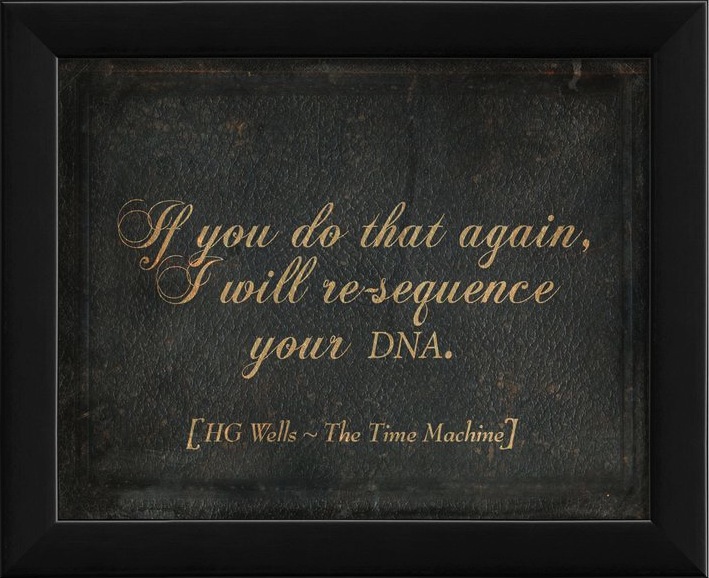
Jargon will make time travel very confusing

6c8be9cc69d429e19aa0eb80216d2c91

This was a gift from my sister and is a solid science fictiony quote – one that I’m quite happy to put on my wall1.
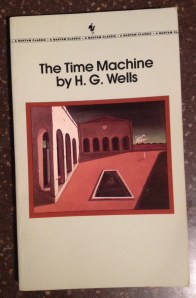
The Time Machine by HG Wells (1991 Bantam Classic Reissue from library of Josh Witten)

Being a fan of, but hardly an expert on HG Wells2 and being a fan of, but hardly an expert on the history of science, I had to wonder if this quote was actually from HG Wells’ The Time Machine, or was from one of the movie adaptations. As you will see, this is an easy question to answer. The trick is figuring out why you might want to ask the question in the first place.

HG Wells was brilliant and reasonably familiar with scientific research. To pen that line, he would also need to be a time traveler himself. Continue reading “Jargon will make time travel very confusing”

JFK on the Sunday Science Poem

Well, not just the Sunday Science Poem. I suppose his remarks could be construed to be about poetry, more generally, and about Robert Frost, more specifically (as the remarks were made in honor of Robert Frost’s passing earlier in 1963):

At bottom, he held a deep faith in the spirit of man, and it is hardly an accident that Robert Frost coupled poetry and power, for he saw poetry as the means of saving power from itself. When power leads men towards arrogance, poetry reminds him of his limitations. When power narrows the areas of man’s concern, poetry reminds him of the richness and diversity of his existence. When power corrupts, poetry cleanses. For art establishes the basic human truth which must serve as the touchstone of our judgment.
President John F Kennedy, Remarks at Amherst College, 26 October 1963

*Hat tip to Greg Proops on The Smartest Man in the World Podcast.

Creative output, social media & the tragedy of the commons

Screenshot 2014-01-24 11.43.27

Ed Yong’s comment on Alexis Madrigal’s article at The Atlantic is spot-on.

Can you spot the fundamental flaw in the logic of self-justifying logic of the owners of @HistoryInPics*?

“Photographers are welcome to file a complaint with Twitter, as long as they provide proof. Twitter contacts me and I’d be happy to remove it,” he [Xavier Di Petta] said. “I’m sure the majority of photographers would be glad to have their work seen by the massives.”
-from “The 2 Teenagers Who Run the Wildly Popular Twitter Feed @HistoryInPics” by Alexis Madrigal

If you don’t tell people who took the pictures, how do the photographers benefit from having their work seen by the “massives”? Sure, having one’s work make an impact is a reward unto itself, but it doesn’t pay the bills.

When our artists can’t pay their bills, we get less art. Or as the internet would say,  “This is why we can’t have nice things.”

*In general, I avoid linking to folks that are making their bank on the backs of uncredited artists.

Don’t give your megaphone to just anyone

On the one hand, it has been a rough couple of months for science communication. We’ve been reeling from problem with sexism/racism/harassment to another. The reputations of even science communication juggernauts like Scientific American and Nature Magazine have not survived intact.

On the other hand, we seem to actually be talking about these issues publicly, which may be a sort of progress.

Established institutions, with their established audiences, retain the capacity to dominate such public discussions. In a must-read post (originally published last week and now republished on the excellent LadyBits), our Raleigh Sewer Tour buddy Anne Jefferson explains the problem of institutions, who claim to not be sexist or racist, providing a platform for bad actors to amplify their sexist and racist messages. As she lays out the problem, it is akin to the issue of false balance in journalism surrounding issues like vaccinations.

Anne also lays out three easy steps to avoid handing your institution’s supposedly progressive megaphone to a jerk. My favorite is tip #1:

If you receive racist or sexist material for publication, DON’T PUBLISH IT. Throw it out.

Due dosi di Brunelleschi

Il Duomo, Florence, Italy (Photo Credit: MarcusObal; CC BY-SA 3.0)

Filippo Brunelleschi is justifiably famous for his design of the dome of Basilica di Santa Maria del Fiore (The Duomo). Famous enough that my household contains not one, but two books about Brunelleschi and his dome, as I recently discovered.

The first is Ross King’s Brunelleschi’s Dome: How a Renaissance Genius Reinvented Architecture, in which King follows the career of Filippo Brunelleschi and the long process that lead to the construction of what may still be the most impressive dome in the long history of human architecture. The story of Brunelleschi and his dome is gripping. If a book about early Italian Renaissance cathedral architecture can be called a “page turner”, Brunelleschi’s Dome deserves the title.

The second is Pippo the Fool, a children’s book written by Tracey Fern and illustrated by Pau Estrada. The books cover much of the same ground. Indeed, Pippo the Fool uses King’s Brunelleschi’s Dome as a reference (yes, it is a children book that lists its references – be still my beating heart). Pippo the Fool, however, is meant as a narrative illustration of an individual genius triumphing over the odds and bullies based upon Brunelleschi’s life; whereas Brunelleschi’s Dome is an exploration of history. Continue reading “Due dosi di Brunelleschi”