
Marie-Claire’s belly button has passed peer review

Marie-Claire’s belly button is on the x-axis

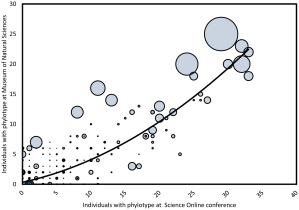
You have probably heard about the new paper in PLoS ONE describing the diversity of microbiological species in the human belly button. Understanding within species variation is critical before we can get a real handle on between species variation in belly button microbial diversity. What you may not know is that our own Marie-Claire Shanahan provided one of the belly buttons used for this study. Marie-Claire is, as it says in the acknowledgements, “curious about the life on their own bodies and in what science can tell them about themselves.”

In fact, Marie-Claire’s belly button is the poster child for this research, at least in Canada. She was featured in a CBC video describing the work, which can be seen here (may only be visible in Canada).

CBD: Cute But Deadly

Leopard Seal

I love to watch animal documentaries on TV. I even own Planet Earth on HD-DVD (I know, I know, serious technology miscalculation there). One of the most beautiful animals I’ve seen documented is the leopard seal. Leopard seals are named for their spotted pelts and can grow to be as large as polar bears. They are thought to be brutal and ruthless killers of penguins, fish and sometimes humans. I recently saw a TED talk by an arctic wildlife photographer (Paul Nicklen) who ran into some leopard seals while shooting penguins. Turns out these seals aren’t always bent on “kill and destroy”. The seal tried to entice him by delivering a freshly killed penguin to him and tried to feed it to his camera.

While these seals primarily live on larger game, it turns out they are capable of feeding themselves in another way. In Polar Biology, it was reported that these seals can sieve krill out of the water just like whales can. Their teeth are structured in such a way that it’s possible for them to gulp up a cloud of krill and expel the extra water keeping the krill to swallow. While this behavior hasn’t yet been documented in the wild, there’s a possibility that these ultimate predators can snack on teeny tiny krill. Turns out, they are indiscriminate binge-eaters at just about every level of the food-chain!


Bees been struggling

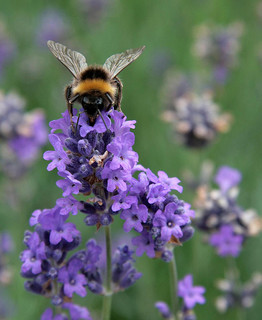
In my random Netflix perusal, I came across a documentary about the striking loss of bee populations, The Vanishing of the Bees. I hadn’t realized this, but in industrial scale farming a large amount of pollinators are needed to pollinate fields of crops, many more pollinators than live in the area normally. Bee farmers fill this role by cultivating large colonies of bees. They move these bees around the country in semi-trucks to farms where they are needed. These bees are experiencing “colony collapse disorder” where entire colonies of bees are wiped out. Without pollinators, many crops will be drastically affected. Fellow blogger Michele has posted artwork that tries to draw attention to the plight of the bees.

While the research into colony collapse disorder is very complex and implicates multiple factors including diseases and pesticides, the documentary focuses on the potential contribution of  pesticide exposure to this disorder. Continue reading “Bees been struggling”

Meet the Sea Pig

The name “sea pig” conjures up many images, but probably not that of a deep-sea holothurian echinoderm. There are three species of sea pigs all in the genus Scotoplanes. They inhabit deep sea floors often high densities and are thus sensitive to deep sea trawling. Continue reading “Meet the Sea Pig”

Linkonomicon VIII

via Jenny Winder
