If we can build it, we understand it… clearly we don’t understand life

This week in Pacific Standard I try to answer the question, why can’t we build life from scratch?

There are two primary ways biologists are trying to build life from scratch – evolution and intelligent design. People like Harvard’s Jack Szostak are trying to understand prebiotic evolution, by evolving autonomously replicating protocells in the lab. On the other hand, synthetic biologists, like those at the Venter Institute, want to be able to go to the whiteboard and intelligently design a genome from scratch. They already know how to synthesize and transplant a genome; designing it is another matter. As I wrote for Pacific Standard, we’re “like someone who knows how to work a 3-D printer but can’t design new digital templates for it.” Continue reading “If we can build it, we understand it… clearly we don’t understand life”

Sunday Science Poem: The Irreversibility of Time

Czesław Miłosz’s “This World” (1994)
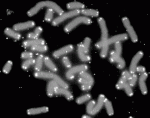
Telomere_capsIt’s a question you’ve certainly heard before – the laws of physics work just fine when you run time backwards, so why, in the real world, does time only go forwards?

Run a movie backwards, and what you see could never happen in real life: a diver never leaps feet first out of the pool onto the board, while drops of water fling themselves back in. But, as Richard Feynman explained, at the level of atoms and molecules, there is no reason why running the film backward should be absurd – our laws of physics say time is reversible at the microscopic level. Feynman argued that time’s forward motion was a macroscopic phenomenon, rooted in the universe’s relentless increase in entropy. Physicist Lee Smolin has pursued a similar (but in many ways a radically different) idea – the forward flow of time is a consequence of a network of relationships in the universe. He may be right, but for the time being, why time is not reversible is still a deep mystery.

Physics isn’t the only place where reversibility appears to be a mystery. Why isn’t life reversible? Aging and death seem inevitable for us individually, but with each birth, the clock is reset. Biological time is reversed. How is that possible?

We don’t really know. Before your children are born you age twenty, thirty, or forty years. Your DNA has been copied and recopied, accumulating damage, telomeres have shortened, and your cells are on the way towards senescence, and yet each newborn gets a fresh start. Amazingly, each successive generation of children is not born ever more prematurely aged. If the clock can be reset for our germ cells, why can’t we reverse biological time in the rest of our cells? Continue reading “Sunday Science Poem: The Irreversibility of Time”

Your Cheating Data

What makes scientists cheat? It’s cheating week over at Pacific Standard, and in my contribution, I talk about why scientists cheat.

I come up with three reasons:

1) It’s easy. So much of science is built on trust; generally, nobody comes into your lab and checks your notebook, equipment, computer code, or raw data. This is true of PIs as well – they trust that their grad students and postdocs are not faking their data.

2) There are (some short-term) incentives to cheat in science. In today’s hypercompetitive scientific community, there can be great pressure to cheat when you think your future in science is threatened. However, I think the long term incentives don’t favor cheating. Most serious cheaters seem to be caught quickly, the risks are huge, and the benefits of cheating scientists are more ephemeral than the benefits of many other types of fraud – scientists aren’t stashing laundered money away in offshore bank accounts.

3) When the data doesn’t go your way, it can be hard to accept that your idea is wrong. So much of science, especially experimental science, is a matter of judgment – what anomalous data is significant, and what data is simply a screw-up. Scientific publications by necessity are a selection of the work done by the authors, not a report of everything they tried. There are moments in every scientists career when some idea you knew just had to be true turns out to be wrong. Some cheaters are scientists who can’t deal with being wrong.

Sunday Science Poem: Believing is Seeing

Wallace Stevens’ “What We See Is What We Think” (1949)

640px-Garden_sundial_MN_2007How much of what we see depends on what we think?

In one sense, everything; seeing is not a passive process, but a sophisticated act executed by our neural circuits. In another sense, seeing is what we choose to see, as Harvard psychologists Christopher Chabris and Daniel Simons demonstrated with their famous video of the gorilla walking across the basketball court.

But does the relationship between thinking and seeing go deeper than the involuntary side effects of our selective attention? Thomas Kuhn argued that it did, in his notorious chapter X from The Structure of Scientific Revolutions (the chapter philosophers refer to, in a classic example of academia’s demented sense of humor, as the ‘X-rated chapter X’): Continue reading “Sunday Science Poem: Believing is Seeing”

The Economist weighs in on what’s wrong with science

This week’s Economist is out with a provocative article about how science goes wrong. It’s a good piece, raises some good points, and it reaches a conclusion that is completely the opposite of mine.

Science goes wrong, the piece argues, because “Modern scientists are doing too much trusting and not enough verifying—to the detriment of the whole of science, and of humanity.” I don’t think this is true, and the old adage that scientists need to “trust but verify” actually doesn’t reflect how scientists throughout history have worked. Scientists have never been particularly interested in spending much time and effort verifying anyone else’s results – unless it advances their own research. Science is not founded on the idea that results need to be replicated – it’s founded on the idea that results need to be fruitful. A scientist’s new ideas and experimental results become accepted because they lead to success in other people’s labs. They lead to progress in other people’s research programs. Continue reading “The Economist weighs in on what’s wrong with science”