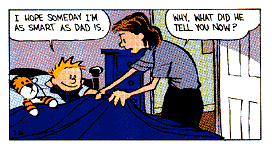
Make Stuff Up with Confidence

Calvin & Hobbes by Bill Watterson

I foresee my lovely spouse having this same conversation with our daughters. To paraphrase a conversation with my younger brother in which we reflected upon our childhood:

Bro: I used to think you knew everything about everything. Finally, I realized that you just made stuff up.

Moi: Yes, but I said it with confidence. . .

Thoughts on Phil’s Dick Presentation

Like most public “dick” presentations, Phil Plait’s “Don’t Be a Dick” speech at The Amazing Meeting 8 was controversial.

Whole tomes have been written on this topic already (this post by Daniel Loxton and the endless comments summarize the debate nicely). Continue reading “Thoughts on Phil’s Dick Presentation”

Skeptically Speaking Interview

If reading my ramblings is not enough rugbyologist for you, you can listen to me ramble melodiously as I attempt to explain my first ever blog post,“Why People Believe Silly Things”, in a interview with Desiree Schell for the “Speaking Up” segment of Skeptically Speaking Friday, 27 August 2010 at 6PM (MDT). For those of you not lucky enough to live within the broadcast radius of 88.5FM CJSR in Edmonton, Alberta, you can listen to the pre-recorded interview live-ish on the Skeptically Speaking UStream feed or download the podcast come Monday.

Myers Test & Tyson Test (New Rugbyologisms)

Thanks to Transhumanism, Part Deux on Skeptically Speaking this past week I was thinking about the Turing Test, and, mostly, how it was not really that great for determining true artificial intelligence (AI), because who the hell cares if SkyNet can talk to you, if it has control of the nukes and has a plan to use them? Thanks to Twitter, I did get a couple of new suggestions for how to determine whether a computer is a true AI or not. With that prelude, I present two new Rugbyologisms: Continue reading “Myers Test & Tyson Test (New Rugbyologisms)”

Why People Believe Silly Things

In a paper in Science from October 2008, Jennifer Whitson and Adam Galinsky report that placing people in situations where they lack control increases the false perception of patterns because of a need to impose structure on even random events.

This study is very interesting because it helps us understand why we develop superstitions and the like, which are based on false pattern recognition. It does not, however, speculate on why some of those superstitions take hold and last (e.g., buildings without thirteenth floors) and some do not (e.g., my efforts to get my tee ball team to wear pink socks after a 3-4, 4RBI game and a laundry accident).

I, however, am not above some wild speculation. The defense of superstitions, quack medical treatments, etc. frequently goes like this: A medical treatment works or it does not work. If it works, people who use the treatment are more likely to live, people who don’t are more likely to die and the treatment keeps getting used. If it does not work, people who use the treatment are more likely to die, people who don’t are more likely to live and the treatment stops getting used. That makes intuitive sense. It sounds a lot like selection, and we like selection. Continue reading “Why People Believe Silly Things”