
H.G. Wells’ The War in the Air (1908)
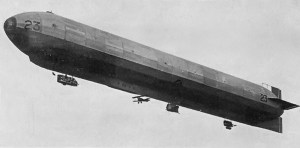 After the First World War, as historian Barbara Tuchman wrote in her landmark history of the pre-war years, “illusions and enthusiasms possible up to 1914 slowly sank beneath a sea of mass disillusionment.” But there were some who were disillusioned long before that. In the decades leading up to the catastrophic conflict, all sorts of writers and thinkers worried about the possibility of a worldwide war, fought with technologies that were capable of causing destruction on an entirely new scale.
Concerns about a massive conflict were so serious that the major European powers held two peace conferences, in 1899 and 1907, despite the fact that they weren’t currently at war with each other. Fiction writers captured the martial zeitgeist with a steady stream of future war stories (including H.G. Wells’ 1898 The War of the Worlds), exploring military possibilities that would soon be realized.
The most bitingly clear statement of pre-war anticipation and disillusionment is H.G. Wells’ 1908 novel, The War in the Air. The book is a major genre milestone, one that explicitly lays out an important theme of the coming century: Our civilization is headed for a catastrophic end unless our moral progress keeps pace with our technological process. Continue reading “Apocalypse 1908: The World War Holocaust”


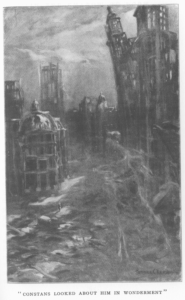 The Doomsman opens in what seems to be the primitive past: A young man sits on the shore of a bay, dressed in a tunic. In the forest behind him are the heavy wooden walls of a stockade, a clue to the defensive nature of life in this sparsely inhabited country. But not everything fits. The young man is looking across the bay at a vague, dark outline of some tall structure, while in his hands he holds a book: A Child’s History of the United States. He is sitting on the shores of New York, looking out at what’s left of Manhattan.
 Post-apocalyptic worlds are always haunted. The empty ruins of great cities, the artifacts of lost technologies, the mouldering books, and the memories of the vanished civilization make it clear that the survivors are now living in the world of the dead. In George Long’s Valhalla, the haunting is literal: the world is now one great hall of the dead, with a billion spirits ready to lend their ghostly hands to help the survivors build a better future. While it’s stiffly written and poorly plotted, this short book is nevertheless an interesting artifact from that optimistic time before the First World War. As he describes a new civilization rebuilt under the guidance of the dead from the last one, Long suggests that the root of human dysfunction is simple: jealousy of love and power. Without jealousy, there would be no serious conflict and people will get along just fine.
 The Finch and Pea