Science Caturday: Playing Hard to Pet

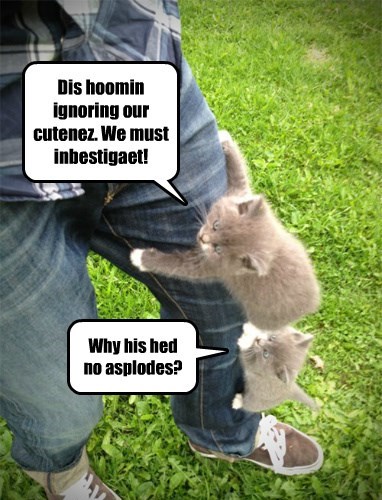
inbestigaet

Why do cats always head straight for that one person who hates or fears them, while avoiding the person who desperately wants to cuddle? According to this article in Slate, the answer is actually slightly more complex than “because fuck you.”

According to Diane Meriwether, “all aggression in the feline world starts with staring,” and people who love cats will tend to look straight at a kitty, while those who don’t will avoid catching the cat’s eye. Furthermore, “When humans don’t like cats, they try not to pet them. If the cat comes over, the person might instinctively pet it once, then he withdraws his hand and hopes the cat will go away. Of course, playing hard-to-get with a cat is one of the best ways to make friends.”

So basically, cats love it when you act like a jerk at a bar, giving them a tiny bit of attention while pretending you’re not really interested, and then backing off. Sigh. If you really can’t bring yourself to act like this, you can always try filling your pockets with catnip.


Science for the People: Coal Wars

sftp51bIOEq1xuL._SL250_ (1)This week Science for the People is learning more about the fossil fuel that powered humanity’s first industrial age, and helpedset us on a course for a looming climate crisis. We’ll speak to Richard Martin, energy editor at the MIT Technology Review, about his book Coal Wars: The Future of Energy and the Fate of the Planet. We’ll also explore the environmental impact of coal with Jeff Deyette, assistant director of energy research in the Climate and Energy program at the Union of Concerned Scientists.

*Josh provides research & social media help to Science for the People and is, therefore, completely biased.

The Days of the Enola Gay are Here

Back in May, Ben Lillie made the suggestion,in the context of the ongoing debate about telescope construction on the sacred volcanic peak of Mauna Kea, that we set aside time from 8:15AM on 6 August to 11:02AM on 9 August to reflect on the dark history that can underlie scientific advancement. These dates and times recall the 70th anniversaries of the nuclear strikes on Hiroshima and Nagasaki. As Ben wrote in his Slate article:

So here is my thought. What if we took a few days each year to reflect on the dark parts of our history, on the terrible things that were done, and are still done, that benefit our science? What if we took this time to read and talk with the people who know of these things? (They are many.) What if we took this time to ask what harm we have done, what we can do to correct it, and what we can do to make sure it never happens again? We constantly reflect on and try to minimize the errors in our data; we should do the same in ourselves.

I think the most significant time to do this, the time when it is clearest that evil was done, is from 8:15 a.m. on August 6 to 11:02 a.m. on August 9, the times when Little Boy and Fat Man were dropped on Hiroshima and Nagasaki.

Let us call this time the Days of the Enola Gay, after the aircraft—named for a loving mother—that flew the fruits of our joyous and universal science to the mass destruction of humanity.
Ben Lille in Slate

sftp-square-fistonly-whitebgWe decided then to add the Days of the Enola Gay to The Finch & Pea‘s calendar of special days. This is us starting to remember that commitment. A fitting start to the Days of the Enola Gay would be to listen to Science for the People’s recent episode on research ethics. Not only does it discuss the lengthy history of ethical missteps in the name of scientific advancement, but it talks about how we can learn from that past and do better.

We here at The Finch & Pea live by the idea that a scientific approach to life makes things more interesting, but are often forced to reckon with the reality that the application and conduct of science has not always made the world a better place – in the hope by doing so we can make it a better place.

Art + Travel + Science on the DNA Trail

On a rainy day in London, Eva and friends went on a quest to find the DNA sculptures scattered around the city by Cancer Research UK.

Any Publicity is Good Publicity?

If you wonder why Twitter seems to have no interest in protecting individual users from harassment, maybe you need to think about how the companies that pay for the annoying “promoted” tweets think about harassment negative online behavior (UPDATE: It has been pointed out that McCaffrey doesn’t address harassment per se or what may differentiate this from “hating on”). For example, here is HBO director of development Kathleen McCaffrey on the Nerdist Writer’s Panel having an honest discussion* how their social media and marketing teams think about Internet “haters” with host Ben Blacker:

McCAffrey: The thing about Girls which is kind of amazing is the haters. And it makes our social media team very happy because they just put one thing out and people come out of everywhere and just start to hate on it. And, so, it is very loud and very strange…just so many people hate it…

Now, bear in mind that the hating on it she refers to will invariably include negativity directed not just at HBO and the show, but at the individuals involved in creating the show:

McCaffrey: but on social media – on Twitter and everywhere – Lena is very polarizing and people love to hate on her. It still surprises me…

Blacker: But, but that’s, that’s good for you, because it’s a loud conversation and it means that the people who do love her will probably come out to defend her.

McCaffrey: Yes. It becomes this weird fight that she’s kind of even not really a part of, like the people around her just yelling about her. It’s very strange and fascinating.

*McCaffrey expresses disappointment with the continuing negative reaction, while acknowledging the utility of the reaction for marketing.