
Rushing yards

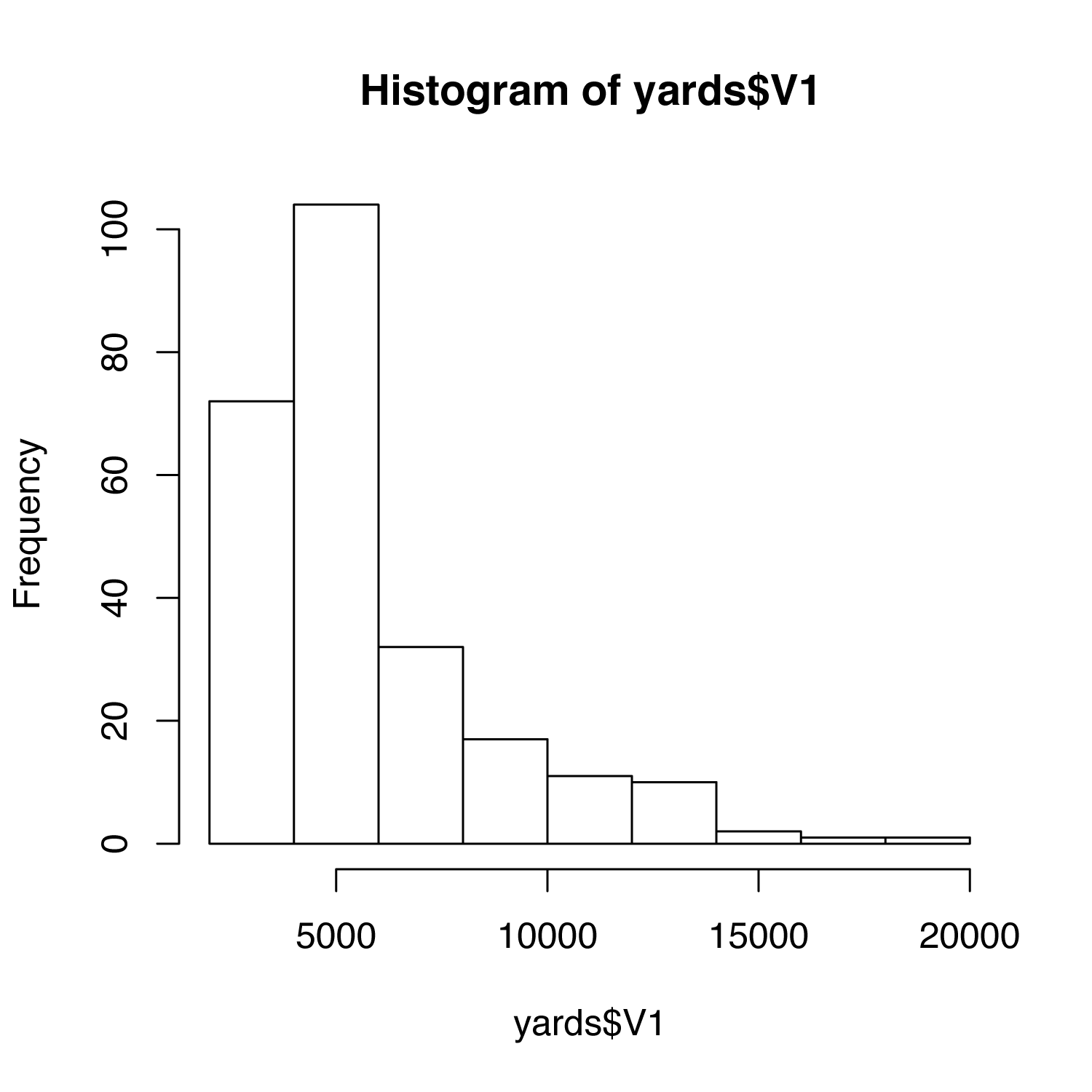
The histogram represents the distribution the top 250 career rushing yard totals in NFL history. It includes active players and is not normalized for the number for years played. I don’t have much to say about this, except that it appears that one must rush for more than 12,000 yards in a career to be truly exceptional. Calculating the yards per year (ypy) indicates that Jim Brown (1368ypy), Walter Payton (1287ypy), and Barry Sanders (1527ypy) are the three greatest running backs in NFL history. It also suggests that Curtis Martin (1282ypy) should be in the Hall of Fame.
The Ewok Line

Frankly, Neil Patrick Harris‘s lecture on Ewoks sounds like the kind of thing I would do. Therefore, I love it. And you should too.

Model angst

As I contemplate presenting my research plans in job talks, I’m worried about clearly conveying what we get out of quantitative models. The vast majority of biologists don’t build or use quantitative models, which I recognize is a reasonable consequence of the history of the field, but I find it shocking nonetheless. What this means is that many of these researchers don’t share my fundamental outlook, and, as good skeptical scientists, they won’t take it for granted that models are useful. In fact they’ve probably seen plenty of examples of bad models.

So here is how I justify my mathematical modeling work: Continue reading “Model angst”

Coming to news stands. . .


Needless to say (but I’m going to anyway), I am pleased as punch that my lab’s most recent offering unto the body of scientific literature (“Analysis of alternative splicing associated with aging and neurodegeneration in the human brain”) was put on the cover of the current issue of Genome Research. In this paper, we investigated the connections between alternative splicing profiles in the aging brain and in brains suffering from neurodegenerative disorders, like Alzheimer’s disease. It is important to note that we were characterizing the alternative splicing differences associated with aging and disease, not identifying splicing changes that cause the diseases or the symptoms. Such questions will require ongoing work, which this study will, hopefully, help guide. Continue reading “Coming to news stands. . .”

Logic 101: Homeowork

Identify at least five* logical fallacies in Dana Ullman‘s article “Disinformation on Homeopathy: Two Leading Sources”. Show your work.

Please know that this review and critique of Mr. Randi and Ms. Brown is not an ad hominem attack on these two individuals. . .this article reviews their actions, their priorities and the organizations that they have represented, all of which are reasonable and appropriate areas for critique and are not personal attacks on who they are.

*The fact that Ullman declares that the article is not an argumentum ad hominem does not mean that you may not identify an argumentum ad hominem fallacy, as Ullman does not appear to know what ad hominem actually means. Nor does he appear to know how the scientific method works.

When Professor Ennis was ultimately sent the protocol, she was shocked at what she received. This protocol was not her experiment (Ennis, 2004). In fact, it was clearly a study that was a set-up to disprove homeopathy.