
The name “sea pig” conjures up many images, but probably not that of a  deep-sea holothurian echinoderm. There are three species of sea pigs all in the genus Scotoplanes. They inhabit deep sea floors often high densities and are thus sensitive to deep sea trawling. Continue reading “Meet the Sea Pig”
A benefactor lost
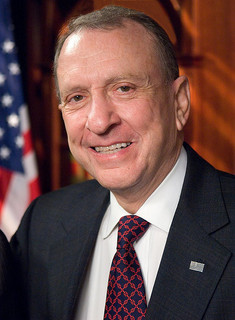 Over the weekend, one of the largest supporters of biomedical research in Congress, Arlen Specter passed away. We scientists often complain that Congress just doesn’t understand and won’t support our research as much as we’d like. There are, however congressmen like Specter, who do tirelessly support our cause in the senate. Specter championed the effort to double the NIH budget from 1998-2003 and encouraged the addition of $10 billion in stimulus funding for the NIH in the 2009 Recovery Act. Continue reading “A benefactor lost”
The Art of Science: Madame Wu and the Violation of Parity

Ele Willoughby (aka Minouette) calls herself a “marine geophysicist by day and printmaker by night”. She carries over this unusual combination into her artwork, which often features concepts and key figures from the history of science.
For example, she explains, “In physics, if there’s a bias which is commonly forgiven (and viewed as harmless, or even right), it’s beauty. I bet that wasn’t what you expected, but it’s true…One thing physicists invariably count as ‘beautiful’ is symmetry. The concept is invaluable in physics; symmetries are very powerful tools for figuring things out….Each symmetry leads to a conservation law.” Continue reading “The Art of Science: Madame Wu and the Violation of Parity”
Scientists and Dan Mangan both Want To Be Pleasantly Surprised, Not Expectedly Let Down
Dan Mangan is no stranger to using scientific references and metaphors to communicate larger meanings about life. His lovely track About as helpful as you can be without being any help at all uses a quote from science illustrator Charlie Harper to beautiful effect (and was a previous Song of the Week). The song that follows it directly on the album (2011’s Oh Fortune) is called How Darwinian and pivots on the lines I should know better by now/there’s only so much to go around. Continue reading “Scientists and Dan Mangan both Want To Be Pleasantly Surprised, Not Expectedly Let Down”
V is for Correlation
Correlation is not causation.
Who hasn’t heard that old chestnut? No one. How many people actually disagree? No one. Who actually uses the phrase “old chestnut”? No one. See the theme? No one. Wait, what? Stupid pattern loving human brain. Where was I? Argh, stupid forgetful human brain. No one.
Deep breath. Start again. While no one may believe that correlation is the same as causation, it is a tired line that is frequently used, not as an incisive critique of analytical errors in analysis, but as a casual dismissal of potentially inconvenient results without any serious consideration. Casual dismissal requires some style, a touch of pithiness. I find the related aphorism to be more aurally attractive:
Correlation does not imply causation.
It has more words, but I think it is something about the rhythm that I like. The accuracy of this phrase is, however, up for debate. And, it is debated, usually in a rather uneducated manner. The debate centers around the word “imply”. In its original, more mathematical usage, “does not imply” essentially had the same meaning as “is not”. In modern, common usage (eg, internet comment sections and dictionaries), “imply” has a much broader meaning more along the lines of “suggest”. This underscores a major problem with distinguishing correlation and causation – we use the same language and tools to discuss them both. Continue reading “V is for Correlation”
 The Finch and Pea