 Dead or alive? Wave or particle? Kittehs handle all the tough physics questions.
lol via Cheezburger.com

Dead or alive? Wave or particle? Kittehs handle all the tough physics questions.
lol via Cheezburger.com
Author’s Note: Post was written without access only to the abstract, not the full text, of the journal article in question. Note that the argument is not with the methods or results of the research, but with how the research question has been presented.
University of Chicago Medicine & Biological Sciences tweeted the following tweet on Twitter today highlighting the work of post-doc Laure Ségurel on genetic risks for Type 2 Diabetes:
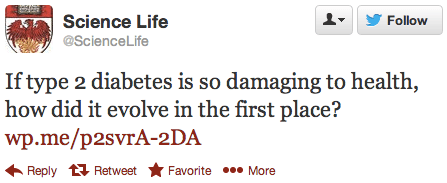
The work itself is interesting in its own right. Investigating the population genetic history of genetic markers associated with Type 2 Diabetes risk could have multiple applications, beyond the high level of intellectual interest.
The question used to frame the research, however, troubles me, because it plays to general misconceptions about the evolutionary dominance and efficiency of natural selection in humans:
Why is this deleterious disease so common, while the associated genetic variants should be removed by natural selection? –Ségurel et al (Eur J Hum Genet. 2013 Jan 23. doi: 10.1038/ejhg.2012.295)
Do you know what is very useful for mapping out the places you have visited? Maps. That’s why we have started plotting out the places we’ve visited and written about here on our handy Have Science, Will Travel Google Map.
In honor of World Book Day, here are a few books that we’ve reviewed and found interesting in the past year:

Springtails are all around us.
Springtails (Collembola) are hexapods but not insects, being members of the insects’ sister class Entognatha (which also includes proturans and diplurans). They are tiny (<6mm), and numerous, occurring at densities up to around 100,000 per square meter of topsoil. They are important components of forest floor ecosystems, and some species can also be found floating on the surface of stagnant water. Continue reading “Meet the Springtail”

 The Finch and Pea