
The Art of Science: Plant Biology Blossoms in Metal

janicehojho

Insect eggs and chloroplasts are among the inspirations for the beautiful handcrafted jewelry of Janice Ho. She describes her work as making “miniature worlds, three-dimensional snapshots of natural elements, and portraits of plants and their littlest parts in silver, gold, enameled copper, and porcelain.” Ho lives and works in an artists’ colony in Hannibal, Missouri that incorporates an old jail (!) and a big garden where she observes plants and insects up close.

She also studies plant biology diagrams, one of which was the basis for this piece, Not an Actual Life Cycle. She explains, “I’ve always loved the layout associated with these illustrations and have translated that into the framework of this piece. The elements represented include details of a poppy seed pod, a plant cell, mason bee house, and paper wasp nest.”

She has made other pieces representing mitosis, photosynthesis, pollination, and the miracle of stink-bug birth, among many others.

You can find many more examples of her work on her website, along with a schedule of upcoming shows.

Crowdfund it?

Need money for your research project? Then someone has probably suggested “crowdfunding” as a solution. But, what does that really mean? Is it really a good solution? How would you actually implement it?

The University of Washington’s College of the Environment has created a crowdfunding FAQ based on the early experiences of its students.

I’m certain that experts in this area will find issues with the document, but what is of real interest is the academic institution taking an active role in trying to help their faculty and students navigate waters that are much trickier and more complex than many realize. In particular, they are providing guidance with how to use crowdfunding within their organization, which will vary from place to place.

There is also a flowchart. Internet, you love flowcharts.

*Hat tip to Steven Roberts.

Exploratorium opens in a new location

Tomorrow, the Exploratorium in San Francisco opens its doors in a new location at Pier 15.

Look how incredibly awesome the new building is going to be.

Because it isn’t yet open, no science tourists have been there yet, but it’s a good time to look back at both the old venue and some of the Exploratorium’s online ventures.

I visited the old location, at the Palace of the Fine Arts, in 2008, but I had virtually met the museum before that.

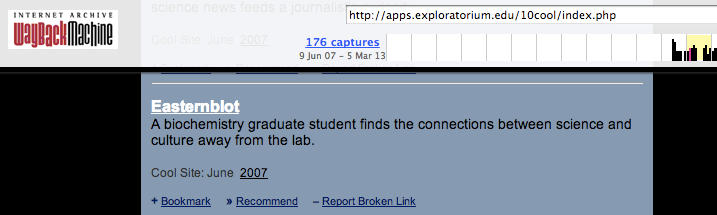
For a few years, the Exploratorium website listed a selection of interesting science websites. They put up a new list once every while, and yours truly once made the list! Easternblot.net was one of the “ten cool sites” on the Exploratorium website in June 2007! (That was when I updated it much more often…)

Proof from the WayBackMachine!
Screen shot 2013-04-14 at 23.06.10

So when I visited in 2008, I knew I would like the museum, because the museum liked me! And indeed, I saw some cool stuff there:

Lessons from the lab
Continue reading “Exploratorium opens in a new location”

Economic Regions

Dirk BrockmanPhysicist Dirk Brockman used data on dollar bill movements to identify economic regions.

While the physical transfer of cash may no longer represent our economic activity as well as it once did, it is still interesting stuff. I do quibble with the concept that the economic activity regions correspond to “states” (Brockman is German). I also think information on direction of flow is extremely important. I am happy to see that the concept of “The Carolinas” is apparently real and that Ohio State fans express their dislike of Michigan with their wallets too.

*Hat tip to Jennifer Ouellette.

Boston

There are many things that can be said about yesterday’s events in Boston. It is hard to imagine saying any of them better than Dave Munger’s “In praise of Boston”. Dave is an editor for Science Seeker and ran the Boston Marathon yesterday.

Marathon day in Boston is one of the warmest and most heartfelt holidays and events that I have ever been a part of. Someone tried to take that away from the people of Boston yesterday, but I don’t think they succeeded. They only gave Boston another chance to show how generous and brave its people are. While I am horrified by the events that occurred yesterday, I’m glad to have had the chance to see so many people at their best.

Boston’s people showed us their true colors yesterday. They gave the rest of us something to aspire to. – Dave Munger

He doesn’t dwell on the evil that was done. He doesn’t even spend a lot of time on the amazing quirk of human nature that makes people run toward a tragedy and danger to help. Dave movingly shows us that we shouldn’t be surprised, because yesterday’s Boston Marathon, both before and after the bombs, demonstrated that we are there for each other.

Tragic events highlight the light and the dark in the human soul, but they are always there. Thankfully, there is a lot more light.