As everyone with access to the internet or cable surely knows, it’s Shark Week. Although some of the science on TV has been highly questionable, our friend David Shiffman, known to many as @WhySharksMatter, has made it his mission to spread accurate information about sharks. Yesterday, he hosted an epic, 3 hour Reddit AMA all about sharks. Read it here, you’re sure to learn stuff.
Editor’s Note: My favorite movie food is Dots. That is not the kind of movie food Ben is talking about here.
In the Disney film The Sword in the Stone, Arthur’s stepbrother, Sir Kay, devours approximately 5 pounds of chicken drumsticks by simply sticking the whole drumstick in his mouth and sucking off the meat. My young mind was astonished to learn that you could eat an entire drumstick in one bite. Turns out, you can’t. There’s all this cartilage and stuff in there and its a bit of a choking hazard. Bummer.
You can, however, sometimes pull off Sir Kay’s trick with the meat on the radius* bone when eating buffalo wings. It’s not nearly as impressive, but still oddly satisfying.
*You know the part of a chicken wing that has two bones in it? I’m pretty sure that the radius is the smaller bone in that portion of the wing. It also has less cartilage and connective tissue, which helps with this particular trick.
A few days ago, a colleague of mine was visiting. When I say colleague, I clearly mean friend that is also a biologist, but I like to pretend that we’re not just up all night drinking and talking about polyandry in frogs. Amidst the usual back and forth game of “no way…did you see that new species they found in wherever”, he mentioned a backwards butterfly. “Did you know about the butterfly that has coloration on its wings to make it look like it’s backwards?” …”uh…no…is that really a thing?”
Photo Credit:Rick Cech Tambopata Research Center, Peru
When my friend shared the picture I had no reply (which almost never happens). Damn. Evolution you are amazing. High five natural selection…high fives all around.
Behold the Zebra Hairstreak (Panthiades bathildis)… Not only are the stripes on the wings going the wrong way, but the ends of the wings look like antennae. Continue reading “Meet the Backwards Butterfly”
Ben has been investigating how COMPASS might help improve interactions between the business and scientific communities. I, apparently, was one of 40+ “thinkers” he talked to about this topic. Fortunately, the other 39+ thinkers were able to make up for my ramblings. Ben summarized some of what he learned from these interviews in a very thoughtful blog post “Looking Beyond the Business Card”:
But over the course of more than 40 interviews with thinkers in nonprofits, government, journalism, and the private sector, I discovered a cultural divide among scientists themselves – between academics and their counterparts in industry. . .While there’s plenty of cross-pollination between university and commercial scientists on topics like chemistry, geology, and medicine, it seems that communication grows thinner in more interdisciplinary and holistic fields like ecology and climate. If this is true, it points to many missed opportunities for both groups to learn from one another.
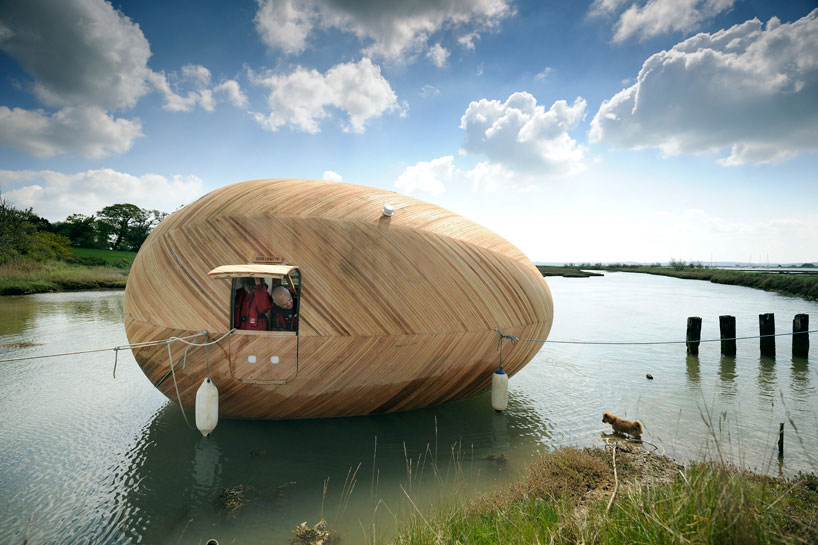
Living in a pineapple under the sea is so 2010. Artist Stephen Turner recently took up residence in a wooden egg on the River Beaulieu in England, where he will stay for about a year. The Exbury Egg, Turner’s new home, is a solar-powered wooden pod which is tethered like a boat in an estuary, rising and falling with the tide.
The main idea of the Egg is to explore “a more empathic relationship with nature” linked more closely with the rhythms of natural life. However, the project does not reject modern technologies but rather seeks to use them in the most effective possible way. For instance, Turner has a computer and phone powered by solar panels. Continue reading “The Art of Science: The Exbury Egg”



 The Finch and Pea