
John Snow and the Broad Street Pump

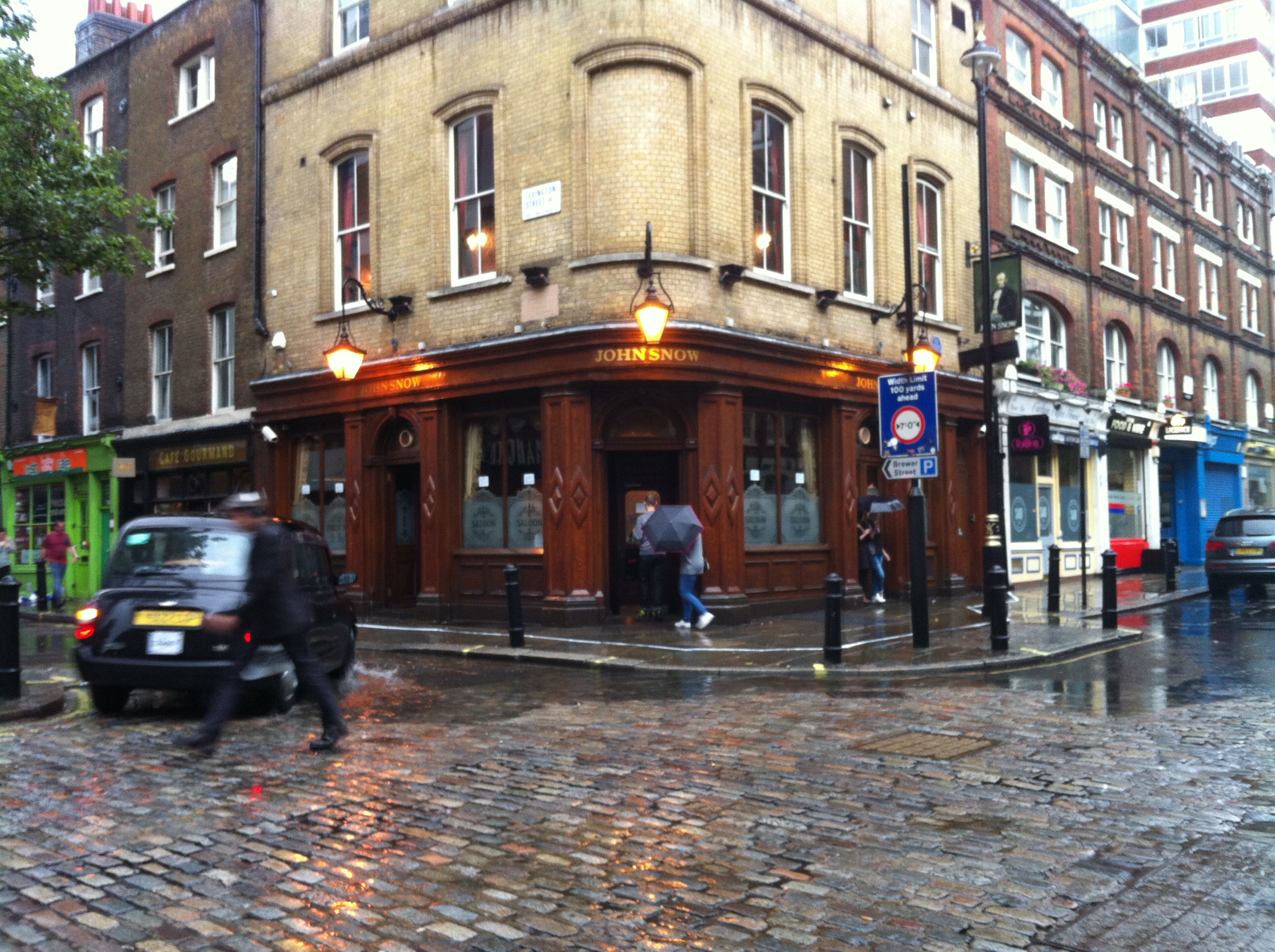
2013-08-24 16.14.10In the summer of 1854, the central London neighbourhood of Soho was struck by a sudden cholera epidemic. Local physician John Snow identified the Broad Street pump as the source of the outbreak, preventing further spread of the disease. These days, the affected neighbourhood is home to many pubs and cake shops, prompting my friends to organise a “cholera and cake” pub crawl with out-of-town visitors this past weekend.

The Broad Street pump is not longer there, but in 1992 a symbolic pump was placed across the street from the John Snow pub, which is thought to have been the original location of the pump.
2013-08-24 16.14.55

Locating the source of the cholera epidemic was an especially impressive feat because the prevailing medical opinion at the time was that cholera was caused by “bad air”, and not by something you can find and eliminate. Germ theory hadn’t yet caught on, but John Snow was skeptical of the “bad air” theory, and suspected that there was something else.  He talked to lots of people in the affected area and in neighbouring streets, and he started to notice a pattern. Continue reading “John Snow and the Broad Street Pump”

We are all heretics

heresy (her-i-se); n; An opinion or a doctrine at variance with established religious beliefs… – Free Online Dictionary

A Pew survey in the UK indicates that there is far greater diversity within religions (and the non-religious) and far greater similarity between religions (and the non-religious) than is commonly portrayed in public discussions. Take a look at the highly contentious issue of abortion limits (an issue on which religious opinion is often portrayed as monolithic):

Even the religions that are somewhat distinct are biased toward “Don’t Know” rather than an extreme position on the issue.

It is notable that the opinions of the religious folks in this survey are diverse despite the official teachings of some of these religions explicitly endorsing a “correct” answer. The members of the religion may fiercely defend their faith, but they also can feel rather free to disagree with their leadership, whether they are technically “allowed to” or not.

This is not a new revelation to anyone who has spent a substantial amount of time interacting with the actual members of many different religious denominations and creeds.

It is time we realize that the “spokespeople” for religions (and atheism) are about as representative of the people in their religion as Senator Lindsey Graham (R-SC) is for some of us in the Palmetto State.

Kenan Malik has a lot more about this survey over at his blog Pandaemonium.

*Hat tip to that Ed Yong.

Get your art on(line)

The Getty has made 1000s of images of artwork that is in the public domain available online. Like Philosophy Presenting the Seven Liberal Arts to Boethius (c. 1460-1470CE) by the “Coëtivy Master”*:

“Philosophy Presenting the Seven Liberal Arts to Boethius” (c. 1460-1470CE) by the Coetivy Master

Like other museums that share portions of their collection online, this make an experience of the Getty’s collections available for people around the world, who cannot actually visit the Getty. While the works of art themselves are in the public domain, the Getty might claim copyright over the scans/photos of the art. Instead, they have taken the step of making clear that this images are available for the public to use and adapt as we see fit.

The Getty makes available, without charge, all available digital images to which the Getty holds the rights or that are in the public domain to be used for any purpose. No permission is required. – The Getty “Open Content Program”

I don’t know if letting me print 300dpi images of classic art will hurt The Getty’s bottom line due to reduced gift shop sales of postcards (not from me, the gift shops never have the pieces I want). Hopefully, The Getty’s program will inspire other museums to consider following suit.

*The results of a search for “science” were a bit disappointing, but I suspect that this is mainly due to the age of many of the works. Using a historically relevant term, like “philosophy” was much more productive.
**Hat tip to Hannah Williams.

Sunday Science Poem: The Future Will Be Like Disney World

IBM Pavilion New York World's Fair 1964-65May Swenson’s ‘The People Wall’ (1967)

In 1965, if you wanted to see what the future was going to look like, you could go to the New York World’s Fair. Under the giant green Moon Dome of the Transportation & Travel Pavilion, you could see the future of space travel; at the DuPont exhibit, you could see futuristic fabrics featured in a musical comedy about chemistry; at the Hall of Science, kids could play radioactive waste disposal in Atomsville, USA; and at the General Motors Futurama II exhibit, you could watch vacationers lounging in underwater cities, and see how in the future trees will be felled with laser beams.

One of the more spectacular exhibits was IBM’s People Wall, a giant grandstand that lifted the visitors into a spectacular “gunite-spayed steel egg, about the size of a Navy blimp,” where they would be bombarded with futuristic images on 14 different screens in what was supposed to be a visual display of state-of-the-art computer data processing. (I have no idea what gunite is, but it sounds futuristic.) Continue reading “Sunday Science Poem: The Future Will Be Like Disney World”

Science Caturday: It’s That Time Again

Are you ready, kids?

bts

photo via Cheezburger.com