The Art of Science: Bouncy Stonehenge

Sacrilege, Jeremy Deller, 21012

My dilemma: I’m supposed to write a weekly post about science-based art, but yesterday I discovered this bouncy, inflatable scale model of Stonehenge. So I had to decide whether to try to squeeze this wonderful thing into a science framework – for example, by discussing how prehistoric people with primitive tools were able to move giant stone slabs and place them atop each other. Or perhaps by noting that the design of Stonehenge indicates that Neolithic people had a surprisingly deep and sophisticated understanding of solar movements and patterns.

But what I really want to say is “Yay! Bouncy Stonehenge! Why did this take so long to be built and when will it come to the US?”

For the record, the real name of bouncy Stonehenge is Sacrilege, and it was designed by British artist Jeremy Deller for the Glasgow International Festival of Visual Art 2012. The inflatable structure traveled to the Queen Elizabeth Olympic Park in London earlier this year. Here’s hoping it pops up on these shores sometime soon.

Tip o’the hat to Despoke
If we can build it, we understand it… clearly we don’t understand life

This week in Pacific Standard I try to answer the question, why can’t we build life from scratch?

There are two primary ways biologists are trying to build life from scratch – evolution and intelligent design. People like Harvard’s Jack Szostak are trying to understand prebiotic evolution, by evolving autonomously replicating protocells in the lab. On the other hand, synthetic biologists, like those at the Venter Institute, want to be able to go to the whiteboard and intelligently design a genome from scratch. They already know how to synthesize and transplant a genome; designing it is another matter. As I wrote for Pacific Standard, we’re “like someone who knows how to work a 3-D printer but can’t design new digital templates for it.” Continue reading “If we can build it, we understand it… clearly we don’t understand life”

The Science is the Art

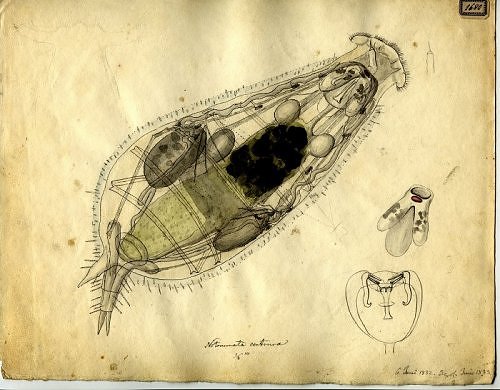
by Christian Gottfried Ehrenberg (Public Domain)

The images Christian Gottfried Ehrenberg made of microscopic organisms in the mid-1800s are both art and ground breaking science. They should be appreciated as both. A massive collection of his specimens, images, and records reside at the Museum für Naturkunde in Berlin.

Found via David Orr pointing to The Caledonian Mining Expedition Company.

Science ruins nothing, Komodo dragon edition

I am, for some reason, very fond of Komodo dragons. I own a Komodo dragon beanie baby. Very fond. My fondness has even survived Ed Yong’s efforts to destroy one of the most cherished myths of my childhood – the septic bite of the Komodo dragon.

Komodo Dragon at the St. Louis Zoo (Photo by Poppet Maulding; CC BY 2.0)

My soft spot for Varanus komodoensis is almost entirely due to the Matthew Broderick classic film, The Freshman. It was reinforced by a moment I had with a Komodo dragon at the St. Louis Zoo. Granted, the dragon was clearly making a threat display because it felt I was trying to encroach on its heat lamp territory. While the dragon was not correctly interpreting my intentions, there was something very compelling about having the attention, one-on-one with such a creature.

My affection for the lizards has not been dampened by Ed Yong revealing that the bite of the Komodo dragon is truly venomous (they essentially inject you with blood thinners and anti-coagulants, the bastards), not toxic from septic bacteria as has been assumed for the past 50 years or so.

In 2009, Fry discovered the true culprit behind the dragon’s lethal bite, by putting one of them in a medical scanner. The dragon has venom glands, which are loaded with toxins that lower blood pressure, cause massive bleeding, prevent clotting and induce shock. Rather than using bacteria as venom, the dragons use, well, venom as venom.
-Ed Yong, “The Myth of the Komodo Dragon’s Dirty Mouth”, Not Exactly Rocket Science

Why do Komodo dragons still capture my imagination? Look, giant lizards with toxic bites are cool. Giant lizards with venomous bites are no less the stuff of really cool nightmares.

Science Caturday: Key Principles of Physics

Science kitteh illustrates two things at once: one of the basic laws of physics, and one of the guiding principles of Caturday.

atrest

Photo via Cheezburger.com