Royal Observatory in Greenwich

Greenwich observatoryIn the 17th century, it was pretty difficult to figure out where you were when on a ship at sea. Navigation by stars was the most accurate way, but it was usually just used as a guideline for which direction you were going. The ultimate goal was to know the exact latitude and longitude of your location. Latitude – how far North or South you are – could be measured by looking at the position of the sun or (other) stars over the horizon, but longitude was much harder.

Telescope

To solve the problem of longitude, King Charles II ordered the construction of the Royal Observatory in Greenwich, and hired an Astronomer Royal, to “find the so much desired longitude of places for the perfecting of the art of navigation”.

In the end, it wasn’t the Astronomer Royal, but a Yorkshire clockmaker who worked out how to determine longitude at sea using a very accurate clock.

Today, the Royal Observatory in Greenwich is most famous not just for celestial-based navigation, but for the Greenwich Meridian. Unlike the lines of latitude, determined by the poles and equator, the lines of longitude are arbitrary. Greenwich was officially declared to be longitude 0° at a conference in 1884, and the line is marked by a metal strip and a long line of tourists in the courtyard of the observatory.

Meridian line pt 1

Inside the Observatory buildings are exhibits about astronomy, navigation and time. I thought it would be a fitting destination to mark my last science travel post of 2013, because it’s not just about science travel, but also about the science of travel – and time!

In 2014 I’ll start writing about science travel destinations that I haven’t visited yet, but would like to visit. Latitudes and longitudes still to be determined.

And don’t forget to check out our Have Science Will Travel map:

Lucretius the Epicurean

If you have been following Mike’s Sunday Science Poem series, you know that we are fans of Lucretius. Lucretius was a Roman poet and philosopher in the first century BC. He is famous for his only extant work De Rerum NaturaThe Nature of Things, covering many topics near and dear to the hearts of modern scientists.

I am also a fan of the podcast History of Philosophy Without Any Gaps by Peter Adamson at King’s College London and LMU Munchen. Lucretius was an Epicurean, which is one of the many schools of philosophy covered. It may not be a replacement for studying philosophy in school, but listening to episodes 55-59 (including an episode on Lucretius himself) will help you understand the philosophical paradigm Lucretius was using when he wrote his great poem, especially when you are reading Mike’s series of posts on Lucretius:

Sunday Poem

Sunday Science Poem: The Epicurean Theory of Vision, and Bedwetting in Ancient Rome

Sunday Science Poem: Why You Should Read Lucretius

Lucretius Did Not Believe in Non-Overlapping Magisteria

Lucretius and The Fear of Death

There is Grandeur in Lucretius’ View of Life

Lucretius: Lightning is Not a Means of Divine Communication


Accidental Art of Science: Parking Lot Mitosis

I came across this amazing example of accidental science art yesterday in a shopping center parking lot in northern Virginia. After I tweeted a cell phone picture of the full sequence of cell division – it’s even in the right order, as you can see from the bottom photo – someone directed me to this excellent post by Malcolm Campbell on the science of oil rainbows.

prophase

anaphase

daughter cells

whole

Science Caturday: One Code, Two Code…

Like a DNA nucleotide, this LOLcat is capable of playing multiple roles. It is good for creation vs. evolution, and so much more. Global warming vs. something else? You are covered. Homeopathy vs. physics? Done. Duons vs. the genetic code? In the bag.

Duons vs. the genetic code? What is a duon?

Good question. A duon is a DNA nucleotide that can do two roles. This perhaps makes it a rather lame nucleotide. DNA nucleotides have a lot of potential tasks they can do (eg, help encode an amino acid, be part of a protein binding site, indicate a splice site, etc) as part of their role storing information in our cells. The idea that a nucleotide might be subject to evolutionary pressure from several different tasks simultaneously is nothing new.

There is, as Emily Willingham points out at Forbes, no real “duon” controversy outside the minds of the folks that wrote the press release (and, perhaps, John Stamatoyannopoulos, if the press release quote is accurate, which I suspect it might be based on his advocacy for the ENCODE Consortium’s “junk DNA is functional” boondoggle). These researchers have provided some evidence to support the hypothesis that evolutionarily conserved codon bias (using one codon, of the several possible for an amino acid, in the genetic code more than expected by chance) is due to selection to maintain transcription factor binding sites.

This is not an unreasonable hypothesis, but it is hardly shocking, hardly requires a new term, and is hardly a controversy.

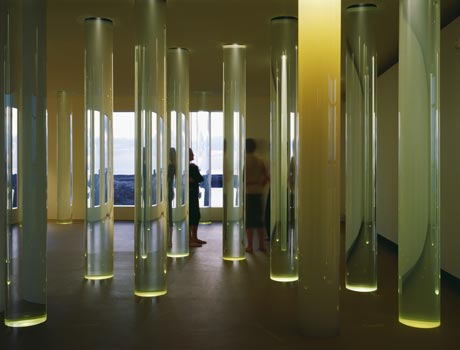
The Art of Science: Roni Horn’s Library of Water

Roni Horn, Water, Selected, 2007

Artist Roni Horn has been traveling to Iceland from her home in New York since the 1970s. The unique nature of the Icelandic landscape and climate deeply informs all her work, which ranges from sculptures and drawings to photos and books.

In the 1990s she discovered the local library in the small town of Stykkisholmur and was impressed with its architectural style and its views of the sea, sky, town and harbor. When the library ceased operations in 2003, Horn proposed the creation of a permanent installation in the building. The result, Vatnasafn/Library of Water, opened in 2007.

The Library of Water consists of three linked parts: The first, Water, Selected is a sculptural installation of 24 glass columns containing water collected from ice from some of Iceland’s major glaciers. The columns bend and reflect the light onto a rubber floor which is printed with words in Icelandic and English related to the weather. As Gordon Burn described it in The Guardian, “with the windows cut to the floor, Library of Water pokes up into the weather. It sets its face at everything the weather can throw at you, which in Iceland invariably means extremes of light and wind and cold; visibility often varies from minute to minute.”

The second exhibit, Weather Reports You, consists of taped interviews with 100 Icelanders about their interactions with the weather and selections from Horn’s books about Iceland. The third part of the library is a private writers’ studio where each year writers from Iceland and abroad are invited to live and work for several months at a time.

The idea of a library of water gathered from glaciers is not only beautiful and novel, but may become essential. A great deal of information about historical climate, atmospheric and geological conditions is trapped in the ice of glaciers. As global warming causes the glaciers to melt, we may have no choice but to look at them in a preserved and cataloged form, like antiquated books in a library.

Information about visiting the Library of Water is here.  If you can’t make it to Iceland, you can see related work by Roni Horn at the Hauser & Wirth Gallery in New York City until January 11, 2014.