We don’t need to wait for vaccines to defeat Ebola

It’s unfortunate that Ebola drugs and vaccines are still experimental during the worst-ever outbreak of the virus. Ebola is causing massive disruption and economic damage in West Africa. The projection that, if things keep going as they are, tens of thousands could be infected by October is frightening.

But as I argue in my latest column over at Pacific Standard, we’ve already got the tools we need to fight the outbreak. While drugs and vaccines would without question be helpful, the main challenges are social, not scientific. Ebola infections have a high fatality rate, but like HIV (which infects almost 25 million Africans), the virus is not that inherently contagious. Outbreaks in the past have been quickly brought to an end with standard infectious disease control measures.

But there is the problem – those measures have failed in West Africa, and local institutions have been overwhelmed. Wealthier nations have been slow to give the help that’s needed. Contagion is not only a function of the virus itself, but also on social conditions. The current conditions in West Africa — poverty, poor communication, and a justified mistrust of local governments — have allowed this outbreak to get so bad. We don’t need to wring our hands over missing vaccines or drugs; we need to provide the equipment and personnel to tamp down the outbreak using the effective tools we already have on hand.

A 2006 report from a major conference on Ebola said as much: Continue reading “We don’t need to wait for vaccines to defeat Ebola”
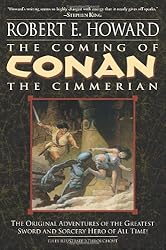
Conan the Philosopher

From Robert E. Howard’s Conan the Cimmerian story “Queen of the Black Coast”, some serious philosophy that is applicable to both theories that the universe is a hologram and that some quantum fluctuation could cause all reality to unravel in a moment:

“But what of the worlds beyond the river of death?” she persisted.

“There is no hope here or hereafter in the cult of my people,” answered Conan.

“In this world men struggle and suffer vainly, finding pleasure only in the bright madness of battle; dying, their souls enter a gray misty realm of clouds and icy winds, to wander cheerlessly throughout eternity.”

Bêlit shuddered. “Life, bad as it is, is better than such a destiny. What do you believe, Conan?”

He shrugged his shoulders. “I have known many gods. He who denies them is as blind as he who trusts them too deeply. I seek not beyond death. ..Let me live deep while I live; let me know the rich juices of red meat and stinging wine on my palate, the hot embrace of white arms, the mad exultation of battle when the blue blades flame and crimson, and I am content. Let teachers and priests and philosophers brood over questions of reality and illusion. I know this: if life is illusion, then I am no less an illusion, and being thus, the illusion is real to me. I live, I burn with life, I love, I slay, and am content.”

This was effectively condensed into the most famous line in the Arnold Schwarzenegger classic Conan the Barbarian:

Mongol General: Wrong! Conan! What is best in life?

Conan: Crush your enemies. See them driven before you. Hear the lamentations of their women.

Mongol General: That is good! That is good.

For actual philosophy, check out Peter Adamson’s podcast History of Philosophy Without Any Gaps or the book version, Classical Philosophy: A History of Philosophy Without Any Gaps, Volume 1 

Apocalypse 1896: Gabriel Tarde and the Fortunate Catastrophe

Gabriel Tarde’s The Underground Man (1896)

Cave1In the decades before the First World War, End of the World visions were influenced by major scientific discoveries of the 19th century. People became aware that the sun, the earth, and the human species itself were moving on a historical trajectory, one that would come to an end naturally, without any need for some divine entity to drop the curtain. The astronomer Camille Flammarion explored different natural scenarios for the End of the World in his 1893 novel La fin du monde, while H.G. Wells’ pathbreaking The Time Machine (1895) described the evolutionary deterioration of humanity and the gradual extinction of all life on earth under a dying sun.
But French sociologist Gabriel Tarde would have none of this cosmic fatalism. In his brief, bizarre 1896 novel, Fragment d’histoire future (published in 1905 in English under the title The Underground Man, with an introduction by none other than H.G. Wells), the extinction of the sun is the best thing that ever happens to us. Living deep underground, cut off entirely from nature, surviving humans have a perfect society where they go about nearly naked in the geothermal warmth, eat synthetic food, and devote all their efforts to happiness and aesthetic achievement. Continue reading “Apocalypse 1896: Gabriel Tarde and the Fortunate Catastrophe”

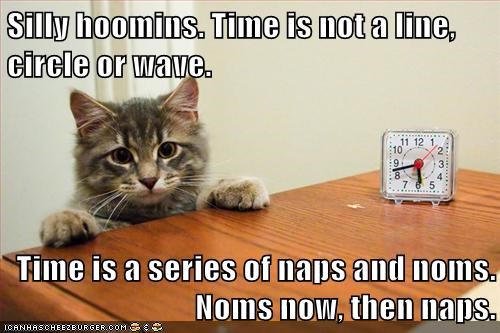
Science Caturday: Time Kitteh is Deep

timecat

Imagining Deep Time, an art exhibition at the National Academy of Sciences in Washington, DC, tackles the profound theme of “deep time,” the timescale not of human life but of trees, rivers, mountain ranges, even stars.  The exhibition features works by 15 artists in a range of styles and media including painting, photography and sculpture. Curator JD Talasek says that the exhibition “explores the role of the artist in helping us imagine a concept outside the realm of human experience.”

The show runs until January 15. More information, including a downloadable catalog, is here.


“…baking IS science”

Editor’s Note: A strip from Danielle Corsetto’s Girls with Slingshots reminded us of Ben’s inaugural post here at The Finch & Pea. Excerpt from post originally published 30 August 2012.

Adapted from "Girls with Slingshots #1882" by Danielle Corsetto (All Rights Reserved - Adapted & Used with Permission)
Adapted from “Girls with Slingshots #1882” by Danielle Corsetto (All Rights Reserved – Adapted & Used with Permission)

Good food, sexy food is the result of passion and science. We talk a lot about passion in cooking, but passion alone can’t make a chocolate mousse cake. Passion can’t ensure efficient heat transfer, make proteins bind, crystallize molecules, or drive chemical reactions. There is science in your food, even if you don’t know how it got there.

I’m here to introduce you, the patrons of The Finch & Pea, to some delicious nosh, to stoke your passion for cooking, and to help you understand how cooking works.

Understanding the science behind a recipe – what the ingredients really are, how they interact with each other, how they change when you manipulate them – will make you a better cook, chef, and diner. When I go to write a cake recipe, knowing flour type composition, hydration ratios, chemical reactions of leavening agents, and methods for strengthen emulsions drastically affects the success of the recipe. Cooking isn’t just about passion. It’s about words you heard in chemistry and physics class. Words like heat conductivity, melting point, vaporization temperatures, phase transition, pressure effects on physical states, hygroscopic minerals, and density differentials all play an important role in almost every aspect of cooking.

Together we are going to explore the science behind everyday cooking. Why should you salt a steak an hour before cooking, but never right before? Why shouldn’t you use vanilla extract? How can baking soda ruin your cookies? How does granulated sugar “cook” your strawberries when poured over top?