The Art of Science: Mike Tyka Folds Proteins in Copper

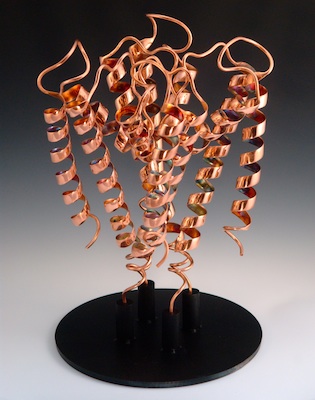
Michael Tyka, KcsA Potassium Channel, Copper and Steel, 2011

Mike Tyka is not the first scientist to see artistic potential through his microscope, but he’s taken his love for the structure of protein molecules much farther than most – not only learning metalworking to make beautiful copper sculptures, but creating a studio/makerspace to do it in.

Tyka earned a PhD in Biophysics in 2007 and went  to work as a research fellow studying the structure and dynamics of protein molecules.  His particular area of interest is protein folding, and he has written computer simulation software to better understand the process.  Tyka says that “protein folding is the way our genetic code is interpreted from an abstract sequence of data into the functional enzymes and nano machines that drive our bodies.”

Tyka got interested in sculpture in 2009 when he helped design and construct Groovik’s Cube, a 35ft tall, functional, multi-player Rubik’s cube.  The cube will soon be on view at New Jersey’s Liberty Science Center as part of its Beyond Rubik’s Cube Exhibit.

Although the Groovik’s Cube project gave him his first taste of art-making, building a giant welded steel cube hardly prepared him to make exquisite replicas of complex biological forms.  So he took to the internet. “I learned almost everything I needed from youtube and from jeweler friends. I didn’t have a space to work so I got together with some friend and founded an artspace (Seattle’s ALTSpace) and acquired or built all the tools I needed.”

Tyka was obviously very familiar with the protein forms and knew how he wanted them to look. He chose to work in copper, a warm, soft metal, because he wanted the sculptures “to look smooth, soft, liquid. Proteins are not solid objects, they’re more like jelly, they move and vibrate. I wanted to reflect that property somehow.”

You can see Mike Tyka’s work at the Hutchinson Cancer Institute in Seattle and at Science House in New York, and see lots more photos on his website. You can follow him on twitter @mtyka
Voyage of Discovery

I’d strongly encourage you to watch the video. Michele, Jessica, and Ellyn provide some very profound thinking about the ways scientists and artists view the world – and challenge both groups to learn from each other.

Even better. If you are in the DC area (or are traveling through), make some time to visit the exhibition in person. Make a point to support these talented artists.

Even betterer. Really support these artists by acquiring some of their work to keep near you at all times. Like their style, but don’t see the one thing you want most in the world. Ask about commissioning a piece. It is often cheaper than you think, yet makes you feel like plutocratic patron of the arts. And, that is a very good feeling.

The Art of Science: Troubled Waters

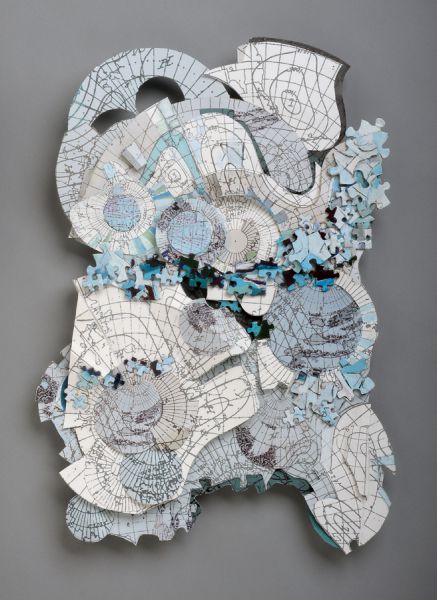
Phyllis Ewen, Northern Waters 3, 2013

Northern Waters, by Massachusetts-based artist Phyllis Ewen, is a series of sculptural drawings looking at water as “a life force that resist being controlled.” Ewen builds her 3D images by scanning maps, charts and photos and then cutting them and building them into layers, adding paint and text, most recently in puzzle-piece shapes.

Ewen’s work explores the ways in which “life-giving waterways have been contested, diverted, polluted, and exhausted by human intervention.” In the case of Northern Waters, the oceans and glaciers are being profoundly reshaped, not by the obvious interventions of dams and agriculture, but by the effects of human-caused global warming.

Some of Ewen’s sculptural drawings are included in a global-warming themed exhibition called Thaw, at the Dorsky Gallery in Long Island City, NY, through April 6. You can see lots more of her work at her website.

The Art of Science: Bouncing Beethoven Off The Moon

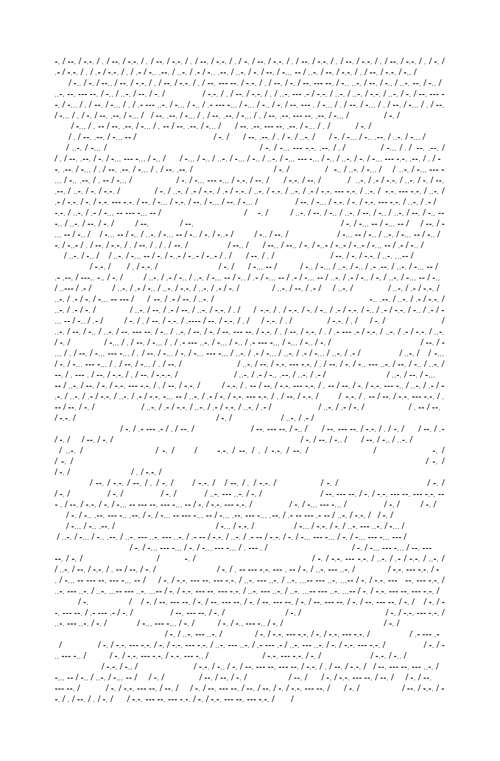
Some of The Moonlight Sonata as received in code from the moon.                    Katie Paterson, 2007
Some of The Moonlight Sonata as received in code from the moon.
Katie Paterson, 2007

For centuries, artists have been inspired by the beauty and mystery of the moon, and for the last 50 years, by the tantalizing possibility of traveling there.  An exhibition in London, The Republic of the Moon, takes those imaginings a few steps further. The show, at Bargehouse in London’s South Bank, “combines personal encounters, DIY space plans, imaginary expeditions and new myths for the next space age,” says its organizer, Nicola Triscott of The Arts Catalyst.

One especially intriguing piece is a sound and data based work called Earth – Moon – Earth, by Scottish artist Katie Paterson.  Paterson translated Beethoven’s Moonlight Sonata into Morse code and “bounced it off the moon” via Earth-Moon-Earth (EME) transmission.  The artist explained:  “The moon reflects only part of the information back – some is absorbed in its shadows, ‘lost’ in its craters … Returning to earth fragmented by the moon’s surface, it has been re-translated into a new score, the gaps and absences becoming intervals and rests. In the exhibition space the new ‘moon–altered’ score plays on a self-playing grand piano.” (You can listen to a clip of it here)

(Full disclosure: I thought Paterson was totally making this EME stuff up. A brief consultation with my friends Google and Wikipedia, however, convinced me that it is indeed possible to bounce a signal off the moon’s surface and people have been doing so since the 1950s. Incidentally, streaming Beethoven to the moon sounds like a perfect project for noted music-and-moon-lover Newt Gingrich. But I digress. )

Is Paterson’s piece a metaphor for the cultural loss that often seems to go hand-in-hand with scientific progress?  Maybe. It’s also intriguing that she chose Beethoven, not only for the “moonlight” theme, but because he couldn’t even hear all the notes himself.

If you’re in London, you have a few more days to catch The Republic of The Moon before it closes on February 2nd.  You can also see her work in upcoming shows in Berlin and Adelaide, Australia or on her website.

Creative output, social media & the tragedy of the commons

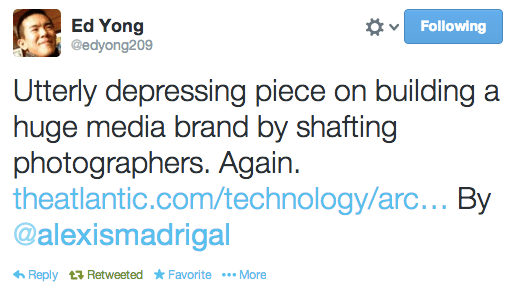
Screenshot 2014-01-24 11.43.27

Ed Yong’s comment on Alexis Madrigal’s article at The Atlantic is spot-on.

Can you spot the fundamental flaw in the logic of self-justifying logic of the owners of @HistoryInPics*?

“Photographers are welcome to file a complaint with Twitter, as long as they provide proof. Twitter contacts me and I’d be happy to remove it,” he [Xavier Di Petta] said. “I’m sure the majority of photographers would be glad to have their work seen by the massives.”
-from “The 2 Teenagers Who Run the Wildly Popular Twitter Feed @HistoryInPics” by Alexis Madrigal

If you don’t tell people who took the pictures, how do the photographers benefit from having their work seen by the “massives”? Sure, having one’s work make an impact is a reward unto itself, but it doesn’t pay the bills.

When our artists can’t pay their bills, we get less art. Or as the internet would say,  “This is why we can’t have nice things.”

*In general, I avoid linking to folks that are making their bank on the backs of uncredited artists.