These controversies have their uses…

May those who love us love us.
And those that don’t love us,
May God turn their hearts.
And if He doesn’t turn their hearts,
May he provide an online discussion of sexism in science,
So we’ll know them by their commenting.

Adaptation of a traditional Irish curse inspired by ridiculous attempts to dismiss the unsavory bits of Richard Feynman’s life as either irrelevant or “worth it”.

Originally appeared as a pair of tweets here & here.

Feynman the Creepy Genius

Another tone-deaf post (now taken down)* related to women and science from Scientific American Blogs sparked a great disturbance in our little corner of the internet around the question of whether or not we should care that Richard Feynman was both a genius and really creepy. Our friend, Matthew Francis has an excellent, thoughtful reply to this discussion.

He starts with a particularly important point about the perils of creating a moral equivalence between personality quirks and serious character flaws in our heroes:

Very few heroes can survive scrutiny unscathed. They all have flaws, by virtue of being human. However, hero-worship blurs those flaws,  leveling them: truly nasty aspects of a person’s personality or behavior become on par with little quirks and eccentricities. In that way, we justify our worship.
Dr. Matthew Francis

Another friend, Janet Stemwedel has an excellent post** on the ethics of evaluating our heroes as individual components, the sum of their parts, or something in between, which should inform all our thinking on individuals like Feynman, or anyone else you think is a great [insert profession], but kind of a dick.

Before you remind me that I should be grateful that individuals of such staggering genius with intellects that cast mine in deep shadow have walked among us, I will remind you that it is a virtual certainty that for every Feynman or Einstein, there are several individuals with greater creativity and intellect who have lived under less fortunate circumstances and who we would be praising today but for the fact that they were not given the same opportunities.

Unfortunately, the comments have been predictably disappointing. I used this as an opportunity to make good on the positive commenting pledge I made with Eva Amsen. Maybe you should try it too?

*I have some thoughts on the editorial & perception difficulties of being Scientific American Blogs as currently structured.

**Hat tip to Matthew Francis.

Editorial Expectations

The views expressed are those of the author and are not necessarily those of Scientific American.
Scientific American Blogs Disclaimer

There is no requirement that what you say you are and what your audience expects you to be will be the same thing. It is very hard, however, to tell your audience that their expectations and reactions are “wrong”.

Scientific American finds itself in this position once again thanks to another tone-deaf post on the Curious Wavefunction blog on the Scientific American Blogs network. Scientific American makes the disclaimer that the content of individual blogs on the blog network does not represent Scientific American.

No matter what they say, people are naturally going to assume that something published under the Scientific American branding will represent Scientific American quality and values.  Continue reading “Editorial Expectations”

Science for The People: The V Word

sftpThis week, Science for The People looking at the social and biological science of female sex organs. They talk to Dr. Anthony Atala, director of the Wake Forest Baptist Medical Center Institute for Regenerative Medicine, about the creation and use of lab-grown vaginas. Biology professor Marie Herberstein exposes the bias against female genitalia in scientific studies. And science writer Emily Anthes tells them about the history and promising future of female condoms.

I’m Old(er)

Today is my birthday.

Thank you.

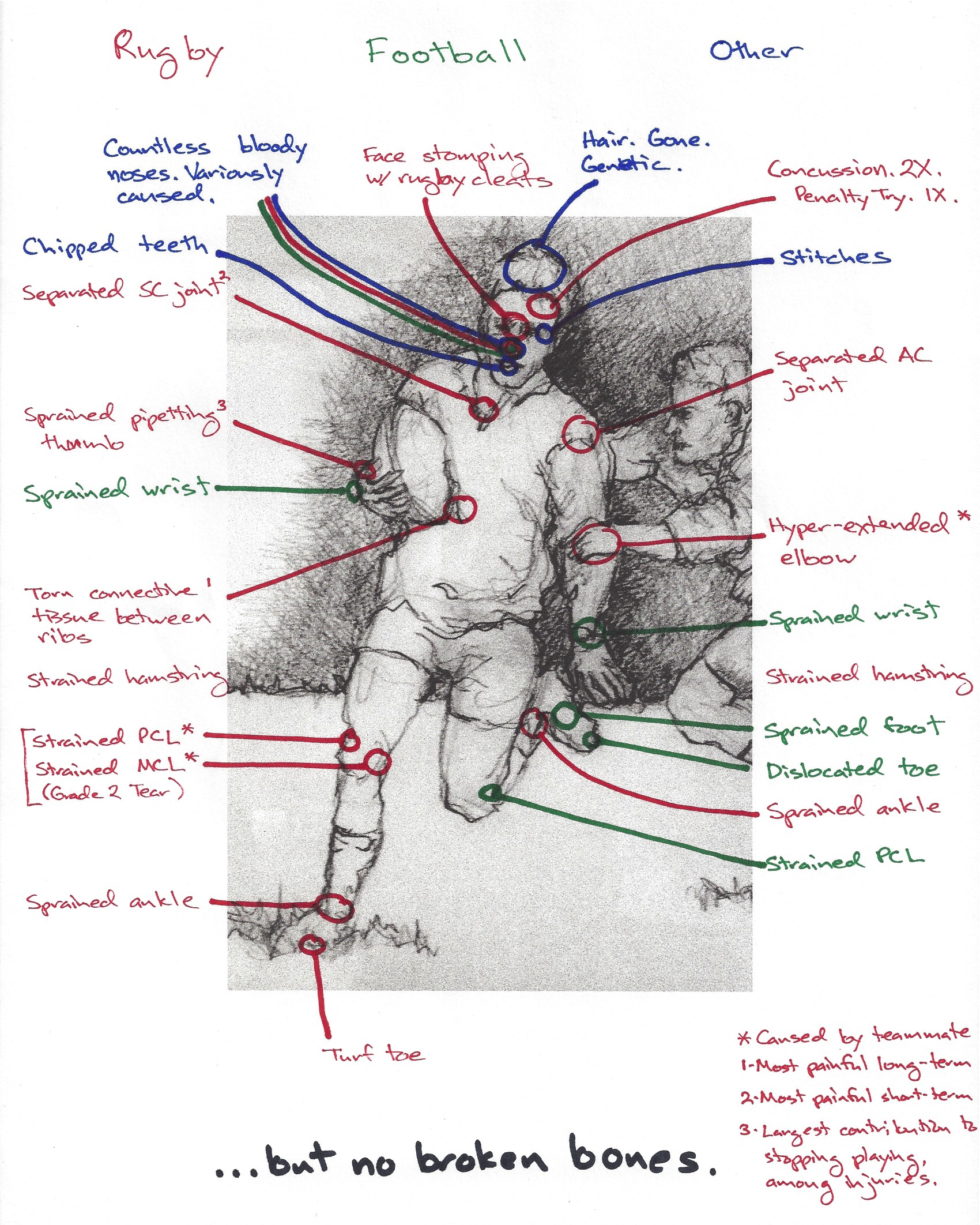
On average, I’m not old, but there is significant variance across my body. Certain joints etc. have accrued a bit more mileage over the years. To celebrate my birthday, I’ve created an illustrated annotation of all the significant injuries I’ve suffered over a variety of activities (color coded for the most major contributors).

Original drawing by Susan Witten (Used with Permission)

The underlying drawing is a badly modified version (to make up for bad photography) of a pencil drawing of me playing rugby that my mother gave me as a college graduation gift.

You can hear me tell a story about the “face stomping” incident here.