Zombie Cabbage!

Image courtesy of Wikipedia

Fly rooms – the place where fruit fly researchers search for virgins and freaks – around the United States have two things in common: fruit flies and NPR. Thus, I heard the craziest science segment I’ve heard in a long time. You know those cabbages at the grocery store? Those heads of cabbage that always seem to always make way too much coleslaw? Even though they’ve been harvested, shipped and chucked onto the sprinkling grocery shelf, they’re aliiiiiive. Continue reading “Zombie Cabbage!”

Sunday Science Poem: Emily Dickinson and the Experiment of Consciousness

Emily Dickinson’s # 822
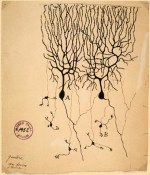
PurkinjeCellHow much consciousness is necessary for experience? Does a lobster or E. coli have experience, or does experience exist only with more awareness, awareness not just of the environment, the direction of a food source or a competitor for a mate, but awareness of self, of the passage of time, of the past, and of the alternative possibilities of the future?

In # 822, Emily Dickinson describes experience as an experiment in consciousness. Each of us, as a consciousness, is aware of environment (‘the Sun’), our fellow species members (‘Neighbors’). We share this basic level of awareness with much of the living world. A much rarer awareness, probably existing only in some vertebrates, is self-awareness (‘itself’ is used five times in this poem of 67 words), and awareness of death.

Beyond self-awareness, we have a capability for mental experimentation that is only possible with language, and is thus probably unique among organisms. Here is how Daniel Dennett illustrates this capacity: Continue reading “Sunday Science Poem: Emily Dickinson and the Experiment of Consciousness”

Finding function in the genome part 2: All function is local (almost)

Yesterday I wrote about why negative controls are important in a genome-scale search for functional DNA. Today, I’ll discuss the main focus of our recent work: understanding what makes a piece of DNA functional.

The particular DNA I’m interested in is known by not very functional term ‘cis-regulatory’ DNA – a term that requires six syllables, an italicized Latin prefix, and a hyphen. This is DNA that is crucial in gene decisions: cis-regulatory DNA helps to control when, where, and how much genes are expressed. This happens because cis-regulatory DNA serves as a landing pad for ‘transcription factors’, proteins that land on cis-regulatory DNA and control the expression of nearby (or sometimes not so nearby) genes.

The question that haunts me is this: why don’t transcription factors get lost? My worry follows from these three observations: Continue reading “Finding function in the genome part 2: All function is local (almost)”

Finding function in the genome with a null hypothesis

Last September, there was a wee bit of a media frenzy over the Phase 2 ENCODE publications. The big story was supposed to be that ‘junk DNA is debunked’ – ENCODE had allegedly shown that instead of being filled with genetic garbage, our genomes are stuffed to the rafters with functional DNA. In the backlash against this storyline, many of us pointed out that the problem with this claim is that it conflates biochemical and organismal definitions of function: ENCODE measured biochemical activities across the human genome, but those biochemical activities are not by themselves strong proof that any particular piece of DNA actually does something useful for us.

The claim that ENCODE results disprove junk DNA is wrong because, as I argued back in the fall, something crucial is missing: a null hypothesis. Without a null hypothesis, how do you know whether to be surprised that ENCODE found biochemical activities over most of the genome? What do you really expect non-functional DNA to look like?

In our paper in this week’s PNAS, we take a stab at answering this question with one of the largest sets of randomly generated DNA sequences ever included in an experimental test of function. Continue reading “Finding function in the genome with a null hypothesis”

Sunday Science Poem: We live in the casts of our imaginations

Wallace Stevens’ ‘Description Without Place’

779px-William_Blake_-_Isaac_Newton_-_WGA02217Science works by making models of the world. We need models, because the data rarely speak for themselves.

As individuals, we also work by making mental models of of the world, both at the automatic, neurobiological level where the brain assembles representations of the world from the neural impulses transmitted by our sensory organs, and at the conscious, conceptual level, the level where we consciously try, with limited information, to decide what’s going on in the world around us. Models mediate between us and reality.

Continue reading “Sunday Science Poem: We live in the casts of our imaginations”