
Evolution and Gene Regulation in Chicago

Happening at the U of Chicago today is the ASBMB meeting “Evolution and Core Processes in Gene Regulation”. The attendees here are an eclectic mix of evolutionary geneticists, systems biologists, developmental biologists, and hard core biochemists. So far the result has been fascinating, as Ian Dworkin over at Genes Gone Wild tells us.

Follow the meeting over at #genereg, where Ian has done a great job summarizing the talks in real time.

I’ll try to chime in occasionally during today’s talks (@genologos) and put up some more in depth thoughts on my favorite bits here.
Academics on the Internets

Via Scott Esposito, I read David Parry on why academics should write more for the general public:

Meanwhile, the general public perceives faculty members as isolated from reality, holding cushy jobs, and uninterested in open communication. The public has little access to the broad diversity of knowledge, experience, and background inside higher education, because those academics who do achieve broader platforms generally come from only the most elite universities. Although many of those public intellectuals are brilliant writers and speakers, they represent only a tiny percentage of the expertise available in the academic world.

This raises the question of what academics have to offer large online media outlets that is different from what excellent professional journalists offer. My first thought is sheer number: there aren’t enough excellent professional journalists who can write competently on certain specialized topics (e.g., we have a lot of great political and sports journalists writing even for smaller outlets, but fewer great science journalists); academics can help fight the good fight and take good opportunities that come their way. Continue reading “Academics on the Internets”

Sunday Science Poem: Emily Dickinson and the Experiment of Consciousness

Emily Dickinson’s # 822

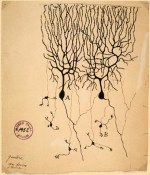
PurkinjeCellHow much consciousness is necessary for experience? Does a lobster or E. coli have experience, or does experience exist only with more awareness, awareness not just of the environment, the direction of a food source or a competitor for a mate, but awareness of self, of the passage of time, of the past, and of the alternative possibilities of the future?

In # 822, Emily Dickinson describes experience as an experiment in consciousness. Each of us, as a consciousness, is aware of environment (‘the Sun’), our fellow species members (‘Neighbors’). We share this basic level of awareness with much of the living world. A much rarer awareness, probably existing only in some vertebrates, is self-awareness (‘itself’ is used five times in this poem of 67 words), and awareness of death.

Beyond self-awareness, we have a capability for mental experimentation that is only possible with language, and is thus probably unique among organisms. Here is how Daniel Dennett illustrates this capacity: Continue reading “Sunday Science Poem: Emily Dickinson and the Experiment of Consciousness”

Online journals have not made publication dates irrelevant…

So why is it so hard to find the pub date in the HTML view of PLoS papers? The date needs immediately visible to be somewhere in this space:

PLOSGen

BTW, this is not my paper – it’s by the other, much more productive Michael A. White in whose shadow I’ve lived for years. I’ve never met him, but I have received his mail at one point.

Finding function in the genome part 2: All function is local (almost)

Yesterday I wrote about why negative controls are important in a genome-scale search for functional DNA. Today, I’ll discuss the main focus of our recent work: understanding what makes a piece of DNA functional.

The particular DNA I’m interested in is known by not very functional term ‘cis-regulatory’ DNA – a term that requires six syllables, an italicized Latin prefix, and a hyphen. This is DNA that is crucial in gene decisions: cis-regulatory DNA helps to control when, where, and how much genes are expressed. This happens because cis-regulatory DNA serves as a landing pad for ‘transcription factors’, proteins that land on cis-regulatory DNA and control the expression of nearby (or sometimes not so nearby) genes.

The question that haunts me is this: why don’t transcription factors get lost? My worry follows from these three observations: Continue reading “Finding function in the genome part 2: All function is local (almost)”