The Art of Science: Summer of SciArt

from Modular Systems (2012) by Laura Splan, on display at SciArt Center

As art inspired by science gains in popularity, new spaces are springing up to showcase it. Europe had a head start, with London’s GV Art and Dublin’s Science Gallery, but now the US is catching up, with the opening of the Art.Science.Gallery in Austin, Texas, last year and SciArt Center in New York City this week.

For its inaugural exhibition, opening on Friday, June 20, SciArt Center has chosen the theme “What Lies Beneath,” as interpreted by artists Daniel Hill, Steve Miller, Jonathon Wells, Laura Splan, Jim Toia, and Jonathan Feldschuh. The exhibition runs through July 5 at the new gallery space on the Lower East Side.

Art.Science.Gallery currently has a group show called “Year of the Salamander” on display through June 21, featuring salamander-inspired artwork by a number of artists including Ele Willoughby, featured here before.  Upcoming events include the Tesla Project on July 5, a day-long celebration of everyone’s favorite eccentric genius.

In Washington, DC, the American Association for the Advancement of Science (AAAS) plays host to “Gedankenexperiment”, a show by 24 members of the Washington Sculptors Group.  The work in the show, which runs from June 16 through August 22, is inspired by scientific and mathematical theories, hypotheses, and principles from Archimedes, I Ching, geology, geometry, architecture, and others.  An opening reception and artist talk will be held on Friday, June 20, from 6-9 pm.


Science Caturday: GOOOOOOOAAAALLLL

soccer

The World Cup kicked off in Brazil this week, promising lots of excitement and drama for sports fans. For science lovers? Well, I found a pretty darn interesting article by Rose Eveleth about how design innovations make this year’s special World Cup ball perform better than its predecessors.

She also wrote this great, slightly scary piece about how many people will get dengue fever, a mosquito-borne illness common in Brazil.  The tournament just started, but Rose Eveleth is looking like a favorite to take the World Cup science-writing crown. You can follow her on twitter here.


The Art of Science: Karen Russell’s Bad Plant Romance

badgraft
Photo by Michael Marcelle for The New Yorker

My art of science posts usually focus on visual art, but this week I stumbled upon a beautiful example of a much rarer species – a short story thoroughly saturated with science. “The Bad Graft”, a story by Karen Russell in this week’s New Yorker, tells the story of a sort of love triangle between a man, a woman and a plant. Russell, best known for her novel Swamplandia, knows her way around exotic flora.

This story is set in the Mojave Desert, where a young couple, Angie and Andy, have come to visit Joshua Tree National Park. The Joshua tree, aka Yucca brevifolia, is a tough, twisted plant with painfully spiky leaves. Angie and Andy happen to arrive in the park during what a ranger calls “a pulse event” during which yucca moths pollinate the trees. “You think you’re in love? The moths are smitten. In all my years, I’ve seen nothing to rival it. It’s a goddam orgy in the canyon.”

The ranger goes on to describe the obligate relationship between the moths and the Joshua trees, each species entirely dependent on the other. He explains that the trees may be on the brink of extinction, and that the current “orgy” may be the ancient species’ “Hail Mary pass” or last shot at survival.

The trees may be prepared to go even further. The “Bad Graft” of the title occurs soon after the couple’s meeting with the ranger. Russell describes it in prose that suggests an earthquake or a war: “The yucca moths arrive like living winds, swirling through Black Rock Canyon. Blossoms detonate. Pollen heaves up. Then the Joshua tree sheds a fantastic sum of itself.”  Angie pricks her finger on one of the plant’s spines “and becomes an entire new creature.”

I won’t spoil the rest of the plot. I’ll only say that Russell has given serious thought to what it would be like to have a hardy desert plant take over the core of your being. She also thoroughly explores the metaphorical aspects of convergent evolution, obligate relationships and the idea of rootedness in both people and plants.

You can read “The Bad Graft” here – it’s subscriber-only, but you can get a free month’s trial that will unlock this little treasure.


Science Caturday: Hurricane? More like an internet ****storm

hurricanekitteh

Squabbles broke out online this week over a report that female-named hurricanes have historically killed more people than male-named ones. The intrepid Ed Yong dove into the research behind the headlines on his Not Exactly Rocket Science blog, and, uh…people reacted. Commenters commented. Twitterati tweeted. Clearly, this called for a lolcat.


Science Caturday: Kitteh Science Week in Review

scilolmap

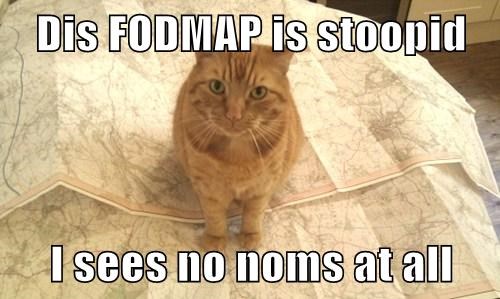
Our hoomin scicomm friends killed it on the interwebs this week, so all we needed to do was line up a few science kittehs to illustrate their great stories. First up, Bethany Brookshire (@scicurious) in ScienceNews explains the science behind gluten sensitivity, including the meaning of FODMAPS, which are, alas, some kind of carbohydrate and not maps to the fud.

quantumkitteh

Next, Matthew Francis (@DrMRFrancis) explains in Slate why quantum mechanics does NOT explain human consciousness. He can also explain why different kittehs spin in different directions, which may be more useful.

faceplantcat

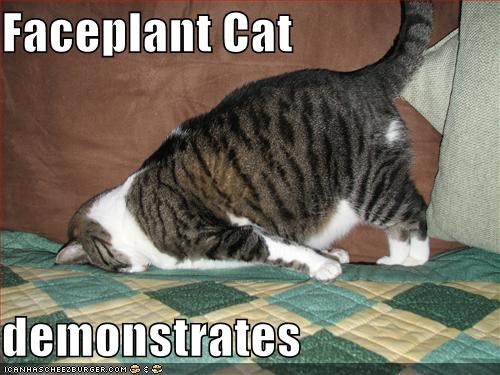
Finally, over at BoingBoing, Maggie Koerth-Baker (@maggiekb1) delivers a masterful explainer (with gifs!) on the science of faceplanting. If I have a tiny quibble with this piece, it’s that kittehs generally look upon faceplanting as more of an art.

All lolcats via Cheezburger.com