The Art of Science: Scenes from the Deep, Distant Past

Alison Carey, Ordovician Period, 440-500 Mya, 2005

Alison Carey’s photographs of “Organic Remains of a Former World” are among the standouts of the current show at the National Academies of Science, Imagining Deep Time.  Carey uses a mix of sculpture, installation and photography to conjure up visions of ancient marine environments from each of the seven periods in the Paleozoic era.

To call these pieces small, murky and brownish would be accurate, but would barely hint at their evocative power and beauty.  Carey uses scientific data about the different periods and consults illustrations of their flora and fauna. The artist says that she was searching for uncharted territories in an era where little of the globe remains unexplored.

“In my search for a location that has not been photographed, I look to the Earth’s ancient past, a world that existed millions of years ago. I am drawn to this space because it is absent from human recollection and experience. Through my photographs, I offer the viewer a glimpse into a primitive landscape that has since been eroded or erased.”

Carey sculpts her creatures and rock formations out of clay, fires them and then submerges them  in the water of multiple 55-gallon aquariums. She then photographs them in her studio using a large format view camera, and prints them as contemporary ambrotypes using 9 x 23” black glass that she hand-coats with silver gelatin emulsion.

She adds that “the organic nature of this process adds to the rendition of these watery scenes by the serendipitous appearance of bubbles, streaks and obliterated areas of darkness.”

If you can’t make it to Imagining Deep Time (on view at the NAS in Washington, DC until January 15, 2015), you can see more of Alison Carey’s work at her website.



Science Caturday: Time Kitteh is Deep

timecat

Imagining Deep Time, an art exhibition at the National Academy of Sciences in Washington, DC, tackles the profound theme of “deep time,” the timescale not of human life but of trees, rivers, mountain ranges, even stars.  The exhibition features works by 15 artists in a range of styles and media including painting, photography and sculpture. Curator JD Talasek says that the exhibition “explores the role of the artist in helping us imagine a concept outside the realm of human experience.”

The show runs until January 15. More information, including a downloadable catalog, is here.


The Art of Science: Pollination as Inspiration

Pollen Grains, Jo Golesworthy

To many people, pollen is a nuisance, coating cars and irritating nasal passages. For artists Jo Golesworthy and Wolfgang Laib, pollen is an inspiration.

Pollen grains are the tiny cases holding the male reproductive cells (gametophytes) of flowering plants. The grains come in a variety of shapes and sizes and have a wide range of surface markings and textures, making them useful for plant identification in fields such as paleoecology, paleontology, archeology, and forensics.

This variety marks the sculptures of Jo Golesworthy, a UK-based artist who creates massively scaled-up versions of many types of pollen from alder and birch to pussy willow and poppy. Her pieces, made by hand from a limestone compound, can be displayed outdoors, where the artist says they will “slowly grow a botanic patina of their own.”

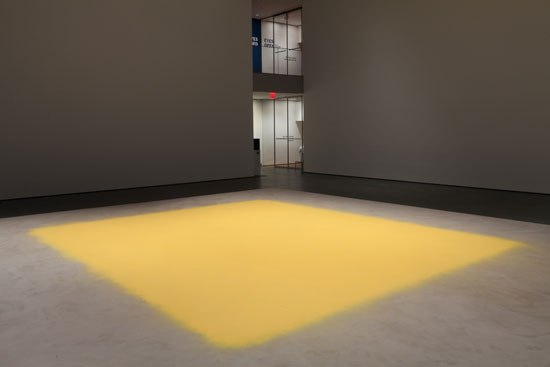
Wofgang Laib, Pollen from Hazelnut, 2013

German artist Wolfgang Laib creates his works out of real pollen, meticulously arranging it in lines, grids, mounds, or – for his largest work – a glowing golden carpet.  Laib’s spectacular 2013 installation, Pollen from Hazelnut, an 18 x 21 foot rectangle of pollen sifted onto the floor of New York’s Museum of Modern Art, required more than a decade’s worth of pollen that the artist himself collected from around his hometown. Laib says that his work, although almost entirely based on nature, refers to many other things, including devotional practices and ancient art.

But essentially, it’s all about the pollen.  As Laib told MoMA, “pollen is the potential beginning of the life of the plant. It is as simple, as beautiful, and as complex as this. And of course it has so many meanings. I think everybody who lives knows that pollen is important.”

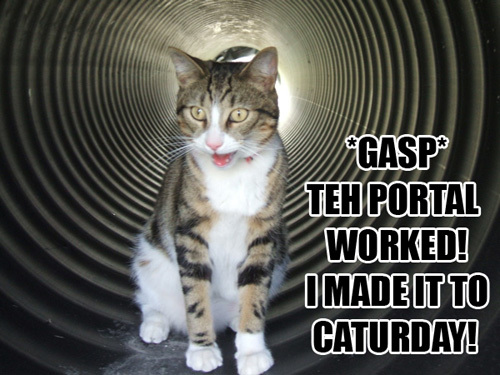
Science Caturday: Made it!

It was a long week, wasn’t it, kittens? But we made it through.

portal

The Art of Science: Voyage Redux, with bonus!

Michele Banks, Micro/Macro 3, Ink on Mylar,  2013
Michele Banks, Micro/Macro 3, Ink on Mylar, 2013

Voyage of Discovery, an art exhibition I created together with Jessica Beels and Ellyn Weiss, will reopen on Thursday for a two-month run at the McLean Project for the Arts in McLean, VA.

The artwork in Voyage of Discovery has its roots in the idea of a journey of scientific exploration, in the tradition of Darwin, Wallace, and the thousands of scientists who constantly travel the globe in search of new findings. This imaginary voyage takes viewers to a polar region where the iconic, seemingly eternal, landscape of ice and snow is in profound and rapid transition due to climate change.

The pieces in the show – ranging from ink paintings to wire and paper and wax sculptures to a massive 30 foot fabric installation – reflect our artistic responses to the transformation of land and sea as the planet warms. The show looks at many aspects of climate change – not only the obvious, like the melting of glaciers and the thawing of permafrost, but also more subtle effects, like the movement of previously unknown species and microbes into the Arctic and the dramatic shift of the color of the land from white to green to black.

Voyage of Discovery, which ran for 5 months at the American Association for the Advancement of Science earlier this year, will open with a reception and gallery talk this Thursday, from 7-9 pm, at the McLean Project for the Arts’ Emerson Gallery, at 1234 Ingleside Avenue in McLean. (details here)

As a special bonus for science fans, the reception takes place on the same day that renowned science writers Carl Zimmer and Sam Kean are speaking in the same building as part of “Fall for the Book”. Their talk starts at 7:30.  So if you arrive at 7, you can take in the art, have a glass of wine, and then go downstairs and hear more about some fascinating science. Win-win.