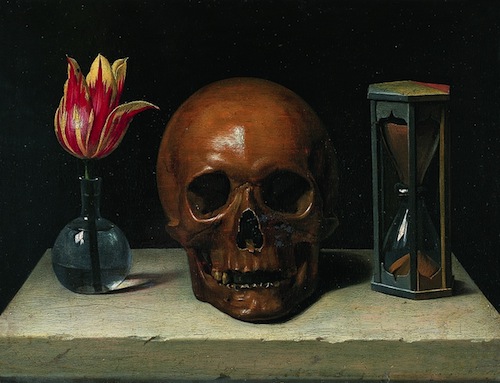
Lucretius and the fear of death

Yesterday’s discussion of Lucretius’ The Nature of Things only touched very briefly on two of the many fascinating ideas of Books I and II. As a supplement to yesterday’s discussion, below is a bit more from the passage in Book I explaining why the fear of death is one of the Epicureans’ main targets, and why an understanding of the nature of things is supposed to aid us in living a life free of anxiety over death. This passage is taken from the Project Gutenberg translation by William Ellery Leonard:

And there shall come the time when even thou,
Forced by the soothsayer’s terror-tales, shalt seek
To break from us. Ah, many a dream even now
Can they concoct to rout thy plans of life,
And trouble all thy fortunes with base fears.
I own with reason: for, if men but knew
Some fixed end to ills, they would be strong
By some device unconquered to withstand
Religions and the menacings of seers.
But now nor skill nor instrument is theirs,
Since men must dread eternal pains in death. Continue reading “Lucretius and the fear of death”

Lucretius did not believe in non-overlapping magisteria

What does science have to do with how we should live? Not much, is often the official answer in our pluralist and technocratic society. We depend on science to be one of two non-overlapping magisteria, for the purpose of social harmony in a religiously diverse society that takes science as a dominating authority, at least in principle – even creationism or climate change denial needs to be couched in technological jargon for it to even pretend to be acceptable in discussion.

This attitude is the opposite of what we find in the Epicurean Lucretius, who wrote the world’s greatest science poem in the express belief that you can’t live life properly if you don’t understand the true nature of the universe. This idea is the key to making sense of what first struck me as an odd juxtaposition in two big features of Epicurean thought: the belief that life’s major goal is to maximize happiness, and the belief that the world emerges from the behavior of atoms. How are these two beliefs connected? The answer is death. Continue reading “Lucretius did not believe in non-overlapping magisteria”

Sunday Science Poem: Why You Should Read Lucretius

We’re bringing the Sunday Poem out of hiatus and will hopefully, with some publisher cooperation, feature some remarkable poetry by contemporary poets who work with science metaphors.

However, before we return to present day poetry, let’s go back two thousand years and tackle the greatest of all science poems: Lucretius’ The Nature of Things.

Why should you read Lucretius? His poem is one of the great works of classical Latin poetry, one which influenced many subsequent Roman poets, notably Virgil. It has the added benefit of laying out Lucretius’ remarkable thinking about the invisible workings of nature. Reading this poem, you inhabit the ancient mind of a sharp observer who was trying to make sense of the macroscopic world by theorizing about motions of the microscopic one.

Lucretius was conscious of the requirements of good science writing. He was explicitly an advocate of the Mary Poppins method of helping the medicine go down with a spoon full of sugar. Lucretius packed his poem with illuminating metaphors and, like Darwin, was capable of making striking observations of everyday phenomena that most of us would take for granted. He used these observations to make inferences about the world we can’t see. As an advocate of the teachings of Epicurus, Lurcetius connects his observations and inferences to crucial ideas about how we should live our lives and think about ourselves.

The Classical scholar Richard Jenkyns makes this argument for reading Lucretius:

Of all the great poems of Europe – and it is indeed among the greatest – Lucretius’ De Rerum Natura (The Nature of Things) is perhaps the most improbable. Here is a poem without people in it, without any story; instead it offers a treatise on science and philosophy. The philosophy, moreover, is a strict materialism, which denies the existence of anything magical, mysterious, or transcendent. It does not sound like promising matter for poetry at all, let alone for a work of more than 7,000 line. Yet the result is a masterpiece. A key to appreciating this most unlikely success is to understand the nature of Lucretius’ beliefs and the circumstances in which he decided to expound them.

– Introduction to the 2007 Penguin edition, vii

Continue reading “Sunday Science Poem: Why You Should Read Lucretius”

Sunday Science Poem: Chicago and the tensions of technological progress

I just got back from a weekend in Chicago, where, among other things, I stood on a three-inch thick glass ledge, suspended a quarter of a mile above Chicago’s streets. The Sears Tower* is a symbol of the optimistic view of technological progress that was still common in the mid-20th century – an era of outsized, iconic engineering projects. Chicago’s history reflects both this optimistic view, and more ambivalent attitudes towards technology and cities, captured in today’s Sunday Poem, Carl Sandburg’s 1904 “Chicago”.

To introduce this poem, I’ll pass the mic to William Cronon, who writes of what Chicago meant to the development of the American West:

“My contention is that no city played a more important role in shaping the landscape and economy of the midcontinent during the second half of the nineteenth century than Chicago… During the second half of the nineteenth century, the American landscape was transformed in ways that anticipated many of the environmental problems we face today: large-scale deforestation, threats of species extinction, unsustainable exploitation of natural resources, widespread destruction of habitat. It was during this period as well that much of the world we Americans now inhabit was created: the great cities that house so many of us, the remarkably fertile farmlands that feed us, the transportation linkages that tie our nation together, the market institutions that help define our relationships to each other, and the natural world that is our larger home.”1

Continue reading “Sunday Science Poem: Chicago and the tensions of technological progress”

Sunday Science Poem: Reality and The Snow Man

For this week’s poem, we’re coming back to Wallace Stevens, with one his most famous poems, “The Snow Man”. If you’ve read any Wallace Stevens, it’s probably this early poem.

John Serio writes that Stevens’ “most distinctive achievement” is this:

In an age of disbelief or, what might be worse, one of indifference to questions of belief, Stevens adds a metaphysical dimension. In doing so, he does not imply anything religious, yet goes beyond humanism. “The chief defect of humanism,” he writes, “is that it concerns human beings. Between humanism and something else, it might be possible to create an acceptable fiction.”… Poetry is supreme because it shifts our orientation from a traditional subject of belief, such as God, to its source – the creative, ever changing, infinitely renewable process of constructing a credible truth.1

The “renewable process of constructing a credible truth” sounds much like Thomas Kuhn’s description of the scientific process. Much of Stevens’ poetry tackles questions about how we construct our mental representations of reality. Continue reading “Sunday Science Poem: Reality and The Snow Man”