Sunday Science Poem: Reproduction will beat Armageddon

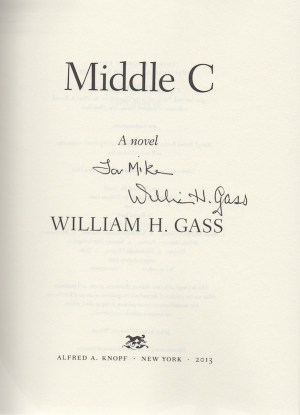
gassmiddlecLast Tuesday I made my way to Left Bank Books, a St. Louis favorite, to listen to William Gass read from his newest book, Middle C. As some readers may know, I am a fan, or maybe even a connoisseur of post-apocalyptic fiction; thus Gass really caught my attention when he read one of the most searing scenes of apocalypse survival I’ve ever encountered, something that makes most works in the post-apocalyptic genre seem exuberantly upbeat.

While this scene is not written as a poem, it is one long sentence written with the attention to cadence and sound that you expect of poetry, and so it qualifies for this week’s Sunday Poem. As for a possible science-related theme, aside from the association I see with my favorite subgenre of science fiction, this passage from Middle C describes the narrator’s speculation that the human species will somehow, despite losing Armageddon, squeak through with its fundamental biological drive to reproduce intact. Continue reading “Sunday Science Poem: Reproduction will beat Armageddon”

Sunday Science Poem: Big Dumb Objects, Arthur C. Clake, John Keats, and the Sublime

RamaThe purpose of the Big Dumb Object in science fiction is to cure us of our familiarity with the universe. We tend to forget that the universe is complex, vast, exotic, eerie, and downright mystifying. Our daily experiences with its odd phenomena constitute what is normal, and normal is, of course, that which we’re inclined to take for granted. Among the bizarre things we accept as normal are the spontaneous development of a child into an adult, our ability to perceive coherent images and sounds that reach us through a tangled mess of reflecting waves, that there “are mountains in Chile, and not a hill in La Plata,” and the fortunate fact that Jupiter hasn’t yet sent the Earth spinning out of the Solar System.

Big Dumb Objects are metaphors that regenerate the strangeness of the universe in order remind us that a strange universe is a necessary condition for the sublime experience of scientific discovery. Two writers who knew this well were Arthur C. Clarke and John Keats. Continue reading “Sunday Science Poem: Big Dumb Objects, Arthur C. Clake, John Keats, and the Sublime”

Lucretius: Lightning is not a means of divine communication

ThetriumphofdeathThe Nature of Things is an unfinished poem, but the sudden ending gives the finale an ironic twist: although a major purpose of the poem is to alleviate our fear of death, it ends in a fearsome, apocalyptic description of the plague that ravaged Athens during the Peloponnesian war.

Before that, Lucretius devotes much of the final book of his poem to a natural explanation for that perennial favorite signifier of the divine mood: the weather. Having spent the last few years in the U.S. Midwest, I’ve developed a fresh, first-hand appreciation for the destructive power of storms. (Given recent meteorological trends, it’s hard not to gain a first-hand appreciation of such destruction no matter where you live.) Before weather.com, radar images, and other tools that give us some predictive power, the violent and capricious nature of bad weather was perhaps easiest to understand as a means of communication between gods and humans.

Lucretius says that ascribing weather to gods is nonsense: Continue reading “Lucretius: Lightning is not a means of divine communication”

There is grandeur in Lucretius’ view of life

stilllifewithpeachesLast year as I was reading Darwin’s The Voyage of the Beagle, I was struck by how much that book foreshadowed the tremendous cultural force that modern science exerts on our understanding of nature:

“As you read the Voyage, and become absorbed its imagery its grand scope, it is easy to miss what is absent. Darwin, in all of his arguments, inferences, hypotheses, and narratives of natural history, quietly refuses to ever invoke God as an explanation. The geographical distribution of animals, the causes of extinctions, the composition of the rock on mountain ranges, the layout of the vast plains of the South American Pampas, are all explained exclusively in terms of natural processes…Darwin and his fellow scientists infer majestic stories of our origin and that of the world around us, stories that have now largely supplanted the competing stories of other major belief systems in our society.”

2,000 years ago, Lucretius was working at a similar project, except that his refusal to invoke divinity as an explanation was anything but quiet. In book V of The Nature of Things, “Cosmos and Civilization”, Lucretius presents a materialist creation story, which he specifically contrasts with a belief in creation by will of the gods: Continue reading “There is grandeur in Lucretius’ view of life”

Sunday Science Poem: The Epicurean theory of vision, plus bedwetting in ancient Rome

640px-Ercolano03For those of you looking for a break from the pre-game show, here’s this week’s reading of The Nature of Things.

Discard, for the moment, everything you know about vision – about light sources that emit photons of various frequencies, about photons that pass through or reflect from materials before impinging on the photoreceptor cells in your retina, stimulating your optic nerve, and generating an image in your brain. As we set aside our modern knowledge and begin from scratch to think about the surprisingly knotty problem of how visual images are faithfully transmitted and perceived across the distance between an object and our eyes, it’s not hard to understand why Lucretius’ Epicurean theory of vision is so convoluted and not very explanatory.

Lucretius didn’t know anything about scattered and reflected photons, but he deeply believed that the world could be explained by the action of particles. So his theory of vision in Book IV of The Nature of Things is based on objects emitting particles:

Let me begin
by saying there are images of things - a sort of skin
shed from the surfaces of objects, from the outer layer -
films that drift about this way and that upon the air…”
- Book IV, lines 29-32

Continue reading “Sunday Science Poem: The Epicurean theory of vision, plus bedwetting in ancient Rome”