Science Caturday: Kitty Cocktails

powdercat

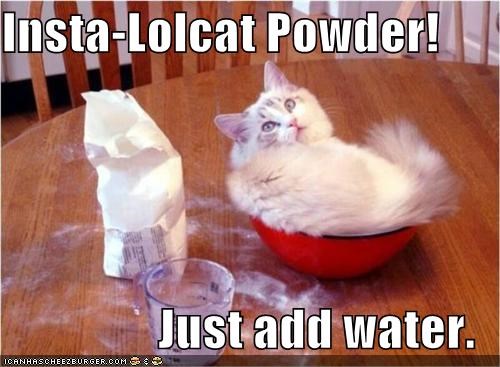
Boozy drinks that you can mix like instant lemonade? The internet was abuzz this week with reports that a company called Lipsmark had received US government approval to sell a form of “powdered alcohol” called Palcohol. Shortly after the company’s announcement, however, the Treasury Department’s  Alcohol and Tobacco Tax and Trade Bureau said that it was withdrawing its approval.

So while we can’t immediately try out a powdered mojito, we can do as the internet folk do, and talk about it. Apparently, the idea of powdered booze has been around for decades, and versions of it are already for sale in parts of Europe and Asia.

Larry Greenemeier at Scientific American talks about the concept and the chemistry with chemist and blogger See Arr Oh, who notes that the alcohol isn’t so much powdered as encapsulated in a form of sugar. Paul Adams at Popular Science provides instructions on making your own “fluffy” powdered booze. And everybody everywhere warns you not to snort it.

The Finch & Pea is a fairly traditional pub, so we’re planning to stick with liquid alcohol for the forseeable future. We’re more interested in the product shown above, which could allow people to take lolcats on plane trips or bike rides, or even send them through the mail. This exciting development could bring a whole new meaning to Chemistry Cat.
Science Caturday: Happy Easter

heisrisen

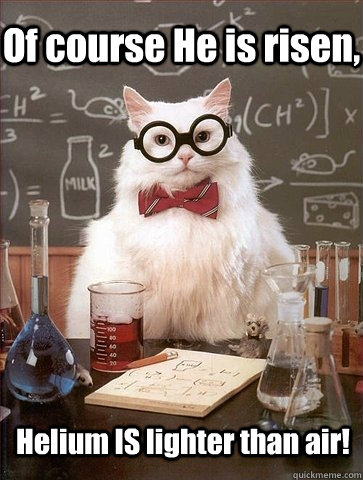
Image via quickmeme.com

Science Caturday: The Cat and the Fancy Fiddle

Invisible_Violin

This week’s mythbusting prize goes to researcher Claudia Fritz of the Sorbonne, who led two studies, both of which revealed that despite their mystique, antique “master” violins – even Stradivari – produce no better sound quality than modern instruments.

In a piece in National Geographic  Phenomena, Ed Yong walks readers through the stages of Fritz’s research, involving a number of different testing protocols, and her findings, which ultimately indicated that professional violinists found no difference in sound quality between old instruments and new.

Of course, our classically-trained kitty will tell you that her particular invisible violin sounds much better than that screeching monstrosity next door.

lolcat via Cheezburger.com


Science Caturday: Rocket Cats!

houston

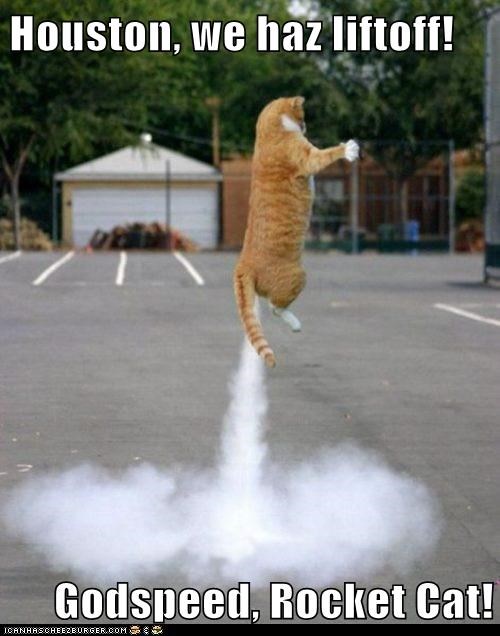
In the headlines this week: 16th century rocket cats. That’s right, experts recently revealed that a military manual dating from around 1530 imagined the use of cats and birds as weapons of war, with gunpowder-filled “jet packs” strapped to their backs to set fire to enemy castles or cities.

According to this article in The Guardian, the academics studying the manuscript believe that cats would be poor weapons. Given their preference for staying close to home and doing pretty much as they please, a gunpowder-toting kitty would be more likely to set fire to his master’s camp than to go near a strange castle.

However, the photo above, obtained from a top-sekrit source, indicates that some testing of rocket cats may have been carried on long after castle walls fell, and may indeed be going on to this day.

Image via cheezburger.com

Science Caturday: How to Lolcat

mu

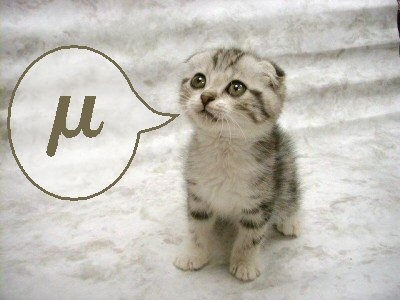
Yesterday at the ScienceOnline conference, we had a great conversation led by Tara Haelle about the importance of images in science communication. Alas, the subject of lolcats did not arise, so I will address it here. Lolcats are, in fact, the key to all successful science communication. The effective deployment of lolcats is a secret scicomm weapon of mass destruction, by means of cuteness-induced head explosions (See Fig. 1 above. Boom.)

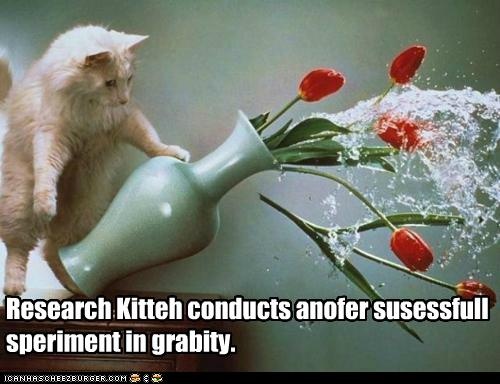
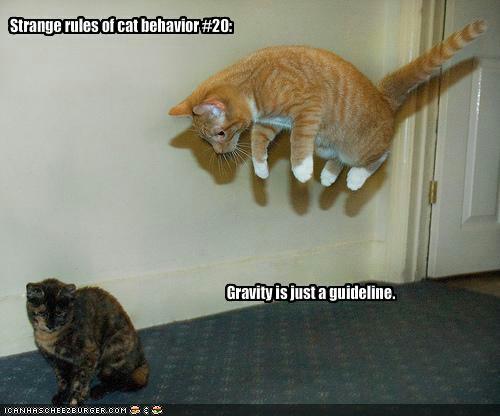
Science communicators should exercise caution when using lolcats to illustrate scientific concepts, however, because it turns out that cats are exempt from certain laws of science.

Fig. 2. Effective use of lolcat to illustrate gravity

grabbity

Fig. 3. Oops.

Gravity-Is-Just-A-Guideline