Back in May, Ben Lillie made the suggestion,in the context of the ongoing debate about telescope construction on the sacred volcanic peak of Mauna Kea, that we set aside time from 8:15AM on 6 August to 11:02AM on 9 August to reflect on the dark history that can underlie scientific advancement. These dates and times recall the 70th anniversaries of the nuclear strikes on Hiroshima and Nagasaki. As Ben wrote in his Slate article:
So here is my thought. What if we took a few days each year to reflect on the dark parts of our history, on the terrible things that were done, and are still done, that benefit our science? What if we took this time to read and talk with the people who know of these things? (They are many.) What if we took this time to ask what harm we have done, what we can do to correct it, and what we can do to make sure it never happens again? We constantly reflect on and try to minimize the errors in our data; we should do the same in ourselves.
I think the most significant time to do this, the time when it is clearest that evil was done, is from 8:15 a.m. on August 6 to 11:02 a.m. on August 9, the times when Little Boy and Fat Man were dropped on Hiroshima and Nagasaki.
Let us call this time the Days of the Enola Gay, after the aircraft—named for a loving mother—that flew the fruits of our joyous and universal science to the mass destruction of humanity.
–Ben Lille in Slate
 We decided then to add the Days of the Enola Gay to The Finch & Pea‘s calendar of special days. This is us starting to remember that commitment. A fitting start to the Days of the Enola Gay would be to listen to Science for the People’s recent episode on research ethics. Not only does it discuss the lengthy history of ethical missteps in the name of scientific advancement, but it talks about how we can learn from that past and do better.
We here at The Finch & Pea live by the idea that a scientific approach to life makes things more interesting, but are often forced to reckon with the reality that the application and conduct of science has not always made the world a better place – in the hope by doing so we can make it a better place.


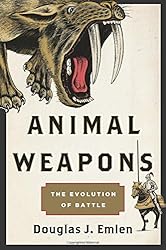 This week, Science for the People is talking about weapons: both the ones that evolve in nature, and those created by humanity. We’ll talk about the arms races that spur the development of horns and claws, warships and nuclear weapons, with Doug Emlen, Professor in the Division of Biological Sciences at the University of Montana, and author of Animal Weapons: The Evolution of Battle.

 The Finch and Pea