
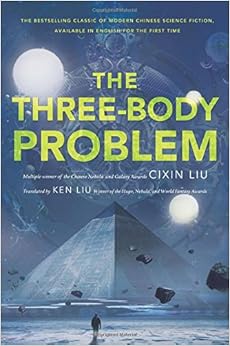
Cixin Liu’s The Three-Body Problem, tr. Ken Liu
Back in the middle of the 20th century, during the height of the Cold War, Soviet science fiction was an exotic commodity. As Judith Merril wrote about her 1966 anthology of Soviet SF:
[This anthology] contains some startling insights into the philosophical premises of the contemporary imaginative outlook in the U.S.S.R. And it provides a rather shocking reminder of how uneven the exchange has been so far.
 For nearly a century, the center of gravity for science fiction has been the U.S and the U.K. But there is much in “the rest of the world” (as one anthology somewhat condescendingly puts it) that English fans never get a chance to read. More than fifty years after Merrils’ anthology, the exchange between U.S and foreign science fiction readers is still uneven, with very little foreign SF being translated. Some of the great works of the Strugatsky brothers remain in print in the U.S. And Stanisław Lem is still the great exception; nearly all of his works are available in English. But by and large non-English science fiction doesn’t really exist for American readers. Continue reading “The next new wave of science fiction will be Chinese”
 Post-apocalyptic worlds are always haunted. The empty ruins of great cities, the artifacts of lost technologies, the mouldering books, and the memories of the vanished civilization make it clear that the survivors are now living in the world of the dead. In George Long’s Valhalla, the haunting is literal: the world is now one great hall of the dead, with a billion spirits ready to lend their ghostly hands to help the survivors build a better future. While it’s stiffly written and poorly plotted, this short book is nevertheless an interesting artifact from that optimistic time before the First World War. As he describes a new civilization rebuilt under the guidance of the dead from the last one, Long suggests that the root of human dysfunction is simple: jealousy of love and power. Without jealousy, there would be no serious conflict and people will get along just fine.
 The Book of Revelation isn’t the only part of the Bible that inspires post-apocalyptic fiction — Genesis plays a big part too. The Bible’s story about the beginning of the world has become a popular way to think about the world’s end. Adam and Eve, a paradisiacal Eden, and humanity’s fall get transformed into a last couple, a post-apocalyptic haven, and the forbidden fruit of some unexplored territory or lethal knowledge. What could be called the
 The Finch and Pea