Letter and drawing from Mary Anning announcing the discovery of a fossil animal now known as Plesiosaurus dolichodeirus, 26 December 1823 (Public Domain)
Mary Anning described the discovery of a plesiosaur to the world in a letter from 26 December 1823. You were probably hungover.
*For the unfamiliar, Boxing Day is the day after Christmas.
Komodo Dragon at the St. Louis Zoo (Photo by Poppet Maulding; CC BY 2.0)
My soft spot for Varanus komodoensis is almost entirely due to the Matthew Broderick classic film, The Freshman. It was reinforced by a moment I had with a Komodo dragon at the St. Louis Zoo. Granted, the dragon was clearly making a threat display because it felt I was trying to encroach on its heat lamp territory. While the dragon was not correctly interpreting my intentions, there was something very compelling about having the attention, one-on-one with such a creature.
My affection for the lizards has not been dampened by Ed Yong revealing that the bite of the Komodo dragon is truly venomous (they essentially inject you with blood thinners and anti-coagulants, the bastards), not toxic from septic bacteria as has been assumed for the past 50 years or so.
In 2009, Fry discovered the true culprit behind the dragon’s lethal bite, by putting one of them in a medical scanner. The dragon has venom glands, which are loaded with toxins that lower blood pressure, cause massive bleeding, prevent clotting and induce shock. Rather than using bacteria as venom, the dragons use, well, venom as venom. -Ed Yong, “The Myth of the Komodo Dragon’s Dirty Mouth”, Not Exactly Rocket Science
Why do Komodo dragons still capture my imagination? Look, giant lizards with toxic bites are cool. Giant lizards with venomous bites are no less the stuff of really cool nightmares.
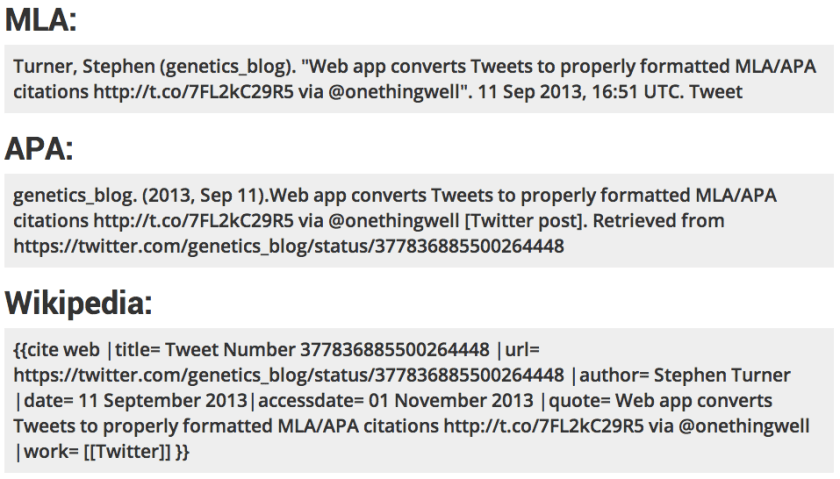
I’m not proud of that title; but I also lack shame. Ben Hedlund, however, should be very proud of his web app Tweet2Cite. Tweet2Cite takes the URL of a tweet and converts it into a properly formatted citation for MLA, APA, and Wikipedia styles. Here are the citations I generated using the tweet from Stephen Turner that brought Tweet2Cite to my attention*:
And, for those of you wondering, yes, you do need to provide a citation or attribution for information/quotes/images/links extracted from other people’s tweets.
The current levels of political polarization and partisanship, which we are keenly aware of in the wake of the US Federal Government shutdown, get blamed on many factors, especially the bogeyman of new technology, the internet and social media.
Political critic Dan Carlin makes the point in his most recent Common Sensepodcast (“The Shutdown Sideshow” at about 8:30) that increased political polarization should be an expected consequence of increased gerrymandering. In gerrymandered voting districts engineered to effectively guarantee the victory of a particular party, the winner of the election is primarily determined by the party primary elections. The winner of the party primaries is determined by each party’s “base” voters.
The inevitable result of such a system is the election of progressively more extreme politicians selected by gerrymandered districts, which effectively cut the majority of moderate voters out of the process. Responses to the activity of these politicians would then drive polarization among voters.
Is Dan Carlin right on this one? I cannot say for certain, but after five minutes of thought, it seems like increased political polarization is the expected consequence of an increasingly gerrymandered system, with or without modern communication technology. The burden of proof, therefore, falls more heavily on those arguing that it is the result of some other factor (eg, internet) or that political polarization has not increased.




 The Finch and Pea