
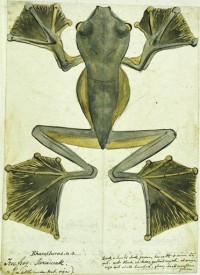
Last week, the Natural History Museum in London unveiled a digital archive of the letters of 19th century naturalist Alfred Russel Wallace, the co-discoverer with Charles Darwin, of evolution by natural selection. The archive, introduced on the 100th anniversary of Wallace’s death, naturally focuses on his writings, but also contains some paintings and drawings. Wallace, who spent years in far-flung places collecting specimens, didn’t have the option of pulling out a camera to document his finds. He often sketched or painted his discoveries, including this lovely watercolor of a flying frog which he painted in Sarawak. It may not be Audubon-level in its artistry and detail, but it’s a useful scientific illustration which also has great personality and charm.
Tag: evolution
Science Caturday: Ceiling Cat
To think otherwise would be like finding a blind watchmaker in the middle of an uninhabited wasteland and concluding that there are no poorly constructed watches about.
Also, the cirumference of a human’s index finger is slightly smaller than the inner circumference of their nostrils. I think the message is clear…
Linkonomicon 15
1. Skin cream from ancient Rome – via Michele Banks.
2. Jerry Coyne on epigenetics, right but crotchety.
3. The life, times, and hugs of Bora Zivkovic.
4. This is just, uh…WOW! – via Alex Wild.
5. Need a 3D printer for your kids’ art supplies? The internet has solved that .- via Maria Popova.
Missouri may have opened a creationist Pandora’s Box
Missourians have voted overwhelmingly for a ‘right-to-pray’ constitutional amendment that creationists may use to let students opt-out of certain topics in science class. When I voted on Tuesday in my St. Louis suburb (against this amendment, of course), the ballot described the proposed amendment with a single, innocuous sentence that basically nobody could disagree with (except maybe Richard Dawkins or Jerry Coyne). No wonder the thing passed with 83% in favor – you can make anything sound good if you’re not constrained by honesty, which, when it comes to prayer, one would think ought to be a constraint.
From the St. Louis Post-Dispatch:
In the months leading up to the vote, Amendment 2 prompted unsuccessful lawsuits over its ballot wording, which its critics argued oversimplified the issue to the point of deceit. Continue reading “Missouri may have opened a creationist Pandora’s Box”
Experimental Evolution: Longest PhD Project EVER?!
I first heard about experimental evolution while reading “The Greatest Show on Earth” by Richard Dawkins. In my naïve view, how could anyone really perform experiments on evolution? Doesn’t it take millions of years? The chapter referenced the E. Coli Long-Term Experimental Evolution Project. I was blown away by the fact that this lab was taking advantage of the short reproduction and life cycle of E. Coli to study evolution in the lab.
I was reminded of this great experiment the other day by an article about another lab studying experimental evolution using microalgae instead of E. Coli. Sinead Collins leads a group in the UK that is studying how microalgae respond to changes associated with ocean acidification or increased levels of carbon dioxide. They have found that while these algae use carbon to complete photosynthesis, they are sensitive to overly high levels of carbon. In an acidic environment, the algae start to get “syndromes” and fail to use up the increased carbon available to them. This goes against the beliefs of many that say that the aquatic life will simply use up the increased carbon in an acidified ocean.
These two groups have each found an organism and a method that will allow them to study evolution experimentally in the lab.
