
I now understand why people like Robert Heinlein…

Unfortunately, many classic sci-fi writers are widely famous for works that serve as a poor introduction to their writing. After reading Stranger in a Strange Land, I didn’t get why people found the author of such overbearing verbiage so compelling. Philip Dick’s A Man In the High Castle on a first read was enjoyable, but it didn’t blow me away. C.M. Kornbluth’s Not This August seemed like a generic work of 50’s Cold War angst.

Eventually I figured out what’s so great about Philip Dick and Cyril Kornbluth, and now I’ve had my Heinlein epiphany. Continue reading “I now understand why people like Robert Heinlein…”
Saving lost SF classics

What a great idea:

We love books. A lot. And we love sci-fi books, new and old. But mostly old.

And there are a lot of great old sci-fi books out there that are out of print, out of circulation, and, worst of all, not available in any sort of digital format.

Given the subject material, that’s just not right. Continue reading “Saving lost SF classics”

The Sensual Science Fiction of C.L. Moore

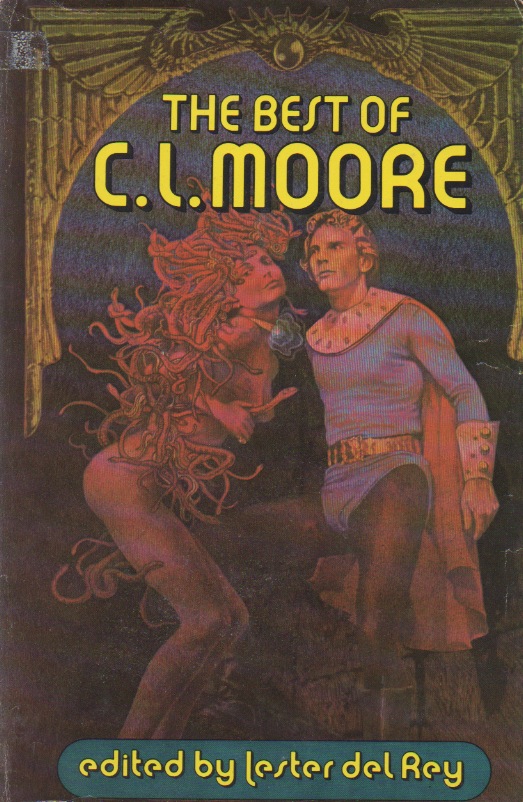
My luckiest find at my local library’s discarded book sale bears one of the most embarrassing science fiction covers I’ve ever seen – a remarkably high bar to reach. This cover features a blond hero in a failed Halloween costume that includes tights, cape, and blue leotard, staring past a naked medusa who is attempting, without much success, to strike an erotic pose while fondling a very phallic snake. For a mere quarter, I picked up this ridiculous piece of art, but along with it I scored some of the very finest stories ever to come out of the Golden Age pulp magazines of the 1930’s and 40’s: The Best of C.L. Moore. In a genre featuring techno-fantasies of omnipotent super-scientists rationally masterminding the world, to the delight of fawning female props, Catherine L. Moore managed to thrill fans with sensuous, complex, character-focused stories about desire, love, and women. The Best of C.L. Moore features ten stories that are essential reading for any fan of Golden Age science fiction. Continue reading “The Sensual Science Fiction of C.L. Moore”

Book club: It’s a digital world and we just live here

Welcome to the first Finch and Pea Book Club. Grab your favorite brew and pull up a chair. Our inaugural book is George Dyson’s recently published Turing’s Cathedral. Have you read the book? Got an opinion? Let’s hear about it in the comments.

On the eve of World War II, when much of the world was beginning to mobilize its industrial and scientific resources in preparation for yet another exercise in mass slaughter, Abraham Flexner, the driving force behind the modernization of America’s higher education, wrote a plea for basic research, “The Usefulness of Useless Knowledge” (PDF). Flexner argued that much of the transformational technology on which our society relies is the consequence of esoteric, abstract, curiosity-driven scientific research that was conceived without specific, practical applications in mind. George Dyson’s Turing’s Cathedral is the story of how the useless knowledge of abstract mathematics and logic led directly to the birth of today’s digital, computerized society, in the boiler room of that most pallid of ivory towers, the Princeton Institute for Advanced Studies. Continue reading “Book club: It’s a digital world and we just live here”

Inside the 50’s science fiction bubble

“American SF by the mid-1950’s was a kind of jazz, stories built by riffing on stories. The conversation they formed might be forbiddingly hermetic, if it hadn’t been quickly incorporated by Rod Sterling and Marvel Comics and Steven Spielberg (among many others) to become one of the prime vocabularies of our age.”

So writes Jonathen Lethem in his introduction to The Selected Stories of Philip K Dick. If you’re looking for that sci-fi conversation at its most hermetic, go read the 1956 celebratory anthology, The Best From Fantasy and Science Fiction, Fifth Series. The collection reads like a series of bad inside jokes, although three stories make it worth the $2.50 I paid for it at my favorite source of vintage sci-fi. (Check out the full listing of this anthology at isfdb.org.)

So where did this collection go wrong? Continue reading “Inside the 50’s science fiction bubble”