
 Our travel guru, Eva Amsen, was recently interviewed by Times Higher Education about using Twitter and other social media productively as an academic in her role as outreach coordinator for F1000. The article includes a handy list of reasons you should be on social media in case your superiors question the number of tweets you posted last month.
The Art of Science: Popsicles Go Viral

Lick a virus? Probably not a good idea, unless it’s a Dangerous Popsicle, a sweet treat created by artist and designer Wei Li. Li decided to play with the “aesthetics of user-unfriendliness” by taking something we would ordinarily never put in our mouths (not on purpose anyway) and inviting us to do just that.
Li created the popsicles by first making 3D prints of HIV, chicken pox and flu viruses and MRSA and E. coli bacteria. Then she created silicone molds of them and filled them with colored, flavored, sugary water. Li created a short video of the project and posted an Instructable online so all you microbiologists can make these for your next party.
Congratulations to Emily Willingham & David Grimes
It makes me very happy to share the announcement that our friend Dr. Emily Willingham is joint winner of the 2014 John Maddox Prize for Standing Up for Science. Emily is brave. That isn’t an adjective that one gets to use for many science writers; but Emily is brave. She has continued to bring clarity of scientific evidence to controversial issues such as autism, vaccines, school shootings, and parenting despite continuous abuse, legal threats, and other challeges.
The judges awarded the prize to freelance journalist Dr Emily Willingham and early career scientist Dr David Robert Grimes for courage in promoting science and evidence on a matter of public interest, despite facing difficulty and hostility in doing so…Emily Willingham, a US writer, has brought discussion about evidence, from school shootings to home birth, to large audiences through her writing. She has continued to reach across conflict and disputes about evidence to the people trying to make sense of them. She is facing a lawsuit for an article about the purported link between vaccines and autism. – Sense About Science
Although we do not know Dr. David Grimes, he also deserves our congratulations, thanks, and deep respect for his work:
David Grimes writes bravely on challenging and controversial issues, including nuclear power and climate change. He has persevered despite hostility and threats, such as on his writing about the evidence in the debate on abortion in Ireland. He does so while sustaining his career as a scientist at the University of Oxford. – Sense About Science
I have received phone calls from a very distressed David Grimes late at night over death threats, looking for a second opinion about how to cope with threats to his livelihood and threats of physical harm against him. While David is no push over, the constant barrage of abuse does take its toll and it’s very brave of him to continue to speak out against scientific falsehoods in the media when he’s under no obligation to as a researcher. – Daniel Murray
Congratulations to Dr. Emily Willingham and Dr. David Grimes.
How bad is the NIH budget really?
In the blowback to Francis Collins’ comments about budget cuts delaying an Ebola vaccine, there is a lot of confusion going around about just how much the NIH budget declined.
The worst offender is the usually very good Sarah Kliff at Vox.com, who writes:
The NIH’s budget rose rapidly during the early 2000s, growing from $17 billion in 2000 to a peak of $31 billion in 2010. This meant more money for everything…
Funding then began to decline in 2010 and has continued to fall slightly over the past four years (this was during a period when Obama was in the White House, Democrats controlled the Senate, and Republicans controlled the House). By 2013, funding was down to $29.3 billion. These figures do not account for inflation.
Inflation – there’s the rub. Because when you do account for inflation, you see that the NIH budget was in decline long before 2010 – in fact things started to go south after 2004, as the AAAS budget analysis shows:

And depending on how you make the inflation adjustment, things can look even worse – you hear claims of a 20% decline tossed around. To understand how this works, lets look at the numbers themselves: Continue reading “How bad is the NIH budget really?”
#ShakesPeerReview
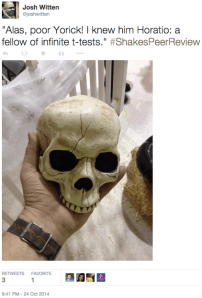 It has oft been our wont on a Friday to indulge in a bit of sciencing of movie quotes – a practice we have saddled with the Twitter sobriquet #SCInema. This Friday, however, was not like most Fridays. For, on this Friday, my friends at the Science for the People podcast released a show featuring interviews with author Dan Falk and scholar Stanley Wells entitled “Science and Shakespeare“.
So, instead of putting the science in movie quotes, we brought the science to the works of The Bard with the hashtag #ShakesPeerReview. It was met with great enthusiasm by science-y folk who were eager to show-off that their knowledge of Shakespeare and their senses of humor (these things do not always go together).
My favorite effort, among many potential favorites, may be this one from Shane Caldwell.

You can find a storify of #ShakesPeerReview tweets here.
 The Finch and Pea