
The Art of Science: Please Eat the Art
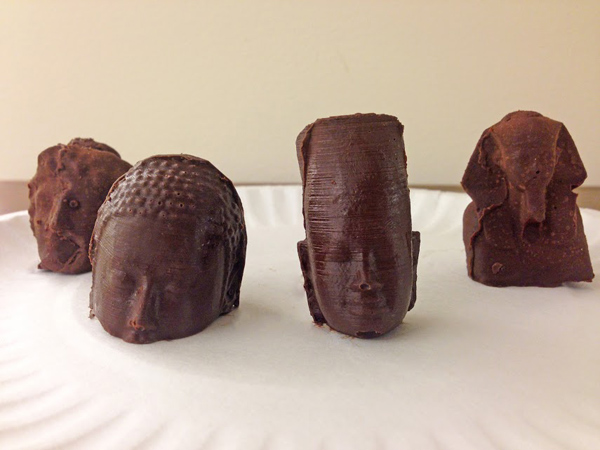
Here at the Finch & Pea, we are big fans of food, art and the scientific method. So when I saw this story about a couple of Media Lab interns at the Metropolitan Museum in New York and their quest to produce edible replicas of museum treasures, I knew I had to share it here. It’s worth reading the whole thing, so please click on over to the Met’s Digital Underground blog for more.
Tip of the hat to Hilary-Morgan Watt
650th anniversary party for University of Vienna
The University of Vienna is celebrating its 650th birthday this year. Happy birthday!
As part of the festivities, the university organised a three-day festival from June 12 to June 14. I happened to be in town for part of this, so I had a look at some of the booths on Saturday.


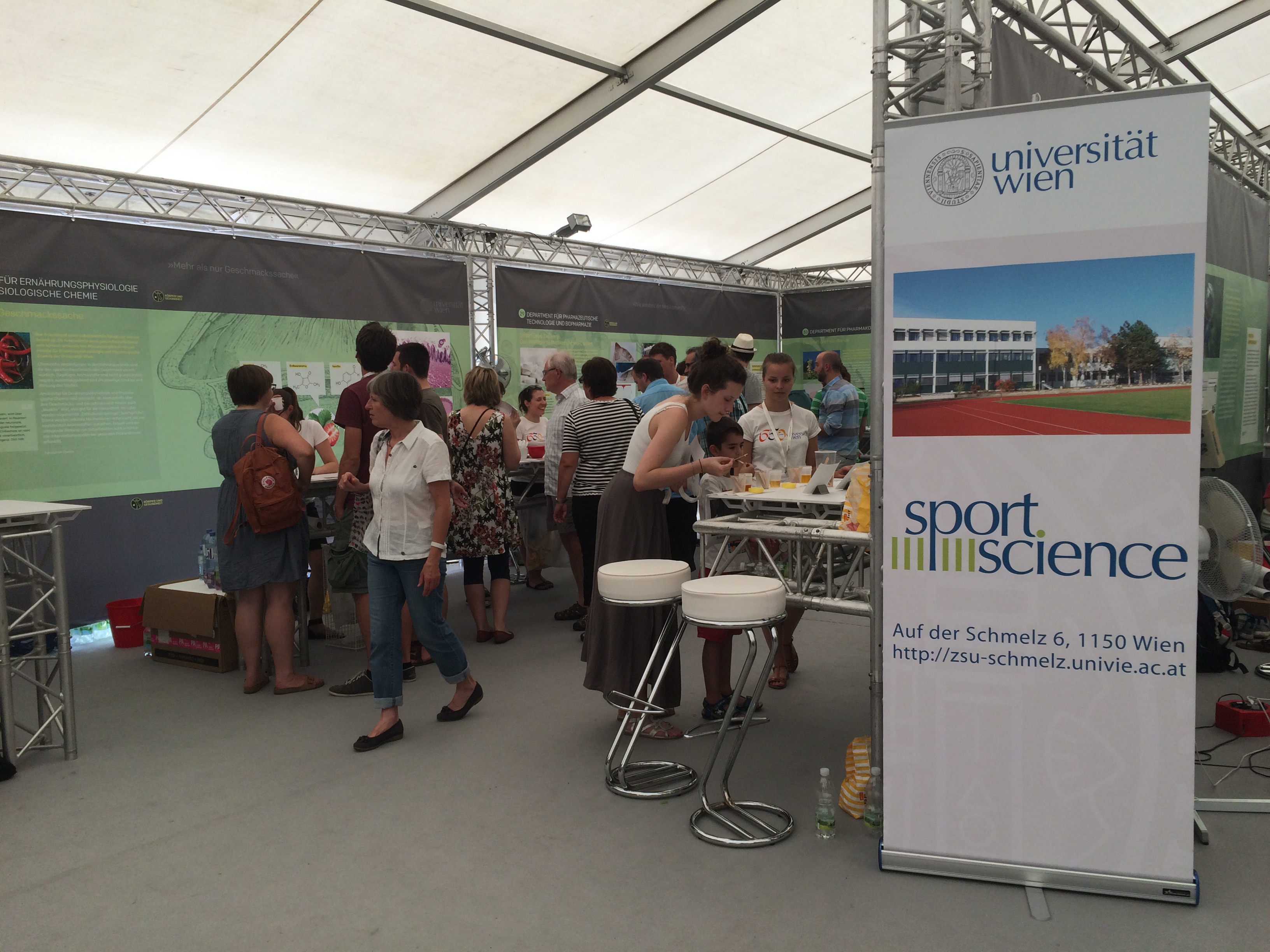
Other parts of the programme included some public lectures, and a “music and science stage”, which included some Austrian science cabaret groups. Here the stage is being set up for Science Busters.

This week, the University of Vienna continues its birthday celebrations with a film festival.
Where Does the Genetic Code Come From? An Interview with Dr. Charles Carter, Part II
“Translating the genetic code is the nexus connecting pre-biotic chemistry to biology.” — Dr. Charles Carter
Last week we discussed the general question of how the genetic code evolved, and noted that the idea of the code as merely a frozen accident — an almost completely arbitrary key/value pairing of codons and amino acids — is not consistent with the evidence that has been amassed over the past three decades. Instead, there are deeper patterns in the code that go beyond the obvious redundancy of synonymous codons. These patterns give us important clues about the evolutionary steps that led to the genetic code that was present in the last universal common ancestor of all present-day life.
Charles Carter and his colleague Richard Wolfenden at the University of North Carolina Chapel Hill recently authored two papers that suggest the genetic code evolved in two key stages, and that those two stages are reflected in two codes present in the acceptor stem and anti-codon of tRNAs.
In the first part of my interview with Dr. Carter, he reviewed some of previous work in this field. In the present installment, he comments on the important results that came out of his two recent studies with Dr. Wolfenden. But before we continue with the interview, let’s review the main findings of the papers.
The key result is that there is a strong relationship between the nucleotide sequence of tRNAs, specifically in the acceptor stem and the anti-codon, and the physical properties of the amino acids with which those tRNAs are charged. In other words, tRNAs do more than merely code for the identity of amino acids. There is also a relationship between tRNA sequence and the physical role performed by the associated amino acids in folded protein structures. This suggests that, as Dr. Carter summarized it, “Our work shows that the close linkage between the physical properties of amino acids, the genetic code, and protein folding was likely essential from the beginning, long before large, sophisticated molecules arrived on the scene.” Perhaps it also suggests – this is my possibly unfounded speculation – that today’s genetic code was preceded by a more coarse-grained code that specified sets of amino acids according to their physical functions, rather than their specific identity. Continue reading “Where Does the Genetic Code Come From? An Interview with Dr. Charles Carter, Part II”
Sunday Science Poem: How Fossils Inspire Awe
Lindley Williams Hubbell’s’ “Ordovician Fossil Algae” (1965)
 To become a fossil, it takes a lot of luck. Your carcass needs to be buried rapidly and then lie undisturbed for tens of thousands, hundreds of millions, or even billions of years. It’s a process that seems best suited to tough, hardy organisms – ancient sea shells, armored trilobites and giant dinosaur bones are what typically comes to mind when we think of fossils. Delicate and beautifully detailed fossils of the gently curved leaves and stems of exotic plants, the veined wings of strange insects, and the mussed feathers of dinosaurs defy our expectations. Fossils that capture such fragile details are a startlingly clear window to an alien world. At the same time they make that world seem very familiar.
In Lindley Williams Hubbell’s poem about fossils, it’s this defiance of expectations that induces a sense of awe and a feeling of the continuity of life across “some odd billion years.” Hubbell is particularly inspired by the fern-like fossil algae from the Ordovician Period, which followed the Cambrian, beginning about 490 million years ago and lasting for about 45 million years. The Ordovician was a great period of invertebrates and algae, all living in the oceans. Vertebrates, particularly jawless, armored fish, were also beginning to show up in greater numbers. And by the end of the Ordovician, there was a major development: the earliest fossils of land-dwelling organisms appear. It was a time of major change and and also major extinction. Continue reading “Sunday Science Poem: How Fossils Inspire Awe”
 The Finch and Pea