
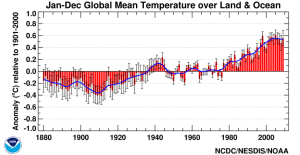
Issa’s priorities are, to an astonishing degree, representative of the new Republican House majority. Last year, when John Boehner, of Ohio, the incoming House Speaker, was asked by ABC’s George Stephanopoulos about his party’s plans to address climate change, he had this to say: “The idea that carbon dioxide is a carcinogen, that it is harmful to our environment, is almost comical.” John Shimkus, of Illinois, is one of four members now vying for the chairmanship of the House Committee on Energy and Commerce. At a congressional hearing in 2009, he dismissed the dangers of climate change by quoting Genesis 8:22: “As long as the earth endures, seedtime and harvest, cold and heat, summer and winter, day and night will never cease.” He added, “I believe that’s the infallible word of God, and that’s the way it’s going to be for His creation.” Another contender for the Energy Committee post, Joe Barton, of Texas—who is one of the House’s top recipients of contributions from the oil-and-gas industry—argues that CO2 emissions have nothing to do with climate change, and, in any event, people will just adapt. “When it rains, we find shelter,” he has said. “When it’s hot, we get shade. When it’s cold, we find a warm place to stay.” (Barton is perhaps best known for the apology he offered, last June, to the C.E.O. of BP, Tony Hayward, for what he described as a “shakedown” of the company by the Obama Administration.)
See “Uncomfortable Climate” at the New Yorker.
Apparently the position of chair of the House Committee on Energy and Commerce goes to the Representative who can deny the most science.
 The much-revered writers of the Golden Age of science fiction can be quite rough around the edges, even downright embarrassing on occasion. The writing is hurried, the plots of plot-driven books are disturbingly inconsistent, and the characters are primarily stock types and authorial mouthpieces. To top it off, many of these novels are ambitious, earnestly offered as novels of big ideas. These ideas are usually sympathetic (tolerance, freedom, racial equality, escape from religious tyranny), but generally reduced to platitudes expressed in long, somnolent sermons by the your standard pointy-headed philosopher-scientist.

 The Finch and Pea