The Art of Science: The Antsy Art of Loren Kronemyer

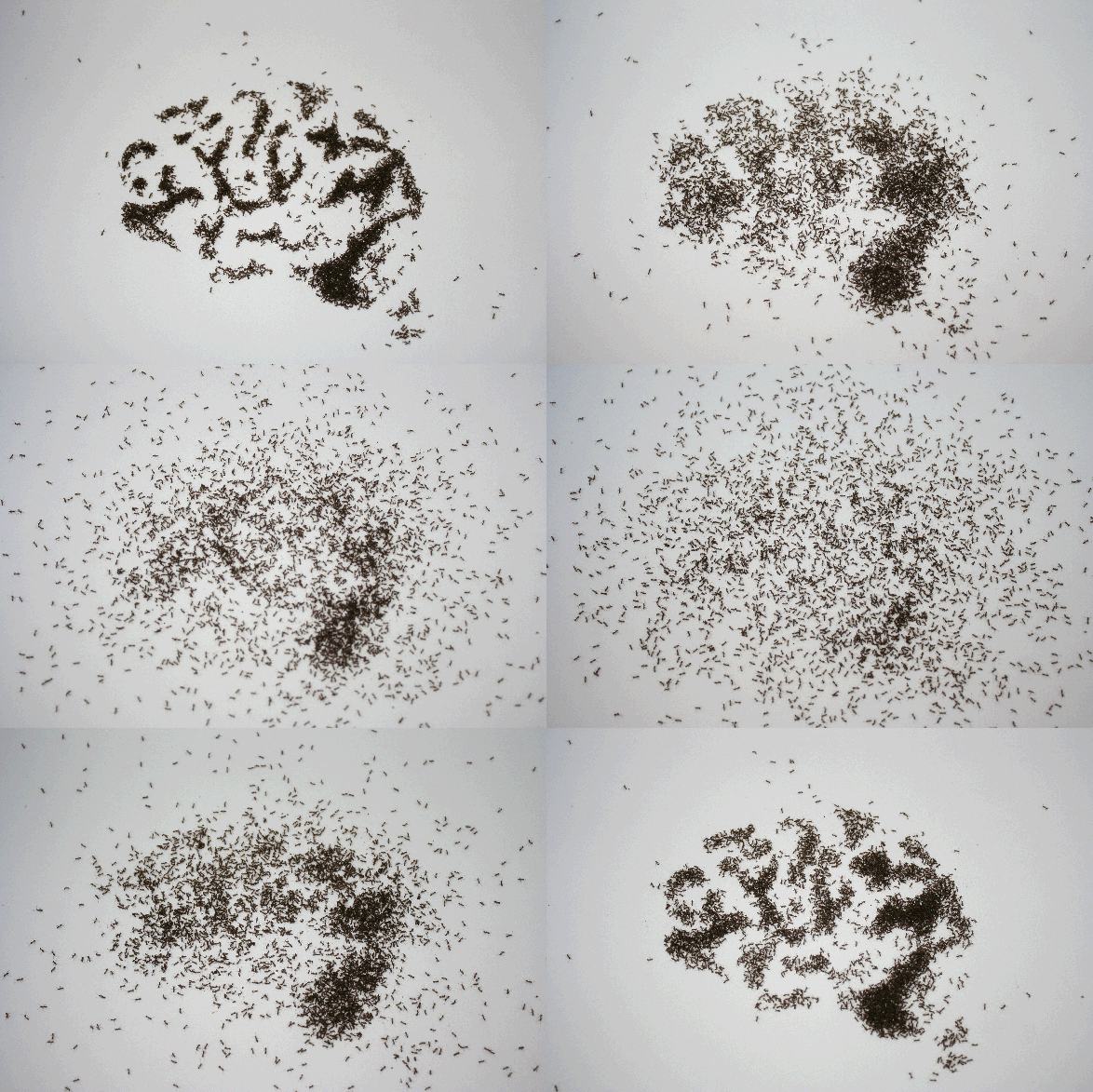
Brain, from Myriad, 2012

Ants fascinate humans with their strength, their adaptability and their astonishing ability to work together to achieve goals. Artist Loren Kronemyer enlisted large groups of them to create her 2012 project, Myriad.

Kronemyer draws on paper with pheromones, then releases ants onto the paper. The ants, drawn to the scent, briefly cooperate in completing her designs before going back to their own patterns of movement. The artist explains that her projects explore “the notion of living drawing” as a collaboration showing the interplay of insect and human intelligence. Kronemyer, who has also created drawings with living tissues, says:

“The ant colony is a superorganism, a system with its own intelligence made up of many individuals, and the tissue is a fragment of an individual that is itself made up of many discreet living entities. I sit somewhere in the middle, meddling with both yet at the same time responsible for caring for them and keeping them alive.” (source)

The various works in Myriad are full of life and movement. The image of the brain, in particular, works as a great visual metaphor for a short attention span, or perhaps a sudden realization.  Kronemyer, an American who moved to Australia to work with SymbioticA Lab, says that “at a certain point I stopped being interested in just representing living systems, and wanted to work with the systems themselves.” It’s a long way from paint and marble, yet the visual delight of her work keeps it from simply becoming a science-fair project and plants it firmly in the territory of art.

You can see more of Loren Kronemyer’s work at her website.

The Burgess Shale

This is the first of two posts about the Burgess Shale. The second one will go up next week.

In 1909, paleontologist Charles Walcott discovered fossils of the strangest organisms anyone had ever seen in the Canadian Rockies. Some had five eyes, some had strange shapes or protrusions. Over the next years he went back many times with his family, in an attempt to collect and describe the organisms.

Charles_Doolittle_Walcott
Charles Walcott and members of his family at the Burgess Shale

The organisms were all from the Cambrian era, and this fossil field, the Burgess Shale, is a treasure trove of fossils. Wolcott found over 65 thousand, and the area is still being studied. Many of the fossils are on display at the Royal Ontario Museum in Toronto and at Cambridge’s Sedgwick Museum, and affiliated researchers of these and other institutes are working on the fossils and discovering new species all the time.

Why is there such a wealth of Cambrian fossils in the Burgess Shale? These were creatures living in the oceans after the “Cambrian Explosion” – a period of time over 500 million years ago when lots of new creatures evolved. These diverse organisms swam around the prehistoric oceans, but were concentrated here in a mudslide. When the continents moved, this area ended up high in the Rockies.

You can visit the fossil fields only on a guided hiking tour. Who knows, maybe you’ll discover a new fossil while you’re there!

Image in the public domain, via the Smithsonian Institution archives.

Science Caturday: The Cat’s-Eye Street View

catmap

A map generally shows a bird’s eye view, but now a small Japanese city has pioneered a paradigm-changer, the cat’s eye view.  The tourism board of Hiroshima prefecture has created an online map for cats — similar to Google Street View, but at a cat’s height instead of a car’s — of a commercial area in the city of Onomichi.

This article in Vox explains the features of the cat map, including cat locators and biographies of the neighborhood’s kitties. Needless to say, it appears vastly superior to a view from a bird, satellite or car. Two paws up.


This Week in Virology Art

The most recent guest on This Week in Virology (or TWiV) is none other than our own Michele Banks. Michele welcomes host Vincent Racaniello of Columbia University into her home for an extended conversation about the hows and whys of her science-inspired art.

For those of you who are not regular readers of Michele’s Art of Science series, what I have always found fascinating about discussing art and the process of creation with Michele, is her engagement with the current art world and the history of art, with an honesty and clarity that is quite brave – when so many artists armor themselves (like scientists) against public judgment in overly complex jargon.

I can’t send Michele to everyone’s living room to have that conversation with you; but, thanks to TWiV, I can send Michele’s living room to you.

The zero meridian, or something like it

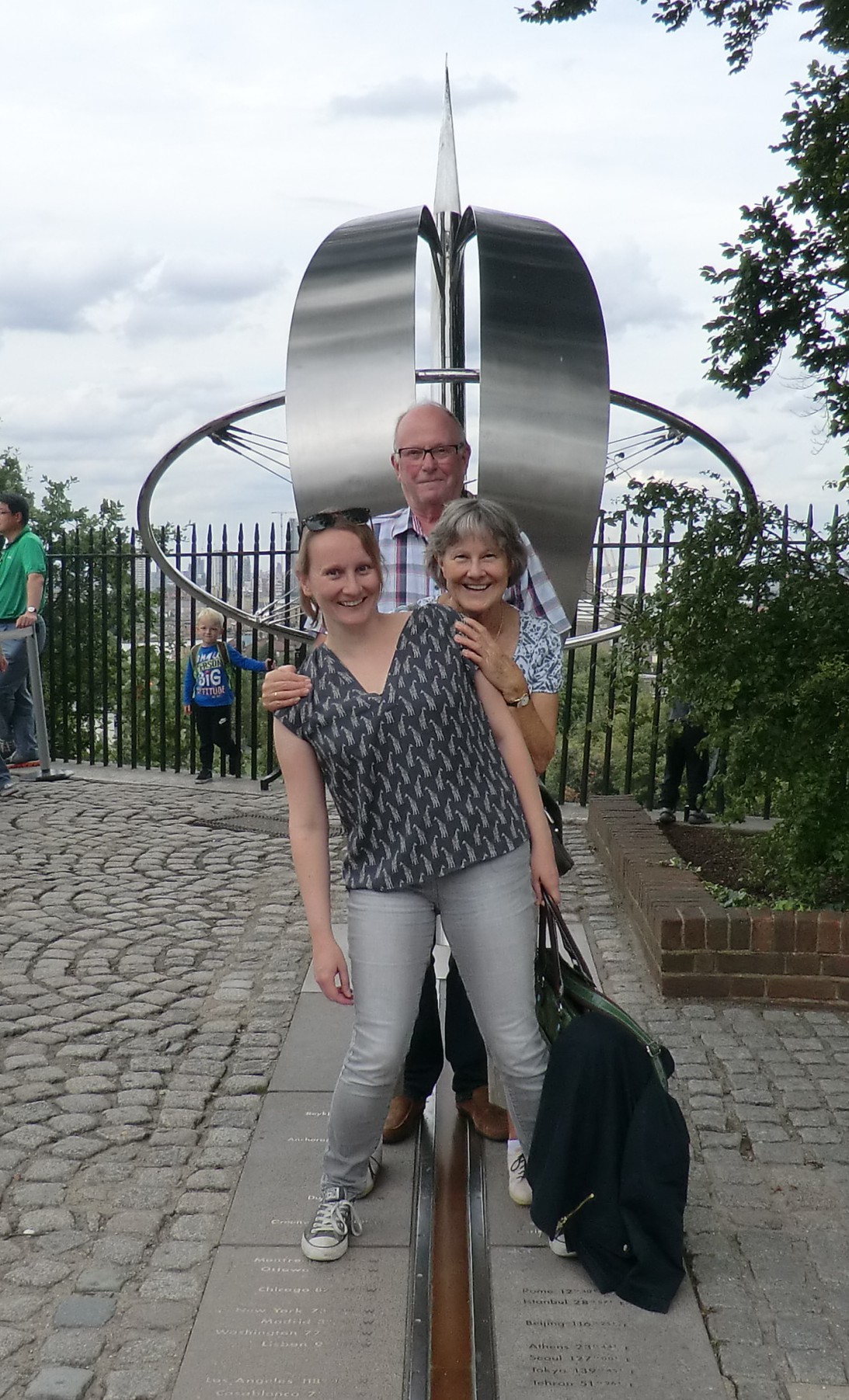
CIMG1443This weekend I took my parents to visit the Greenwich Meridian – or did I?

The marked meridian on the site of Greenwich Observatory, where tourists line up to pose for silly pictures with one foot in the East and one foot in the West, has claimed to be zero degrees longtidude since 1884, but if you check your smart phone GPS on that spot, you’re NOT at exactly 0.000 degrees.

According to GPS, the zero meridian appears to be in a park adjacent to the observatory, and not in the section behind the fence that charges admission so you can “visit the meridian”.

2015-08-29 14.06.58

What’s going on here?

Earlier this month, an article by Stephen Malys and others in the Journal of Geodesy revealed the reason behind the discrepancy. The technology used in the 19th century to determine the location of the zero meridian was subject to local distortions from the Earth’s gravity and shape of the local terrain. GPS technology uses measurements from satellites, which aren’t affected in the same way as technology located on Earth.

Screen Shot 2015-08-31 at 21.00.00
The dotted line is the much photographed meridian established in 1884. The solid line is where the GPS says it should be.

So the meridian really is in the wrong place. What does that mean for maps or for time? Well, the Ordnance Maps used in the UK were already using a slightly different zero meridian as reference point, because they were established before the 1884 meridian convention. And the effect of the new meridian location on Greenwich Mean Time, which determines Universal Time, is unnoticably small, so nothing much has changed.

Except, for a shorter line and a cheaper visit, you could technically skip the museum and the crowd of tourists and find the true GPS meridian about a hundred meters to the East of the Observatory in Greenwich Park. It’s probably not as fun a place for a family visit, though.

Aerial photo is Figure 1 from the article by Malys et al. (CC-BY). Photos taken from the ground are by me and by the man who was behind us in line at the almost-but-not-quite meridian line. I previously wrote about the history of the Greenwich Observatory on this site.