
You’re gonna suck…And the best it was ever described to me was actually at a kids summer camp. And the guy said, “Ok, here is how you do it. You’ve got an editor in your brain. That editor, you make a deal with the editor. That’s your self-conscious editor that’s telling you this sucks, this sucks, this is going to suck. Don’t do it. That guy, you ask him to leave the room. He doesn’t get to be in the room; but your deal is, when he comes in tomorrow he gets to bring his hatchet. He gets to bring a chainsaw and do whatever he wants. He can cut the whole thing. He can cut it all except for one syllable. He can do whatever he wants to, but today is yours. So, you just write everything you want to and tomorrow the asshole’s coming back with his hatchet.” And, I think that’s really useful because so many ideas are stopped. What are you afraid of? What’s so scary about having a shitty idea?
–Ben Folds discussing failure as part of the creative process on The Nerdist Podcast
Art of Science: Philip Beesley’s Glittering, Radiant Soil

When artists depict soil, it is often as a dark, heavy, brown mass. Philip Beesley sees it differently. His 2013 installation, Radiant Soil, is full of light and movement, glittering with metal and glass. As Beesley describes it, “this contemporary soil seethes with a myriad of seeded viscera, miniscule fragments gathering and efflorescing, redolent with chorusing oceans of growth to come.”
“Radiant Soil forms interlinking clouds of industrial design biomimetic components of polymer, metal and glass, arranged in suspended filter layers contain a near-living carbon-capture metabolism. Frond-clusters fitted with shape-memory alloy mechanisms react to viewers as they approach, flexing and setting off bursts of light that stimulate the protocells and trigger chains of motion that ripple throughout the environment. Scent-emitting glands attract viewers and encourage interaction with the system, providing stimulus that increases air circulation and protocell formation.” (source)
Is this really happening beneath your peaceful front lawn? Well, yes and no. Beesley is not trying to make an enormous, interactive scale model of actual soil. His goal is to make us rethink the boundaries of our environment. There may not be flashing lights in soil, but there are signals flying among plants, animals and microbes, there are minerals glinting and spores bursting. There’s a lot going on beneath our feet, and Beesley brings it to the surface with bravura.
In his ongoing Hylozoic Series of installations, which have been exhibited around the world, he and his team are “trying to provoke a reconception of architecture, not as a set of closed walls where you see your office as a fort, but rather to think of architectural walls and roofs as deeply layered zones for interchange.” (Wired)
Originally an architect working on much more conventional projects, Beesley changed direction in 2001 after meeting Mitchell Resnick, an MIT professor who introduced him to the possibilities of digital fabrication and low-cost sensors. Using what he calls the “little bits of intelligence and interactivity” the technology provided, he began to create interactive, immersive environments, evoking forests, jungles, plant cells, or in this case, soil. Beesley now works with a team of architects, mechanical engineers and chemists, who (among other things) create interactive features that move, “breathe”, and release scents when activated by visitors
The series title, Hylozoic, refers to the belief that all matter is alive. Looking at Beesley’s conception of soil as a light, airy, sparkling and motion-filled space (video), it’s hard to disagree.

Science Caturday: Water on Mars Confirmed
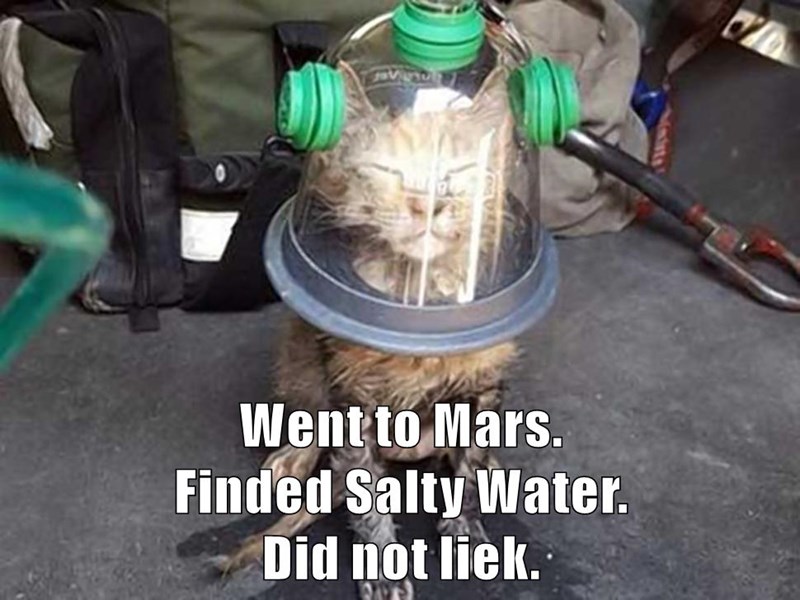
Scientists this week announced the strongest evidence yet that there may be liquid water on Mars. A paper published in Nature Geoscience described observations made by researchers over the past three years that indicate that water – most likely in the form of a salty brine – appears seasonally on Mars, forming dark lines as it trickles down steep slopes. Although scientists have known for years that Mars once had water, the new evidence provides hope that one day humans may discover life on the red planet. The latest announcement was based on the study of photographs of the surface of Mars. However, we can reveal here exclusively that a super-sekrit kitteh mission led by Commander Kibbles flew up to have a look and can confirm the findings. Yes, there is water, and yes, it is yucky.
The Perimeter of Wisdom

When this happens in graduate school, they give you your degree and kick you out.
Science Caturday: Cetacean Needed

Several whales have been spotted in the western part of Long Island Sound in recent months, the first such sightings since 1993. Boaters have been startled by minke, humpback and beluga whales in the waters off Connecticut and New York State.
According to this article, experts believe the whales were attracted by a big increase in bait fish in the Sound, including menhaden, which are rich in omega-3 oils and calories. We figure that the whales decided to come to the East Coast to see Pope Francis. Whatever the reason, the whales have served as role models for some other hefty mammals.
 The Finch and Pea