This is terrible career advice:

From Stewart Firestein’s Ignorance: How It Drives Science:

The poet John Keats hit upon an ideal state of mind for the literary psyche that he called Negative Capability – “that is when a man is capable of being in uncertainties, Mysteries, doubts without an irritable reaching after fact and reason”…Scientists do reach after fact and reason, but it is when they are most uncertain that the reaching is most imaginative. Erwin Schrödinger, one of the great philosopher-scientists, says, “In an honest search for knowledge you quite often have to abide by ignorance for an indefinite period”… Being a scientist requires having faith in uncertainty, finding pleasure in mystery, and learning to cultivate doubt. There is no surer way to screw up an experiment than to be certain of its outcome.

Continue reading “This is terrible career advice:”

“Lectures on Chemical Reaction Networks”

A classic set of lectures by Martin Feinberg:

The occasion was a semester-long in-gathering of people interested in the behavior of complex chemical systems. At the end of that period there was a large meeting, the proceedings of which were published by Academic Press in a book, “Dynamics and Modeling of Reactive Systems,” edited by W. Stewart, W. H. Ray and C. Conley. My chapter amounted to a summary of some of the things I talk about during the course of the nine lectures.

It was an exciting time, which began when Charles Conley called me at the University of Rochester. He explained the MRC plans for 1979 and asked if I could spend a semester in Wisconsin. He said that they would pay my salary, provided that my salary wasn’t too high. I told him my salary. Conley asked if I could come for a year.

These seem useful, at least based on what I see in this paper: “A Linear Framework for Time-Scale Separation in Nonlinear Biochemical Systems,” Jeremy Gunawardena.

Love art? Love science? Read The Age of Insight

Nobel Prize-winning neuroscientist Eric Kandel’s book about “The Quest to Understand the Unconscious in Art, Mind, and Brain, from Vienna 1900 to the Present” will keep you busy. It’s stuffed with history of Viennese Expressionism (Klimt, Kokoschka, and my new favorite, Schiele), Freud (what he got right and what he didn’t), cognitive psychology, and a fascinating discussion about how our minds, particularly our unconscious minds, respond to art.

There are a lot of neuroscience details, but the big point of the book is that Freud was right – most of our cognitive processes are unconscious. A key aspect of creativity is to facilitate the exchange between the unconscious and the conscious, and good artists take aesthetic moves that play on the unconscious responses of beholders, and to increase our awareness of the unconscious that operates in us. Kandel gives a neuroscientific justification of James Watson’s famous claim that “it’s necessary to be slightly underemployed if you are to do something significant.”

Particularly fun was the discussion of why Klimt and the Expressionists pursued particular stylistic directions. Klimt was directly influences by his contact with scientists, and many of the symbols in his paintings are inspired by microscope images of cells.

The Art of Science: Olympic Edition

The lighting of the flame in the stadium is an iconic moment in any Olympic games. The designer of the cauldron for the 2012 London games, Thomas Heatherwick, preserved the tradition but gave it a few new twists. As Heatherwick told a press conference in London,  “When we were thinking about the cauldron , we were aware that cauldrons had been getting bigger, higher, fatter as each Olympics has happened and we felt we should not try to be even bigger than the last ones. Continue reading “The Art of Science: Olympic Edition”

Sperm Donors Save Coral


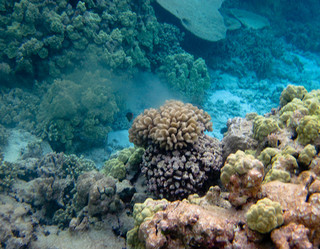
For a time in graduate school, my research involved the use of zebrafish. We would collect and freeze eggs and sperm from the fish to provide a back-up for our stocks. While I’m not a zebrafish expert, freezing these stocks efficiently enough to generate a viable embryo after thawing is extremely challenging. Therefore, I was really impressed by a project to build a coral “sperm bank” described in a recent NY Times article. These sperm banks could be the best tool to preserve the biodiversity of our oceans, both by saving the coral and consequently preserving the coral-based habitats of over one million species.


Stationary coral are especially vulnerable to changes in their immediate environment. Many also have very irregular and inefficient methods of breeding. This “sperm bank” approach will be critical for the coral that are dying off at an alarming rate. Approaching conservation by building banks of sperm, however, may signal that scientists are beginning to realize our efforts at environmental conservation are failing. This leads to some important questions. Should scientists be pursuing better ways to preserve sperm and eggs of all endangered species at the cost of traditional conservation measures? Should more funding for sperm banks be included in budgets for environmental conservation? Conservation will buy time to preserve these species, but is time running out?