
Even Bugs are Going Green

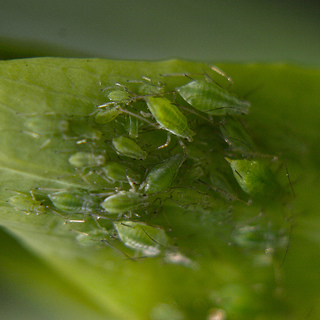
Aphids on the underside of a leaf

Aphids, the scourge of many a gardener, may be the first insect found to use photosynthesis (in addition to wrecking your lettuce). It seems a bit greedy to eat up all of my tomato plants if you can still make energy just basking on the shriveled remains of my plants. Photosynthesis is the process of generating chemical energy from light energy derived from the sun. This puts aphids in the category of the most advanced organisms using photosynthesis including sea slugs and salamanders. In addition, plants, algae and some bacteria have been known to use this process to fuel their energy needs.

Aphids are small insects that feed on a great number of plant species. They have been shown to make their own carotenoids, molecules necessary for oxidation control or light detection. This is the first animal known to make it’s own carotenoids and not require them from their diet.

A new article in Nature shows very early evidence that aphids are using these carotenoids to generate chemical energy from the sun’s light energy. While the evidence is still preliminary, aphids could turn out to be much more than just plant sap suckers. It still doesn’t make me feel any better about my garden.
 

One small step for a coach, one giant leap for football?

With my background in evolutionary biology and genetics, it should be no surprise that I’m an advocate of variation. As an athlete, I really love seeing unconventional approaches to sports, especially because most sports involve so many variable that “solving” an truly optimal way to play is unlikely.

Convention and tradition are often held up by commentators as “the best” way to play because they appear to have survived the test of time. This is very true in football.

The conventions of football have almost never been put to the test. They do not reflect proven strategies for victory. They reflect strategies that are least likely to get the coach fired by the team owner or athletic director. Thus, almost every team in the United States punts on fourth down. A notable exception is Kevin Kelley at Pulaski Academy in Arkansas (notably, he is his own athletic director), who has been successful while refusing to punt or kick (104-19 with 3 state championships).

There may be a new, if limited, addition to this counter-culture. According to reports, San Diego State’s coach, Rocky Long, is considering “going for it” on fourth downs on his opponent’s side of the field. Continue reading “One small step for a coach, one giant leap for football?”

Time to (re)read Thomas Kuhn

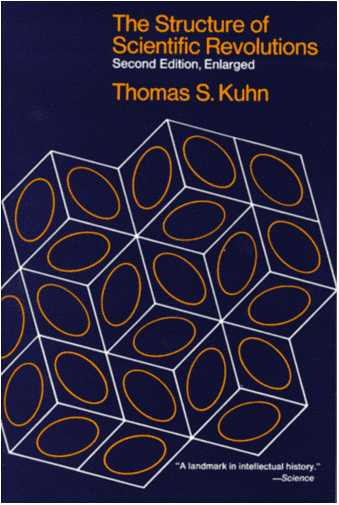
I will admit that I’m a sucker for book anniversaries of any sort, and since this month marks the 50th anniversary of the publication of The Structure of Scientific Revolutions, here’s your excuse to finally read it. I’ve been looking for an excuse to re-read it, since the first go around apparently made no impression on my brain – I will admit that I can’t say a single, intelligent thing about it.

To get yourself jazzed up, you can read the appreciation in The Guardian, and you can buy yourself the swanky new 50th anniversary edition. As for me, I’m sticking with my less glitzy second edition with the cool, somewhat minimalist cover.

Here’s our schedule, with discussions on Fridays: Continue reading “Time to (re)read Thomas Kuhn”

Nick Everett and the Zone of Proximal Development


Sometimes a song just grabs you right away. Nick Everett‘s Liar was one of those songs. I wasn’t content, though, just enjoying it. I wanted to know why I found it so compelling.

I caught my first glimpse of Nick as he tuned up his guitar before a set a few weeks ago at the Wunderbar in Edmonton. The place was cheerfully packed with music types enjoying carefully selected craft brews while Nick stood unassumingly on stage, wagging his head emphatically with song playing during the break. Once it had finished, he leaned gently into the mic, “Helllloooooo, I’m going to start singing songs now.” Continue reading “Nick Everett and the Zone of Proximal Development”

Sunday Science Poem: Mitochondrial Mothers

Despite my experiences of crushing boredom studying cell trafficking pathways in grad school, there was no way I was going to just walk past a book of poems titled Cell Traffic without stopping. In this delightful book, poet Heid E. Erdrich mixes themes of genetics, motherhood, ancestry, and Native American mythology to produce poetry that feels very relevant in a day when we can read information about our ancestry from the text of our DNA.

Today’s Sunday Poem is “Seven Mothers.” The title refers to the seven major, maternally inherited mitochondrial haplogroups popularized by Bryan Sykes in The Seven Daughters of Eve. Since Sykes’ book was published, we have developed a greater ability to use genetic variation in our nuclear DNA to trace our ancestry, and mitochondrial DNA now plays less of a role in our efforts to understand human ancestry than it once did. But it’s hard to beat the impact of mitochondrial maternal ancestry on our imaginations. Continue reading “Sunday Science Poem: Mitochondrial Mothers”