
Yes, I just served up a 15-minute Song of the Week. And I’m not sorry. An extended Neil Young guitar solo is totally worth it. It really starts to get good around the halfway mark. This thing of beauty, though, owes at least something to a largely unacknowledged pioneer: an electrical engineering student named Sidney Wilson. Continue reading “Neil Young and Sidney Wilson’s winning engineering fair project”
CBD: Cute But Deadly

I love to watch animal documentaries on TV. I even own Planet Earth on HD-DVD (I know, I know, serious technology miscalculation there). One of the most beautiful animals I’ve seen documented is the leopard seal. Leopard seals are named for their spotted pelts and can grow to be as large as polar bears. They are thought to be brutal and ruthless killers of penguins, fish and sometimes humans. I recently saw a TED talk by an arctic wildlife photographer (Paul Nicklen) who ran into some leopard seals while shooting penguins. Turns out these seals aren’t always bent on “kill and destroy”. The seal tried to entice him by delivering a freshly killed penguin to him and tried to feed it to his camera.
While these seals primarily live on larger game, it turns out they are capable of feeding themselves in another way. In Polar Biology, it was reported that these seals can sieve krill out of the water just like whales can. Their teeth are structured in such a way that it’s possible for them to gulp up a cloud of krill and expel the extra water keeping the krill to swallow. While this behavior hasn’t yet been documented in the wild, there’s a possibility that these ultimate predators can snack on teeny tiny krill. Turns out, they are indiscriminate binge-eaters at just about every level of the food-chain!
Science Caturday: Geokittehs
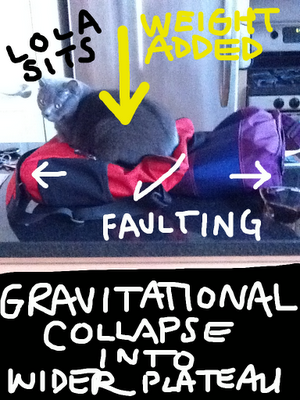
We’ve had biology, physics and genetics lolcats here at the Finch & Pea, but we must admit that our personal feline friends don’t know much about geology. Luckily, there’s a whole blog to help people learn about rocks with the help of kitties. It’s called Geokittehs, and it’s run by geologists and bloggers Evelyn Mervine and Dana Hunter. With the assistance of some very clever cats, they explain geological phenomena such as weathering, subduction, lava flows and stream capture. Here, guest cat Lola illustrates normal faulting.
Want more geology cats? Follow on twitter @geokittehs.
Photo by Callan Bentley via Geokittehs
Bees been struggling
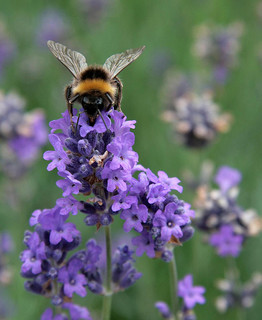 In my random Netflix perusal, I came across a documentary about the striking loss of bee populations, The Vanishing of the Bees. I hadn’t realized this, but in industrial scale farming a large amount of pollinators are needed to pollinate fields of crops, many more pollinators than live in the area normally. Bee farmers fill this role by cultivating large colonies of bees. They move these bees around the country in semi-trucks to farms where they are needed. These bees are experiencing “colony collapse disorder” where entire colonies of bees are wiped out. Without pollinators, many crops will be drastically affected. Fellow blogger Michele has posted artwork that tries to draw attention to the plight of the bees.
While the research into colony collapse disorder is very complex and implicates multiple factors including diseases and pesticides, the documentary focuses on the potential contribution of pesticide exposure to this disorder. Continue reading “Bees been struggling”
The Art of Science: Protect-a-Bear Workshop
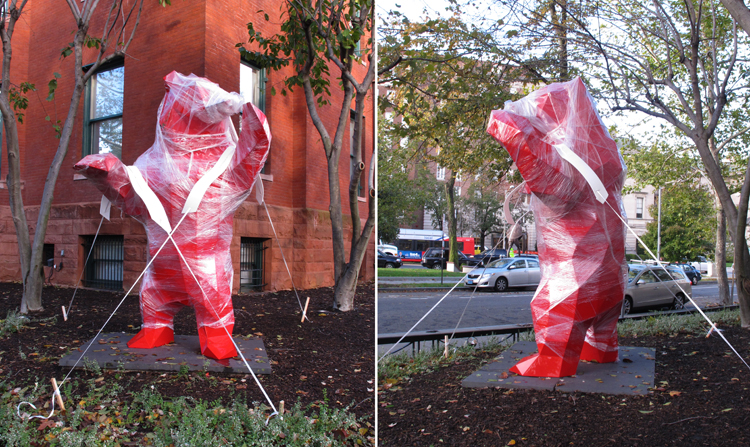
Outdoor public art is built and installed to withstand a tremendous beating from the elements, which is why you rarely see a statue topple even in the worst storms. But this shiny red resin bear is only a temporary visitor to Washington, DC, so its hosts at the Phillips Collection were understandably concerned for its safety in the face of an expected hurricane earlier this week.
So they did some old-fashioned storm-proofing, covering The Bear (by Xavier Veilhan, whose steel shark was featured here a few weeks ago) with sheets of plastic and tying it with ropes attached to stakes in the ground.
Fortunately, although the storm produced heavy rain and strong winds, The Bear came through it unscathed and is currently standing guard at the intersection of 16th and Q Streets, NW. Veilhan’s show at the Phillips opens on November 3 and runs through February 10, 2013.
Photos by Sarah Osborne Bender via the Phillips Collection Blog
 The Finch and Pea