
Milton Mermikides, guitar virtuoso and music theorist, spent 4 months living at Charing Cross Hospital being treated for acute lymphoblastic leukemia. This rendition of “Always Look on The Bright Side of Life” (words and music by Eric Idle) was one of many thank yous to the medical staff that helped save his life.
Sunday Science Poem: Abstraction is crucial in science and poetry
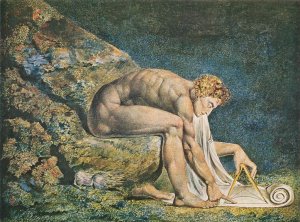 I recently heard a presentation by the Caltech biophysicist Rob Phillips, in which he issued a challenge to those who claim biology, in contrast to physics, is too complex and messy to be understood with mathematical theories: take a look at Tycho Brahe’s 16th century astronomical data, and see if you can make sense of it without math. Take a look at the data, and see if you can demonstrate, without a mathematical theory, that the orbit of Mars is an ellipse.*
In order to understand the messy real world, scientists use abstractions that can be quite distant from our everyday experiences. The historians of science Stephen Toulmin and June Goodfield explain how this was crucial to Newton’s method:
[W]here Aristotle’s theory of motion was based on familiar, everyday principles, Newton’s was stated in terms of abstract mathematical ideals. The circling heavens, a falling stone, smoke rising from a fire, the steady progress of a horse and cart: these were the objects by comparison with which Aristotle explained other kinds of motions. For Newton, on the other hand, the explanatory paradigm was a kind of motion we never encounter in real life. Nothing ever actually moves uniformly and free of all forces, at a steady speed and in a constant Euclidian direction. Yet Newton was able to bring together the threads left loose by his predecessors by systematically applying just this abstract idea of ‘natural’ motion. So far from being guided by experience alone, he could not afford to be too much tied down to the evidence of his senses, or to the results of experiments: it was, rather Aristotle who stuck too closely to the facts. Newton was ready to imagine something which was practically impossible and treat that as his theoretical ideal.
Musicians, artists, and poets have also found that abstraction is crucial. The abstract features make it tough for most of us to grasp modern works. Jacques Barzun explained it this way:
Like the would-be purist in art, the scientist takes a concrete experience and by an act of abstraction brings out a principle that may have no resemblance to the visible world… Poets and prosaists, whether Abolitionist, Decadent, or Symbolist, found that to create works adequate to their vision the language must be recreated.
If we recognize the common role of abstraction in art and in science, the baffling poetry of someone like Arthur Rimbaud begins to make much more sense.
Continue reading “Sunday Science Poem: Abstraction is crucial in science and poetry”
Science Caturday: Tax Time
It’s the last weekend before tax day, so the science kitties have taken time off from their important research to help you with any last-minute filing issues.

Lol by Penelopesdad via Cheezburger.com
Analyzing splicing via RNAseq
 During my postdoc in Jernej Ule’s lab at the Laboratory of Molecular Biology in Cambridge (UK), we studied the genome-wide regulation of splicing (aka, alternative splicing, but these days all splicing is “alternative”). This involved integrating information on protein-RNA interactions with information on splicing isoforms (mRNA transcript variants from the same gene) from next generation sequencing. I could spend hours talking to you about how complicated this type of thing can get. Or, I can show you this figure from Eduardo Eyras.
This is not a Prisoner’s Dilemma, or is it?
A little bit ago, Cory Doctorow posted a story from Inside Higher Ed about students organizing to beat the curve in a Johns Hopkins computer science class. The professor, Peter Fröhlich, scales grades based on the highest grade1. The students all refused to take the test, making the highest grade a 0. Thus, a 0 was an A, meaning they all got As.
…students in Fröhlich’s…classes decided to test the limits of the policy, and collectively planned to boycott the final. Because they all did, a zero was the highest score in each of the three classes, which, by the rules of Fröhlich’s curve, meant every student received an A…The students waited outside the rooms to make sure that others honored the boycott, and were poised to go in if someone had. – Zack Burdyk, “Dangerous Curves” from Inside Higher Ed
Doctorow labeled this as a solution to the Prisoner’s Dilemma. A brief perusal of the 113 comments on his post will convince you that the internet thinks that this is NOT an example of the Prisoner’s Dilemma. Continue reading “This is not a Prisoner’s Dilemma, or is it?”
 The Finch and Pea