Better stem cell tech, more controversy

Over at Pacific Standard, I offer brief layman’s guide to the latest pluripotent stem cell technologies, and I argue that better stem cell technology will not make the ethical controversy go away. (In last week’s Nature, Martin Pera & Alan Trounson make a similar point.)

To understand where I’m coming from, let’s take a step back a few years, in the aftermath of the Bush Administration’s controversial decision to limit NIH-funded research on human embryonic stem cell (ESC) lines. Back then, much of the debate was over the merits and ethics of ESC’s versus lineage-restricted adult stem cells: ESCs were for the most part derived from leftover IVF embryos or aborted fetuses (and thus didn’t carry the genome of a patient). Adult stem cells could be taken from patients, but were much more restricted in their potential applications. Dolly the sheep was old news at that point, but the technology to create Dolly (and thus also create embryonic stem cells with the genome of a living adult) did not actually work with human cells. Continue reading “Better stem cell tech, more controversy”

When immune cells attack…

A neuron wrapped in many layers of myelin
An electron microscopy image of a neuron wrapped in many layers of myelin

…it’s usually a good thing! Immune cells normally protect our bodies from foreign objects or marauding bacteria. Sometimes, this finely tuned protective machinery can go haywire. An example of this is the disease Multiple Sclerosis.

Multiple Sclerosis (MS) is thought to be caused by confusion of a person’s immune system. Their immune cells mistakenly attack the protective coating of their nerves (myelin) and progressively strip it away leaving the nerves vulnerable and exposed. When someone has MS they often come to their doctor with symptoms of neurological dysfunction that can vary widely depending on what nerves have been damaged. They could have trouble walking or have a tingling pins and needles feeling in their arm. Unfortunately, there is currently no cure and most remedies are not effective in alleviating the progression of the disease. A new phase one clinical trial may provide some hope. Continue reading “When immune cells attack…”

Sense Memories: Prosciutto & Melon + The Pirates of Penzance

“prosciutto with melon” by Pen Waggener (CC BY 2.0)

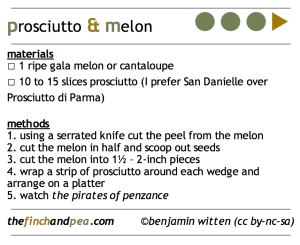
I think everyone has had the experience of taking a bite of food that has transported them. That bite of food that takes them mind and soul back to their childhood or to a special place or to a fond memory. Food has that power. All food. Its part of its magic. I can’t eat prosciutto and melon (Recipe Card: PDF – 88kb) without thinking about The Pirates of Penzance, because my first time trying the delectable salty-sweet duo was while watching a movie adaptation of the play. I haven’t seen the movie since (about 20 years now), but I will almost universally be caught humming “Modern Major General” after eating prosciutto and melon.

Click image for printable recipe card (PDF - 88kb)
Click image for printable recipe card (PDF – 88kb)

In the spirit of food’s nostalgic powers, I thought it would be fun to periodically share those recipes that are close to my heart. In some cases, I was able to lay my hands on the very recipe. In others, I have recreated recipes that never fail to invoke warm remembrances of bygone days.

These are my memories, but I’d love to hear from you. What are your favorite nostalgic dishes?

Linkonomicon: Science, Democracy, and Plato’s Revenge

Some decisions clearly require expert knowledge, but democracy is a commitment to letting consequential decisions be resolved by a group of people who are clearly not experts on every important issue, i.e. all of us. And so we have a problem.

My favorite philosopher of science, Philip Kitcher, says Plato would think we’re crazy:

If the public does not think a particular issue should be addressed, then it is entirely right that nothing should be done about it. Plato saw this as a fundamental commitment of democracy, and, because he understood that people may be massively deceived – or misled – about what is in their interests, he drew the conclusion that democracy is a political disaster.

But Kitcher doesn’t think Plato should have the last word. Go check out his ideas about the role of experts in democracy in “Plato’s Revenge: An Undemocratic Report from an Overheated Planet”, via the journal Logos

Send not to know for whom the patent trolls, It trolls for thee

According to the Electronic Frontier Foundation (EFF), Edith Ramirez, Commissioner of the Federal Trade Commission (FTC), announced that the FTC is committed to using its investigatory and antitrust powers to take on patent trolls:

First, she revealed that the FTC will conduct a wide-ranging investigation into the conduct of patent trolls. Second, she confirmed that, when appropriate, the FTC is committed to using its antitrust enforcement powers. – Daniel Nazer for EFF