Finding function in the genome with a null hypothesis

Last September, there was a wee bit of a media frenzy over the Phase 2 ENCODE publications. The big story was supposed to be that ‘junk DNA is debunked’ – ENCODE had allegedly shown that instead of being filled with genetic garbage, our genomes are stuffed to the rafters with functional DNA. In the backlash against this storyline, many of us pointed out that the problem with this claim is that it conflates biochemical and organismal definitions of function: ENCODE measured biochemical activities across the human genome, but those biochemical activities are not by themselves strong proof that any particular piece of DNA actually does something useful for us.

The claim that ENCODE results disprove junk DNA is wrong because, as I argued back in the fall, something crucial is missing: a null hypothesis. Without a null hypothesis, how do you know whether to be surprised that ENCODE found biochemical activities over most of the genome? What do you really expect non-functional DNA to look like?

In our paper in this week’s PNAS, we take a stab at answering this question with one of the largest sets of randomly generated DNA sequences ever included in an experimental test of function. Continue reading “Finding function in the genome with a null hypothesis”

You can take the yak out of Tibet…

Do yak die at low altitude? When I visited Tibet, I was told that they did, and that the yak you see in zoos are all cross-breeds. Yak genetics have adapted to the high altitude, they said. You can’t take them down, they said.

It sounded plausible, and I thought it was a neat fact to include in a post here. I just needed a reference.

But when I searched, I didn’t find any convincing evidence that yak can’t survive low altitudes. In fact, the more I searched, the less I knew what a yak even was. I found info about wild yaks and domesticated yaks, and some notes about cross-breeds. Among the muddled facts, I found two things that everyone seems to agree on: Bos grunniens is a domesticated yak, and it exists in low altitude zoos far away from Tibet.

Yak
Domestic yak walking out of a Tibetan zoo and nibbling on a plant.

Continue reading “You can take the yak out of Tibet…”

Science Caturday: Ceiling Cat is Just a Myth

This week, tech writer Virginia Heffernan caused a stir by publishing an essay entitled “Why I am a Creationist“. Here at the Finch & Pea, we believe that everyone is entitled to their opinion, but when it comes to explaining stuff, we put our trust in Science Cat (and his friend Chemistry Cat), and leave Ceiling Cat to looking pretty and keeping mice out of the attic.

scicatceiling

Photo via Cheezburger.com

The Art of Science: Collaborations with Bees

The Promise, 2008  Photo: Michael Gibson Gallery
The Promise, 2008
Photo: Michael Gibson Gallery

Aganetha Dyck gets a lot of help creating her artwork. But rather than employ studio assistants or take on interns, the artist collaborates with hundreds of bees. Dyck, who says her main focus is “how knowledge is transported and transcribed between humans and other species”, considers her work to be an equal collaboration with the insects. “My research has included the bee’s use of sound, sight, scent, vibration, and dance. I am studying the bee’s use of the earth’s magnetic fields as well as their use of the pheromones (chemicals) they produce to communicate with one another, with other species and possibly with the foliage they pollinate.” (source) Some of her most striking pieces are small figurines that she places inside hives, to allow the bees to adorn with honeycomb. She also sometimes places drawings or paintings inside hives and lets the bees add texture and color to them.

Dyck’s (and the bees’) small sculptures are particularly striking because of their uncanny effect of juxtaposing something highly refined but essentially useless (porcelain figurines of lords and ladies in fancy dress) with something raw, natural and made with a clear purpose (honeycomb). Both parts of the sculpture seem somehow alien, like something found in grandma’s attic on another planet. That quality may be especially appropriate for work made with bees, a crucially-important species whose numbers continue to drop dramatically. This unique artwork may one day be impossible to create if Dyck’s collaborators continue to die off.

Dyck’s work is featured in the exhibit “Nature’s Toolbox: Biodiversity, Art and Invention”, which opens at the Ulrich Museum of Art in Wichita, KS next month through December 2013.

You can see lots more art and information at Aganetha Dyck’s website

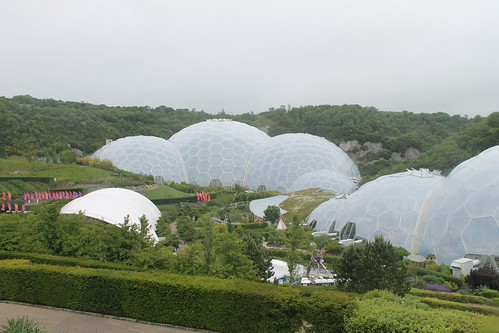
The Eden Project

The Finch and Pea at the Eden ProjectLast month I took a four-hour train journey from London to the closest rainforest: the Eden Project in Cornwall. Several people recommended it to me after I described the Biodome in Montreal, and I mentioned it in my blog post about that, as one of the other large biomes in the world.

the Eden Project

The Eden Project consists of three biomes – a 50m high (tropical) rainforest biome, a slightly smaller one with a Mediterranean and Californian climate, and an “outdoor biome”. The latter isn’t in a glass dome, it’s the gardens of the project, and these obviously have a Southern English climate.

I spent most of my visit in the rainforest biome. I was expecting to be hit by a wall of heat, which is what happens when you enter the rainforest area of the Montreal Biodome, but that didn’t happen. It was cool and breezy. I was a bit disappointed. Not because I was looking forward to heat – I don’t do well in anything above room temperature – but because I thought it wasn’t authentic.

I was wrong.

It did get hot in the rainforest biome, just not immediately. After walking further into the forest, the temperature rose to a sticky 32C (about 90F), and that wasn’t on a particularly hot day.

32 degrees C

The warmest spot was the rainforest lookout, a platform at the very top of the dome, from which you had a great view of the rainforest below.
Continue reading “The Eden Project”