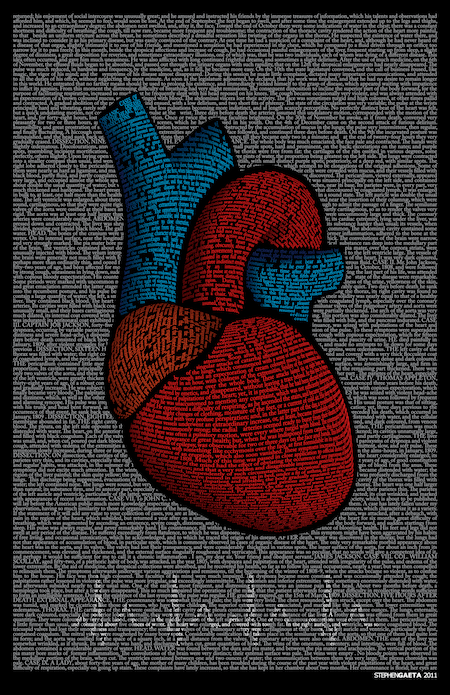
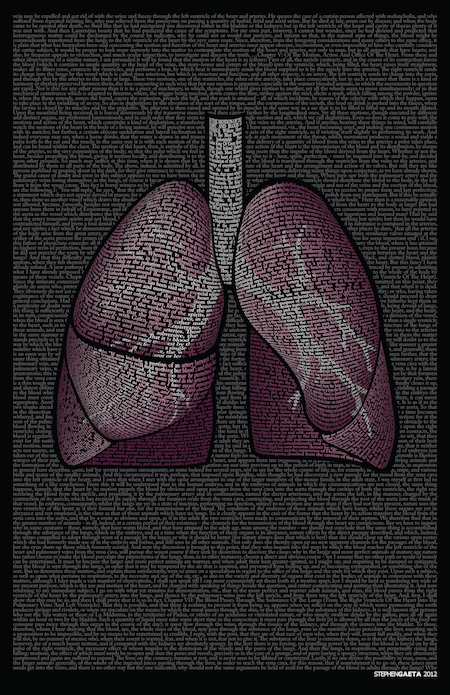
When cardiologist Stephen Gaeta was finishing his PhD on cardiac arrhythmias, he decided to do something more creative than just hang his diploma on the wall. He used the words of his dissertation as create an image of an anatomical heart, which he signed with a segment of his own ekg. He later redesigned the heart using an 1809 monograph on cardiology and renamed it Beat Poetry. Since then, he has continued to create images from classic scientific texts, including an eyeball, a transgenic mouse and a set of lungs (below). The lungs feature the text of the 1628 treatise Exercitatio Anatomica de Motu Cordis et Sanguinis in Animalibus (An Anatomical Exercise on the Motion of the Heart and Blood in Living Beings) by William Harvey. You can read more about his work and buy prints at Street Anatomy.
“Malheur National Wildlife Refuge is closed until further notice”, says the website for the Oregon bird sanctuary.
This is the refuge that is currently being held by an armed group. There is much circulating online about the fact that they have guns and want snacks, but very little is mentioned about the location.
Some unarmed occupants of the Malheur National Wildlife Refuge
The Malheur Refuge was originally founded in 1908, and has expanded since then by government purchase of surrounding lands. This is ultimately what the group holding fort in the wildlife center is acting against: they are acting on behalf of ranchers who want their land back – not just this land, but land in other locations as well.
So why has the wildlife refuge been buying these lands? Conservation.
In the late 19th century, many birds in the area fell prey to hunters who gathered their feathers to sell to the hat industry. The white heron population almost entirely disappeared during this time. Rather than sitting idly by as their local fauna was turned into hats and fascinators, locals took action. Wildlife photographers and the Oregon Audubon Society lobbied for the creation of a preservation area, and in 1908 President Roosevelt established what was then known as the Lake Malheur Reservation.
Researchers make use of the refuge for moth, bee and bat inventory studies. According to a recent study, Malheur is one of the few places in the Pacific North-West where the canyon bat is found.
If you want to see the bats or birds on the refuge, you’re going to have to wait for the occupation to end. Don’t send snacks.
Nature Microbiology: When did you first become exposed to scientific images?
Michele Banks: I started doing watercolours about 15 years ago. I was mainly working in pure abstraction, just playing with colour and with the properties of the paint. One of the things I love to do is wet-in-wet technique, which gives a ‘bleeding’ effect. I showed some of my wet-in-wet work at the Children’s National Medical Center here in Washington DC about 10 years ago, and they told me they liked my work because it looked like things under a microscope.
We hope the interest in the overlap of science and art will be a theme that continues throughout future Nature Microbiology issues – also open access, gender balance in publishing, shying away from bogus impact factors. etc. etc…


 This week, Science for the People is trying to better understand our human brain, it’s quirky ways and unexpected processes, so we can use it better in daily life. We’ll speak with Guy Harrison, author of Good Thinking: What You Need to Know to be Smarter, Safer, Wealthier, and Wiser, about how to cope with our brain’s built-in pitfalls. And we’ll speak to Ben Lillie about The Story Collider, a podcast that blends science and storytelling to show how science touches everyone, scientist and layperson alike.

 The Finch and Pea