Hello Dolly

Science + ScotlandLast week I went to Edinburgh for the first time. I gave a talk on Friday and another in Newcastle on Monday. So, I stayed in Edinburgh for the weekend.

On my weekend off I explored Edinburgh. I saw the castle, the National Museum of Scotland, and a bagpipe player. I even caught a movie that was set in Edinburgh. It was all very cultural. But Edinburgh is also a hotbed of science, and I inevitably came across some of it. Continue reading “Hello Dolly”

Migration & The Melting World – Science for The People

sftp-fullsize-redbg
Today, my usual, totally biased praise of the most recent episode of Science for The People will be extra-biased. This week, host Desiree Schell interviews Christopher White about the effects of climate change in Glacier National Park. The discussion focuses on the clearly visible changes in the park, how those changes are monitored, and the cascade of effects resulting from those changes on the park’s ecology. Christopher White and I were both at the Santa Fe Science Writers Workshop earlier this year. He is one heck of a nice guy.

He did, however, miss a good reason to keep calling Glacier National Park “Glacier National Park”, even after all the glaciers are gone. The name begs the question, “Why do you call it Glacier National Park if there are no glaciers?” That question has a sobering and educational answer.

The show’s second interview, with Stephen Castles about human migration patterns, is equally interesting. Castles debunks some of the more grandiose claims about the effect of climate change on migration and refocuses the discussion on the true complexity of the issues.

Finally, how many podcasts do you know that provide links to supporting materials? Well, you know at least one now.

Science Caturday: Or is it Punday?

A bad pun (and really, is there any other kind?) is built right into Science Caturday. You might say it’s in its DNA…..

badpun1

And since two bad puns are better than one….

badpun2

photos via Cheezburger.com

At-twitter-bution

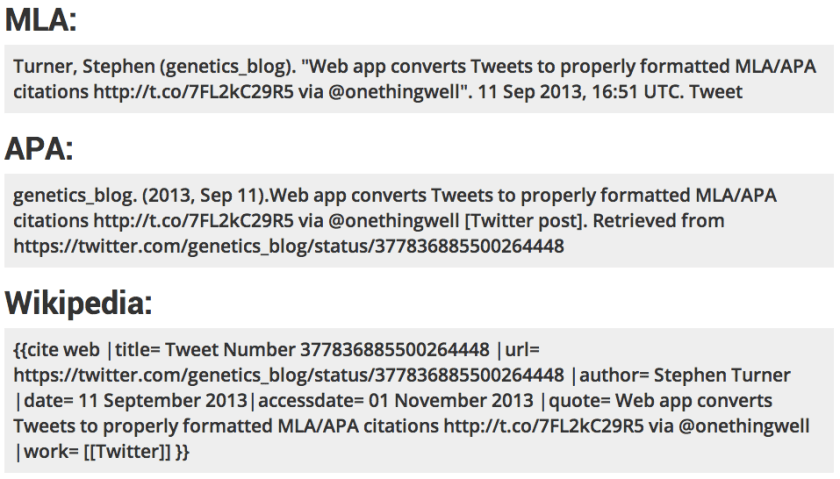
I’m not proud of that title; but I also lack shame. Ben Hedlund, however, should be very proud of his web app Tweet2Cite. Tweet2Cite takes the URL of a tweet and converts it into a properly formatted citation for MLA, APA, and Wikipedia styles. Here are the citations I generated using the tweet from Stephen Turner that brought Tweet2Cite to my attention*:

Screenshot of citations for Stephen Turner's tweet about Tweet2Cite generated using Tweet2Cite
Screenshot of citations for Stephen Turner’s tweet about Tweet2Cite generated using Tweet2Cite

And, for those of you wondering, yes, you do need to provide a citation or attribution for information/quotes/images/links extracted from other people’s tweets.

*I am ever so meta.

Trick or Treat: Meet the Aye-Aye

medusaface

The aye-aye (Daubentonia madagascariensis) is the very definition of narsty. A nocturnal solitary lemur so weird that it is not only the sole living species in its genus, but also the only member of its family. They lead a solitary existence and try to avoid mirrors, because when you’re this ugly you don’t need a reminder.

Beyond their homely looks, these guys have rodent teeth and the creepy-best middle fingers ever.

Watch this National Geographic video to see them in action:

If you want to learn more check out the Duke Lemur Center website, but do yourself a favor and plan to visit this place to see the aye-aye and other lemurs.

“Meet the…” is a collaboration between The Finch & Pea and Nature Afield to bring Nature’s amazing creatures into your home.