Science Caturday: Celestial Kittehs

uniberse

This week, astronomers made two exciting discoveries: the first is a ring system surrounding an asteroid named Chariklo, which orbits in a region between Saturn and Uranus.  This surprising finding makes Chariklo’s the fifth known ring system in our solar system , joining Jupiter, Uranus, Neptune and Saturn, and the first known to have formed around an asteroid.

happynao

The second major find is a distant, icy dwarf planet in the far reaches of the solar system, 7.5 billion miles from the sun. The object, officially known as 2012 VP113, measures about 280 miles across.  It’s extremely cold with a temperature of around minus 430 degrees Fahrenheit and is reported by astronomers to be faint and pink, making it hard to detect.

Our thanks to Kibbles kitteh and Mr. Boots for playing the roles of Chariklo and VP113 so graciously.

LOLemur, the Movie

Good friends of The Finch & PeaCristina Russo, John Romano, and Chris Smith – collaborated to turn their visit* to the Duke Lemur Center into this video.


“LOLemur” is my name for my occasional habit of attempting to caption lemur pictures as if they were LOLcats; but imagine if LOLcats were actually cute, intelligent, and charming.

I’d also ask you to keep an eye on the Twittersphere for our efforts to guilt Ocean Spray into donating a mere 260 pounds** of the lemurs favorite treat, Craisins, to the Duke Lemur Center each year.

*Chris Smith was not visiting. He works there; but he likes what he does.

**According to the head keeper at the Duke Lemur Center, 250 lemurs combine to eat 5 pounds of Craisins each week.

Emerging Infections

#258 - Emerging Infections
#258 – Emerging Infections
Image from National Institutes of Health

This week, my other other family at Science for The People is discussing invading organisms large and small. They talk to Dr. Michael Osterholm, director of the Center for Infectious Disease Research and Policy at the University of Minnesota, to learn why (and how) researchers are creating new strains of flu virus. They’re joined by marine invertebrate researcher Dr. Benjamin Miner, to talk about the wasting disease killing starfish on the west coast of North America. And they talk to physicist Ross Lockwood about the HI-SEAS project, exploring the psychological conditions facing a human crew on a mission to Mars.

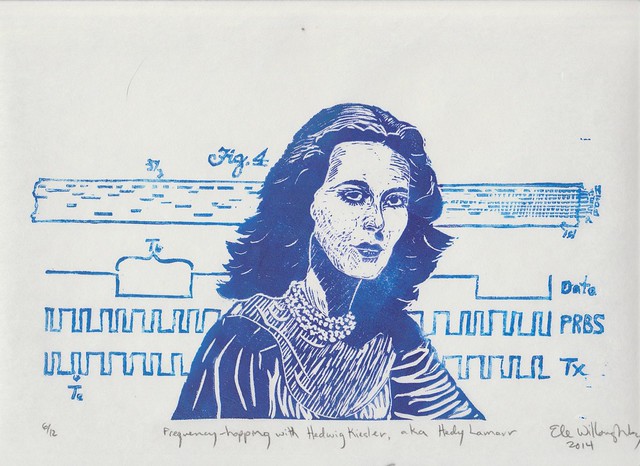
Hedy Freaking Lamarr

Hedy Lamarr may be the greatest movie bombshell of all time, because of what was above her shoulders. Her entry in Wikipedia begins, “Hedy Lamarr was an Austrian actress and inventor.”

Frequency Hopping with Hedwig Keisler, aka Hedy Lamarr by Ele Willoughby (All Rights Reserved; Used with Permission)

The post featuring the art above celebrates her most famous, life saving invention; and is headlined with “Hedy Lamarr, Inventor of Frequency Hopping”. As I said on Twitter, if that headline does not immediately compel you to drop what you are doing and read, we can no longer be friends.

The Art of Science: Tissues from Tissues

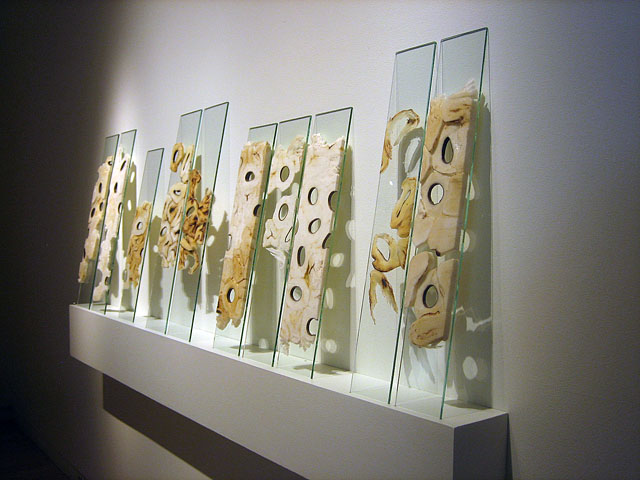
Jessica Drenk: Soft Cell Tissue toilet paper, wax, glass
Jessica Drenk: Soft Cell Tissue
toilet paper, wax, glass

I spotted a wall sculpture by Jessica Drenk recently at the Adah Rose Gallery in Maryland. The piece attracted me because it looked like osteocytes, a type of bone cell that I’ve featured before in my paintings. It took several more glances before I realized that these particular cells were, in fact, made of rolls of toilet paper.

As it turns out, this is exactly Drenk’s oeuvre – taking common, manufactured items and transforming them back into the building blocks of nature. In addition to toilet paper, she has used pencils, books, mop heads, Q-tips, coffee filters and PVC pipe to create familiar yet unfamiliar versions of natural forms, from rock formations to nerve cells.

As she describes her work:  “By transforming familiar objects into nature-inspired forms and patterns, I examine how we classify the world around us. Manufactured goods appear as natural objects, something functional becomes something decorative, a simple material is made complex, and the commonplace becomes unique. In changing books into fossilized remnants of our culture, or in arranging elegantly sliced PVC pipes to suggest ripple and wave patterns, I create a connection between the man-made and the natural.” (source)

Her work is currently on view in a group show at the Seager Gray Gallery in California and will be featured in a solo show at the Adah Rose Gallery in Kensington, MD next month. You can see lots more at her website.