Science Caturday: Kitteh Science Week in Review

scilolmap

Our hoomin scicomm friends killed it on the interwebs this week, so all we needed to do was line up a few science kittehs to illustrate their great stories. First up, Bethany Brookshire (@scicurious) in ScienceNews explains the science behind gluten sensitivity, including the meaning of FODMAPS, which are, alas, some kind of carbohydrate and not maps to the fud.

quantumkitteh

Next, Matthew Francis (@DrMRFrancis) explains in Slate why quantum mechanics does NOT explain human consciousness. He can also explain why different kittehs spin in different directions, which may be more useful.

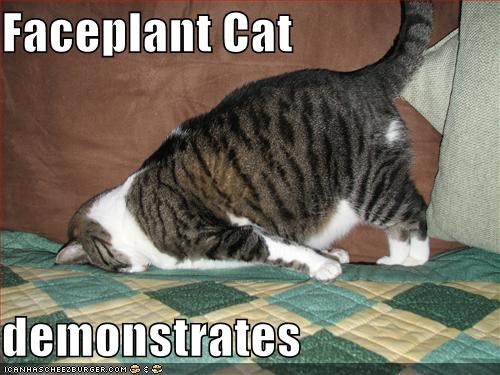
faceplantcat

Finally, over at BoingBoing, Maggie Koerth-Baker (@maggiekb1) delivers a masterful explainer (with gifs!) on the science of faceplanting. If I have a tiny quibble with this piece, it’s that kittehs generally look upon faceplanting as more of an art.

All lolcats via Cheezburger.com


Science for The People: Ephemeral Particles

#267 - Ephemeral Particles
#267 – Ephemeral Particles

This week Science for The People learns about some of the many invisible particles that surround us. They speak to astrophysicist Ray Jayawardhana about his book “Neutrino Hunters: The Thrilling Chase for a Ghostly Particle to Unlock the Secrets of the Universe.” And they talk to ecology professor Donald Canfield about his book “Oxygen: A Four Billion Year History.”

Haldane, Huxley, dystopia, biopunk, biotech, and Windup Girl

All that in six minutes and 40 seconds. Last week I gave my first Pecha Kucha talk at Openly Disruptive’s Disruptive Diner series. The topic was science foreshadowed by science fiction. Have a look. The script of my talk is below the fold. If you want the post-talk Q&A session you can find it on Openly Disruptive’s YouTube channel, where you’ll also find science fiction author Mark Tiedemann’s talk on robots in our society and imaginations.


Continue reading “Haldane, Huxley, dystopia, biopunk, biotech, and Windup Girl”

Space Updatity

We have a hopeful sounding update on the takedown of astronaut Chris Hadfield’s video cover of David Bowie’s “Space Oddity” from the International Space Station. According to Ars Technica, it was Hadfield himself who took down the video in order to comply with his original agreement with David Bowie. For those paying close attention (eg, not me), Hadfield gave us a little advanced warning that this was going to happen:

Screenshot 2014-05-28 11.23.48

Hadfield and Bowie’s camps are reported to be working on a new licensing deal that should see “Space Oddity” from orbit return to the Web at some unspecified future date. Don’t hold your breath, though. Getting the details of the first, one-year license hammered out apparently took several months – probably due to the variety of individuals and government organizations involved.

If I were David Bowie*, I would be grumpy with my representatives for not getting a new deal done before the old one expired. In the one line of an otherwise very wise discussion of the copyright issues surrounding Hadfield’s “Space Oddity” cover (endorsed by Hadfield) that misses the point, Meera Nair says:

Yet the fact that something that people liked to watch was disappearing from YouTube prompted a bewildering public outcry.

The outcry might have been unreasonable, but there was nothing bewildering about it to regular viewers of the Internet.

The original one-year license made sense at the time. In retrospect, the video seems like the most likely candidate to go viral ever. At the time, who knew it would matter so much when the license expired?

Hadfield’s cover of “Space Oddity” was tremendously good press for Bowie and introduced the song to generations that were not necessarily familiar with his oeuvre. While not necessarily fair, it was obvious that the removal of Hadfield’s cover from the public spaces on YouTube would make Bowie look like a monster. In many ways, this is less a copyright FAIL than a public relations FAIL.

*I suspect that, were I David Bowie, that this issue has not been at the top of my priority list.


The Art of Science: Warhol’s A Whizz

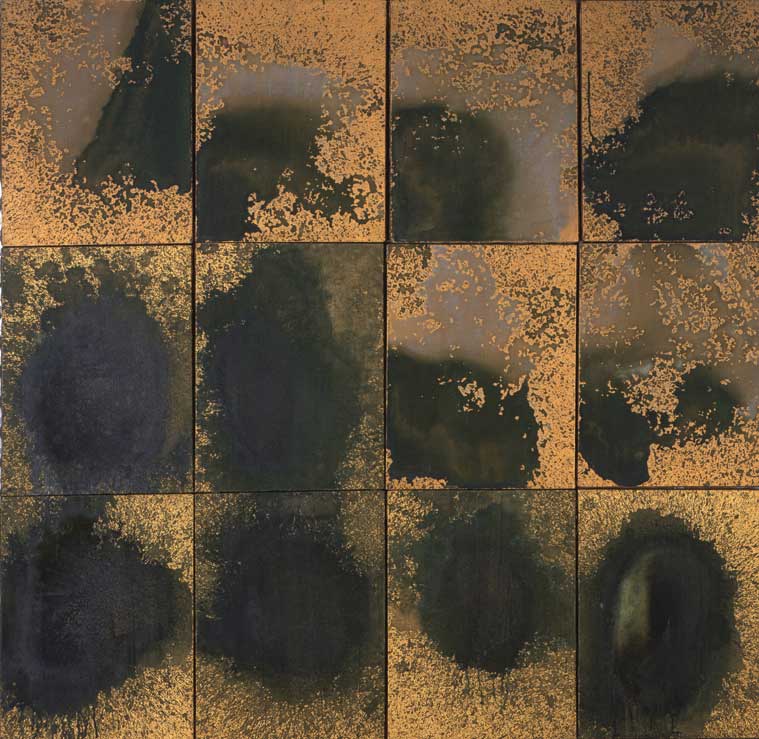
Andy Warhol. Oxidation Painting (in 12 parts), 1978.

In the late 1970s, more than 10 years after he “retired” from painting, Andy Warhol got a yen to put paint on canvas again. This time, he didn’t use a brush.

To create what were originally called the “Piss Paintings” and now are more formally entitled the Oxidation Paintings, Warhol and his studio assistant Ronnie Cutrone coated canvases with copper-infused paint and then urinated on them.

The catalytic reaction of urine and metallic paints created a range of brilliant golds and acidic greens that glow against the textured surfaces. The paintings are generally considered to be a kind of parody of Jackson Pollock’s drip paintings, which took the art world by storm in the 1950s, when Warhol was beginning his career.

Most of the Oxidation Paintings don’t actually bear the “hand” of the master – Warhol invited employees, friends and hangers-on to pee on canvas, and studio legend has it that Cutrone’s urine was especially prized because he was taking large quantities of B vitamins, which produced especially vivid colors.

Examples of the Oxidation Paintings can be seen at the Brooklyn Museum of Art and Pittsurgh’s Warhol Museum.