Introducing Banks’ Second Theorem

A neighbor recently opened an etsy shop to sell her paintings. She asked me a bunch of questions about the process, which I was happy to answer. Then she asked me the essential question: “How do you get people to find you on the internet?”

Getting people to find me on the internet (ohai!) is the central struggle of my career. It’s a constant battle that I’ve been fighting every single day, with some success, for the past five years. But of course I didn’t tell my neighbor this, because I didn’t want to scare her off. So I suggested she start by posting her new shop on her Facebook page. “Well, that’s the thing, I don’t do Facebook.” Twitter? Nope. Instagram? What? We didn’t even get to the idea of submitting work to blogs.

I had a sudden flashback to a conversation with another artist a few years earlier, who complained that twitter wasn’t working well for promoting her work. “I tweet a lot,” she explained, “But I don’t actually READ tweets.” Dear fellow artist,

cheese-wrong

This is not to say that twitter is the only way to go, or that artists have to spend as many hours a day on the internet as I do. They probably shouldn’t!

procrastinate

But really, selling online has a lot in common with selling offline. You need to put in some time. You have to get out there and forge relationships. You need to know who the players are. I’m going to call this Banks’ second theorem:*

If you want to sell on the internet, you have to be on the internet.

If you had a brick-and-mortar shop, you would know the other shopkeepers in your neighborhood, wouldn’t you? Well, if you have an online shop, the internet is your neighborhood. Get out there, take a walk every day, and say hello. Read some blogs. Read some tweets. Make some intelligent comments. Show other people the cool things you find on your walks. Then say, “here, have a look at what I’m working on.” Repeat.

*I’ll get to the first theorem later. My blog, my rules.

(originally posted on Artoblogica)

The Art of Science: Comet-Chasing Shoes

Meterorite Shoes by Studio SWINE, 2014 Photo: Petr Krejci

New York based design team Studio SWINE (led by architect Azusa Murakami and artist Alexander Groves) were so inspired by the landing of the Philae probe on Comet 67P/Churyumov-Gerasimenko that they wanted to celebrate it by making shoes. Shoes that look like meteorites fallen from space, of course.

They decided to use aluminum foam, which they note is generally “hidden inside high-end cars and buildings as sound insulation,” not made into footwear. Aluminum foam is just what it sounds like – aluminum that’s been melted down and then injected with a gas to produce a matrix of bubbles or cells.

Murakami and Groves visited the American Museum of Natural History to study the meteorite collection and gather images to make 3D scans of space rocks. They adapted the scans to make a shape that would fit on a foot and then used more traditional milling and shoemaking techniques to create a pair of strong, lightweight high-heeled pumps.

The finished Meteorite Shoes might not be quite the thing for everyday wear, but they are undoubtedly out of this world.

The Art of Science: Please Eat the Art

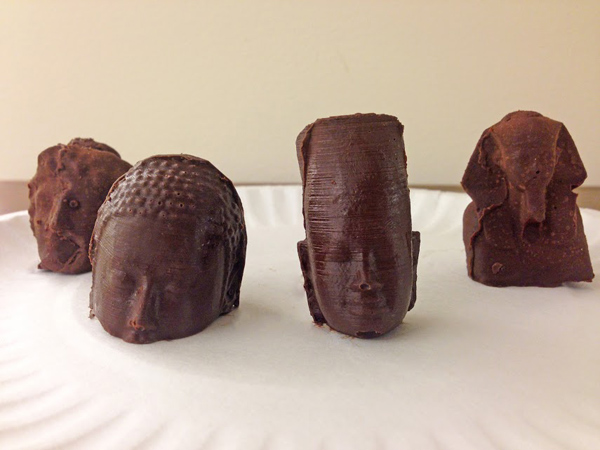
Molded chocolate castings by Jimmy Tang and Yuanjin Zhao

Here at the Finch & Pea, we are big fans of food, art and the scientific method. So when I saw this story about a couple of Media Lab interns at the Metropolitan Museum in New York and their quest to produce edible replicas of museum treasures, I knew I had to share it here. It’s worth reading the whole thing, so please click on over to the Met’s Digital Underground blog for more.

Tip of the hat to Hilary-Morgan Watt


The Art of Science: A Handful of Dust

Lucie Libotte, Dust Matters, Ceramic, 2014

Science is increasingly focusing on whole environments – ranging from our guts to the ocean – exploring how all the parts of a system work together to function in a healthy way. Lucie Libotte’s 2014 work, Dust Matters, now on exhibit at the Science Gallery in Dublin, creates art from one of the inescapable elements of our domestic environment – dust.

In a kind of “citizen sciart” project, Libotte had a group of friends in various areas of the UK collect dust from their homes. She then fired the dust as a coating on ceramic vessels, which look strikingly varied. Says the artist, “Dust Matters’ aim is to re-evaluate this ‘dirt’, and convey the value of dust as an indicator of our environment, showing how it reflects our daily life and traces our journey through the world.”

Libotte’s work is part of an exhibition at the Science Gallery called HOME\SICK: POST-DOMESTIC BLISS, which “looks at the meanings of home, from rubbish to robots and microbes to micro-dwellings, asking whether the changing nature of home is for better or worse.”

HOME\SICK, which runs through July 17, features the work of many other artists, scientists and designers, including the microbial bellybutton stylings of Finch & Pea friends Rob Dunn and Holly Menninger of North Carolina State University.

You can get lots more information about the show at the Science Gallery website.

Art of Science: Klaus Enrique’s Dmanisi Skull

Klaus Enrique, Dmanisi Skull, 2014

Artist Klaus Enrique uses a wild array of materials to create his sculptures, many of which are inspired by the work of 16th century painter Giuseppe Arcimboldo. He’s made a Mona Lisa out of fruit, a Princess Diana out of flower petals, and even a super-creepy Darth Vader out of dead insects. But for you, my geeky friends, I’ve chosen this very special piece – The Dmanisi Skull, a recreation of one of the most significant archaeological finds of the 21st century – made from small, hairless rodent corpses.

The real Dmanisi skull is a 1.8-million-year-old intact skull excavated from the town of Dmanisi in the Republic of Georgia in 2005.  Scientists studied the skull and several others found nearby for several years before publishing a paper in Science in 2013 that posited that several early hominid species were, in fact, all one species – Homo erectus.

It’s no surprise that a huge discovery that rewrote a chapter of human evolution would inspire a work of art. But why the hairless mice? Could they be a nod to our even older ancestors, the shrewlike insectivores from which all mammals evolved? Or was Enrique playing on the tradition of the Memento Mori by making old, dry bones out of flesh?

Because of the highly perishable nature of his materials, Enrique doesn’t display his sculptures, but rather photographs them and exhibits the photos. You can see many more of his works on his website. For some fascinating insights into the Dmanisi discoveries, I recommend this post by anthropologist John Hawks, who once held the real skull in his hands.