
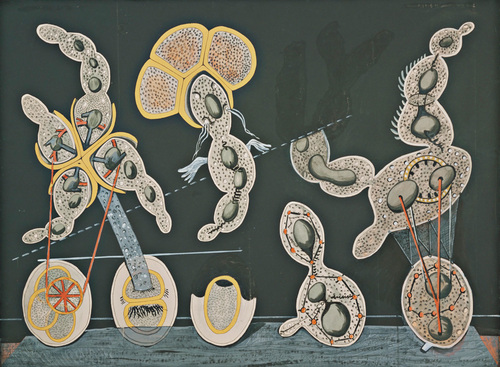
The Dada movement of the early 20th century was a reaction against the conventions of artistic beauty and meaning. Dada’s practitioners worked with images and materials which were not considered traditionally “appropriate” for art. This painting, The Gramineous Bicycle (c. 1921) by Max Ernst is a perfect example. Continue reading “The Art of Science: The Gramineous Bicycle”
Category: The Art of Science
Celebrate with hand-picked, handmade science gifts
There’s a lot of great science-based art and craft out there, and many purveyors of geeky goodness have really outdone themselves creating special gifts and decorations for the holiday season. So show your sci pride while supporting hardworking makers. Here are a few favorites – but be sure to dig deeper into these shops for many more unique items. Continue reading “Celebrate with hand-picked, handmade science gifts”
The Art of Science: Manufactured Nature
Tara Donovan is a New York-based artist who turns huge quantities of everyday manufactured materials, such as plastic cups, paper plates, pencils and straws— into sculptural installations that evoke clouds, landscapes and gigantically magnified microscopic organisms. Curator Nicholas Baume notes that, although her work contains elements of classical minimalism, it also suggests ”digital, cellular, emergent networks. It seems to speak to the systems that are shaping our lives.” (source) Continue reading “The Art of Science: Manufactured Nature”
The Art of Science: Chemical Balance
Jean Shin’s Chemical Balance (2005-2009) is a sculptural installation made of used prescription bottles collected from nursing homes, hospitals and individuals. Says Shin, “Chemical Balance speaks to our culture’s over-consumption of prescription drugs and our bodies’ dependency on these medications. The piece acts like a group portrait, mapping our society’s chemical intake.” Continue reading “The Art of Science: Chemical Balance”
The Art of Science: Altered States
One of the most fun and rewarding ways that artists can play with science is by exploring transitions between states of matter in their materials. Solid rocks can be turned into liquid paints, spread on paper or canvas and dried to a solid again. That paint can be formed into droplets and sprayed at walls. Wax is melted down for encaustic and formed again stronger than before. And humble silica pellets can be liquified and then poured into molds or blown through tubes to make marvelous, airy forms in glass. Continue reading “The Art of Science: Altered States”


